Ancient Monument · Roman · Spain
Aqueduct of Segovia
The Aqueduct of Segovia is a Roman water bridge of 167 arches that strides across the lower town of Segovia, about 28 metres high at Plaza del Azoguejo. Built around the turn of the 2nd century AD from granite blocks laid without mortar, it carried water to the city until 1973 and can be seen free at any hour.
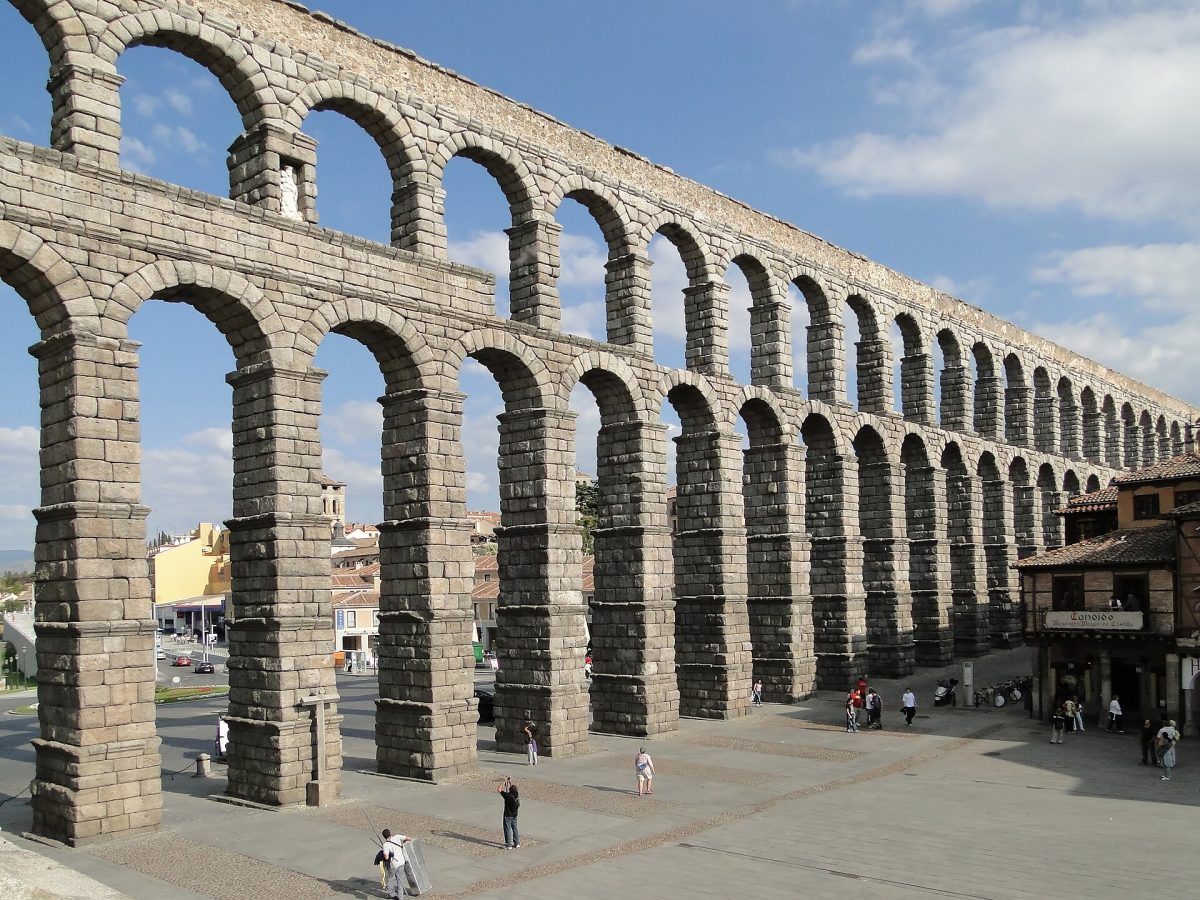
Photo: Bernard Gagnon, CC BY-SA 3.0
Aqueduct of Segovia tickets: which one for you
Our pick for each kind of visit, with live dates and prices from GetYourGuide. Free cancellation on most.
Best for: A first day trip from Madrid
Return transport from Madrid and a guide from the aqueduct up through the old town to the Alcazar; the simplest way to cover the three main sights in one day.
- Private, at your own pace: Madrid to segovia roman aqueduct private tour A private guide and driver from Madrid, so you decide how long to stay at the arches, when to eat and whether to add La Granja; good for families and small groups.
Tickets and tours: all the options
There is nothing to buy for the aqueduct itself: it is a public monument standing over a city square, free to see from every side by day or night. Tickets only come into play for the sights around it, chiefly the Alcazar, the cathedral and the stretch of city wall that can be walked, each sold separately at its own door.
What GetYourGuide sells is the trip from Madrid. The common format is a guided day out by coach or minibus that starts at the aqueduct, walks up through the old town past the cathedral and ends inside the Alcazar; entry to the castle is often included, lunch is extra. Some versions add Avila or Toledo, which makes for a long day with little time in each city. The other option is a private tour with a driver and guide, which costs more but lets you set the pace and stop for roast suckling pig, the local speciality, when it suits you.
If you are comfortable on trains, going independently is easy and cheaper: the fast train takes half an hour and the old town is compact. A guide adds most inside the Alcazar and the cathedral rather than at the aqueduct, where the tourist office on the square has maps and background. For a first trip the group day tour is the sensible choice; travellers with more time can do it alone.
What to see at Aqueduct of Segovia
Plaza del Azoguejo
Start in Plaza del Azoguejo, where the arcade reaches its full height of about 28 metres, nearly six of them in foundations. Stand right under the two tiers of arches to see that the granite blocks hold together by their own weight, with no mortar at all. High on the upper tier a niche on each face once held a figure; one now contains an image of the Virgin.
Steps to the Postigo viewpoint
On the old-town side of the square, a flight of stone steps climbs beside the arches to the city wall at the Postigo del Consuelo. From the top you are close to the level of the channel that ran along the summit of the bridge, a groove only about half a metre wide, and you look down the full line of arches over the roofs of the lower town.
2 tickets and tours for Aqueduct of Segovia
Live dates and prices from GetYourGuide. Free cancellation on most tickets.
Arches towards Plaza Diaz Sanz
Walk back down and follow the arcade south-east, away from the old town, towards Plaza de Diaz Sanz, where the structure makes a sharp turn. As the ground rises the pillars shorten and the two tiers give way to one. This first stretch includes the 36 arches destroyed in 1072 and rebuilt in the 15th century under the Catholic Monarchs, so look closely at the stonework.
The water route in the old town
Return to the Azoguejo and climb Calle Real towards the Plaza Mayor. Inside the walls the water left the bridge and ran underground to a distribution tank, and the line of the main channel is marked in the paving, so you can trace it uphill. Come back after dark, when the arches are floodlit and the square below is at its liveliest.
A short history
Rome built the aqueduct to bring water from the Rio Frio in the Sierra de Guadarrama, about 17 km away, to the town on its rocky ridge. A lost bronze inscription, reconstructed by Geza Alfoldy from the holes that fixed its letters, pointed to Emperor Domitian and a date near AD 98, but evidence published in 2016 suggests completion after AD 112, under Trajan or early in Hadrian's reign. In 1072 Moorish forces destroyed part of the arcade, and 36 arches were rebuilt under the Catholic Monarchs in the 15th century. The aqueduct supplied Segovia until 1973. Together with the old town it became a UNESCO World Heritage Site in 1985.
Getting there
From Madrid the fastest route is the high-speed train from Chamartin to Segovia-Guiomar, which takes about half an hour. Guiomar station lies some 5 km outside the city; urban bus 11 meets the trains and drops you by the aqueduct in about 15 minutes, and taxis wait outside. Frequent buses from the Moncloa interchange in Madrid take around an hour and a quarter to Segovia bus station, a ten-minute walk from Plaza del Azoguejo. From Madrid-Barajas airport, allow roughly two hours by public transport. Drivers take the AP-6 and AP-61 toll motorways; use the public car parks on the edge of the centre, as traffic is restricted in the old town.
Rules and what to bring
The arches are a protected monument: do not climb the pillars, sit on the lower stones or scratch them, and keep out of any fenced areas at the base. Flying drones over the city centre is not allowed without a permit. Segovia stands at about 1,000 metres, so summer evenings turn cool and the wind across the square is bitter in winter; bring a warm layer. Cafes, restaurants and toilets are easy to find around the Azoguejo and the streets above it.
When to go
Because the aqueduct is outdoors and free, timing is about light and crowds. Coach tours from Madrid arrive from about 10 am and gather in Plaza del Azoguejo, which stays busiest until early afternoon, especially at weekends and on Spanish public holidays. Come before 9.30 am for an empty square and soft light on the granite, or stay into the evening, when the floodlit arches look their best and the day-trippers have gone.
Spring and autumn are the most comfortable months. Summer days are hot but dry, and the city is noticeably cooler than Madrid. Winter brings frost and occasional snow, which makes for striking photographs but icy steps up to the Postigo. Allow half an hour to an hour for the aqueduct itself, or a full day if you add the old town, the cathedral and the Alcazar. Staying the night lets you see the arches both at dawn and lit after dark.
Combine it with
From the aqueduct, walk up Calle Real to the Plaza Mayor and the late Gothic cathedral in about 15 minutes, then on to the Alcazar at the western tip of the old town, another ten minutes. The royal palace and gardens of La Granja de San Ildefonso are about 20 minutes away by bus or car, and the walled old town of Avila is roughly an hour by road.
At a glance
| Hours | Outdoor monument visible at all hours; floodlit after dark |
|---|---|
| Closed | Open daily |
| Entry fee | Free |
| Time needed | 30 minutes to an hour |
| Best time | Before 9.30 am or after dark; spring and autumn |
| Booking | No ticket needed; book only a guided trip from Madrid |
| Access | Flat paved squares at the base; steep stone steps lead up beside the arches to the old walls |
| Getting there | High-speed train from Madrid Chamartin to Segovia-Guiomar, about 30 minutes, then bus 11 |
| Founded | AD 98 (c. AD 98 (Alfoldy); possibly after 112) |
| Civilisation | Roman |
| Height | 29 m (Tallest arches incl. foundation) |
| UNESCO | Old Town of Segovia and its Aqueduct |
| Checked | October 2026 |
Frequently asked questions
When is Aqueduct of Segovia open?
Outdoor monument visible at all hours; floodlit after dark. Open daily.
How much is the entry fee for Aqueduct of Segovia?
Entry fee: Free.
How long do you need at Aqueduct of Segovia?
Allow 30 minutes to an hour for Aqueduct of Segovia.
Do I need to book Aqueduct of Segovia in advance?
No ticket needed; book only a guided trip from Madrid.
Can I book a ticket or tour for Aqueduct of Segovia online?
Yes. GetYourGuide lists 2 tickets and tours for Aqueduct of Segovia, with live dates and prices and free cancellation on most of them.
When is the best time to visit Aqueduct of Segovia?
Before 9.30 am or after dark; spring and autumn.
How do I get to Aqueduct of Segovia?
High-speed train from Madrid Chamartin to Segovia-Guiomar, about 30 minutes, then bus 11.
Is Aqueduct of Segovia accessible, and what is the terrain like?
Flat paved squares at the base; steep stone steps lead up beside the arches to the old walls.
Is Aqueduct of Segovia worth visiting?
Worth it for one of the best-preserved Roman aqueduct bridges anywhere, free to see at any hour. Shorten it to half an hour if you came only for the aqueduct, and spend the rest of the day on the Alcazar, the cathedral and the old town.
How old is Aqueduct of Segovia?
Aqueduct of Segovia dates from AD 98 (c. AD 98 (Alfoldy); possibly after 112).
Is Aqueduct of Segovia a UNESCO World Heritage Site?
Yes. Aqueduct of Segovia is part of the UNESCO World Heritage Site Old Town of Segovia and its Aqueduct.