Ancient City · Near Eastern · Tunisia
Carthage
Carthage is the Phoenician and later Roman city on the Gulf of Tunis whose ruins now lie scattered among the villas of a modern suburb. Founded in the 9th century BC, it ruled much of the western Mediterranean until Rome destroyed it in 146 BC. The sea-front Antonine Baths were the largest Roman baths in Africa.
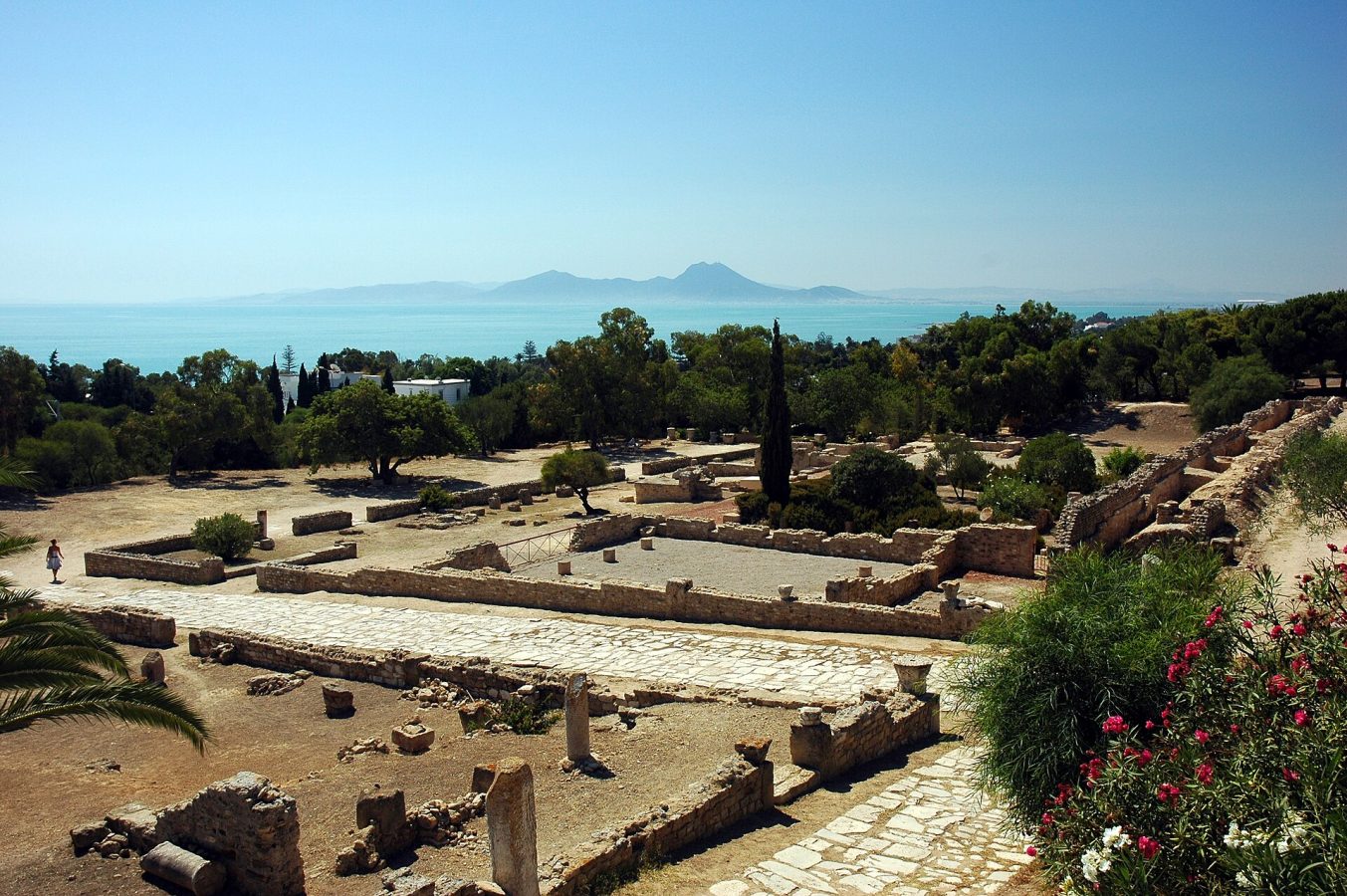
Photo: Calips, CC BY 2.5
Carthage tickets: which one for you
Our pick for each kind of visit, with live dates and prices from GetYourGuide. Free cancellation on most.
Best for: First visit, with a guide and car
A guide and transport between the scattered sites, which spares you working out the stations and walks between Byrsa, the baths and the ports.
- Active travellers: Carthage guided bike tour of the archaeological site Cycling links the scattered sites far better than walking, and a guide fills in the Punic and Roman story along the way.
- Cruise passengers at La Goulette: The best of tunis carthage for cruise ship Built around a ship's timetable, with transfers from the port and the medina of Tunis added on the same short visit.
Tickets and tours: all the options
Carthage is not one fenced site but a group of separate monuments in the residential suburb north of the Lake of Tunis. A single pass, bought at whichever gate you reach first, covers the main ones: Byrsa Hill with the Carthage Museum, the Antonine Baths, the Roman villas, the theatre, the Magon quarter, the Tophet and the Punic ports area. Keep the ticket, as each gate checks it. The Bardo Museum in Tunis, which holds the best mosaics from Carthage, has its own ticket, or a combined one with Carthage.
Most tours on GetYourGuide treat Carthage as one stop in a half or full day that also covers Sidi Bou Said, the medina of Tunis and often the Bardo. They include a driver or minibus, a guide and sometimes lunch; the entry fees are usually extra, so check. Some start from Hammamet, Sousse or Mahdia, which means two to three hours on the road each way. There are also shore excursions for cruise ships at La Goulette, private guided tours of the ancient sites alone, a guided bike tour and an app-based self-guided option.
Independent travellers can do it well by light rail and on foot. For a first visit, a private guide with a car for half a day is the most efficient choice, followed by lunch in Sidi Bou Said.
What to see at Carthage
Byrsa Hill and Carthage Museum
Start at the top of Byrsa Hill, the citadel of Punic Carthage, a steep walk from Carthage Hannibal station. Excavated houses of the Punic quarter from the 2nd century BC lie beside the museum, whose collection runs from Punic masks and stelae to Roman mosaics. The terrace looks over the ports and the gulf, and the 19th-century Saint Louis cathedral stands next door.
Antonine Baths
Walk or take the train down to the shore. The Antonine Baths, built in the AD 140s and 150s under Antoninus Pius, were the largest baths in Roman Africa. Only the basement service level survives, but one re-erected column suggests the height of the vaults. The seaside park also holds Punic tombs and a small Christian chapel.
83 tickets and tours for Carthage
Live dates and prices from GetYourGuide. Free cancellation on most tickets.
Roman villas and theatre
Uphill across the road from the baths, the park of the Roman villas preserves houses with mosaic floors, the best known being the restored Villa of the Aviary with its garden. A short walk away the Roman theatre has been heavily rebuilt and is used for the summer festival of Carthage. The Odeon hill nearby is usually less visited.
Punic ports
South along the coast, near Carthage Salammbo station, two lagoons are what remains of the famous harbours. The round military port had a central island with the admiral's headquarters and covered sheds for well over a hundred warships. A small museum on the island has models of the ports, and the rectangular merchant harbour lies just south.
Tophet of Salammbo
A few streets inland from the ports lies the Tophet, the sacred precinct of the gods Baal Hammon and Tanit. Rows of carved stone stelae stand among trees above vaulted chambers where urns with the cremated remains of infants and animals were buried for centuries. Whether these were sacrifices is still argued over, and the guides tell both sides.
A short history
According to tradition, Phoenician settlers from Tyre led by Queen Elissa, or Dido, founded Carthage in 814 BC. It grew into a trading empire with colonies across North Africa, Sicily, Sardinia and Spain, and fought three wars with Rome, the second led by Hannibal. At the end of the Third Punic War in 146 BC, the Romans took the city after a long siege and razed it. A century later Rome refounded it as the capital of the province of Africa, and it became one of the largest cities of the empire, later ruled by Vandals and Byzantines. Arab forces destroyed it in 698. Excavations began in the 19th century, and UNESCO listed the site in 1979.
Getting there
Carthage lies about 15 km north-east of central Tunis and only a few kilometres from Tunis-Carthage airport, about 20 minutes by taxi. The TGM light railway runs from Tunis Marine station at the end of Avenue Habib Bourguiba along the causeway to La Marsa, with trains every 15 to 20 minutes. Get off at Carthage Salammbo for the Tophet and ports, Carthage Hannibal for Byrsa Hill and the Antonine Baths, which are about 25 minutes from Tunis. Walks between the sites take 10 to 20 minutes. Taxis are cheap and plentiful; agree the fare or insist on the meter. Cruise ships dock at La Goulette, about 15 minutes away by car.
Rules and what to bring
The presidential palace stands beside the Antonine Baths: never photograph or film towards it, and do not fly drones anywhere in the area. Do not climb on walls or stelae. Bring a hat, water and comfortable shoes, as there is little shade and the ground is uneven. Cafés and toilets are limited at the sites themselves but easy to find in the suburb and in Sidi Bou Said. Dress modestly when continuing to the medina and the mosques.
When to go
The sites are rarely crowded, but cruise and coach groups from the Hammamet and Sousse resorts arrive between about 10 am and 1 pm and fill Byrsa Hill and the baths for a while. Start at opening with Byrsa, then work downhill to the coast, and keep the ports and the Tophet for the afternoon. Late afternoon light is lovely at the Antonine Baths.
Spring, from March to May, and October and early November are the best months, warm and usually dry. July and August are hot and humid, though the sea breeze helps at the coastal sites. Winter brings rain but is mild and very quiet. During Ramadan opening hours may be shortened. The international festival held in the Roman theatre in July and August brings evening concerts. Allow three to four hours for the main sites, or a full day with Sidi Bou Said and the Bardo.
Combine it with
Sidi Bou Said, the blue and white village on the cliff, is one stop further on the light railway and ideal for lunch. The Bardo Museum in Tunis, about 30 minutes away, holds one of the world's greatest collections of Roman mosaics, many from Carthage. The medina of Tunis is reached directly from the terminus of the light railway.
At a glance
| Hours | About 8 am to 7 pm in summer, to 5 pm in winter; check locally during Ramadan |
|---|---|
| Closed | Open daily; some sites close on public holidays |
| Entry fee | from TND 20 for the main-sites pass; TND 30 from January 2027 |
| Time needed | Half a day |
| Best time | Early morning or late afternoon; March to May and October |
| Booking | Pay at the gate; no need to book |
| Access | Sites spread over about 4 km; uneven ground, steps at Byrsa, little shade |
| Getting there | TGM light rail from Tunis Marine to the Carthage stations, about 25 minutes |
| Founded | 814 BC (traditional date 814 BC; Roman city refounded 1st century BC) |
| Abandoned | AD 698 |
| Civilisation | Near Eastern |
| Area | 5.0 km² |
| UNESCO | Archaeological Site of Carthage |
| Checked | October 2026 |
Frequently asked questions
When is Carthage open?
About 8 am to 7 pm in summer, to 5 pm in winter; check locally during Ramadan. Open daily; some sites close on public holidays.
How much is the entry fee for Carthage?
Entry fee: from TND 20 for the main-sites pass; TND 30 from January 2027.
How long do you need at Carthage?
Allow Half a day for Carthage.
Do I need to book Carthage in advance?
Pay at the gate; no need to book.
Can I book a ticket or tour for Carthage online?
Yes. GetYourGuide lists 83 tickets and tours for Carthage, with live dates and prices and free cancellation on most of them.
When is the best time to visit Carthage?
Early morning or late afternoon; March to May and October.
How do I get to Carthage?
TGM light rail from Tunis Marine to the Carthage stations, about 25 minutes.
Is Carthage accessible, and what is the terrain like?
Sites spread over about 4 km; uneven ground, steps at Byrsa, little shade.
Is Carthage worth visiting?
Worth it for the Antonine Baths, the Punic ports and the story of Hannibal's city, combined with Sidi Bou Said. Skip or shorten it if you expect a walled ancient city: the remains are fragmentary and spread over several kilometres.
How old is Carthage?
Carthage dates from 814 BC (traditional date 814 BC; Roman city refounded 1st century BC). It was abandoned in AD 698.
Is Carthage a UNESCO World Heritage Site?
Yes. Carthage is part of the UNESCO World Heritage Site Archaeological Site of Carthage.