Necropolis of Anghelu Ruju
41 km away
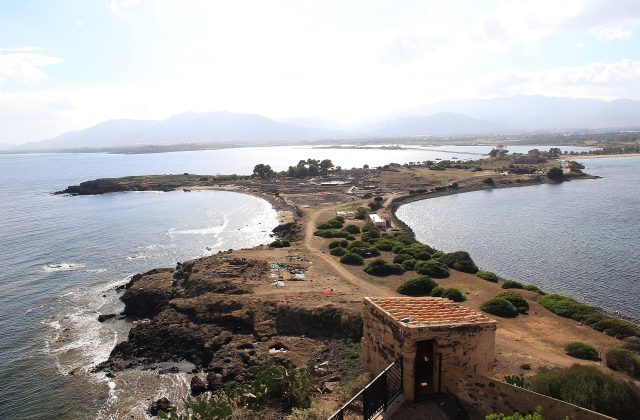
Anghelu Ruju, north of Alghero in Sardinia, is the largest prehistoric cemetery on the island: 38 rock-cut tombs dug…
1 ticket or tour
Megalithic Site · Prehistoric · Italy
Nuraghe Santu Antine is one of the largest Bronze Age towers in Sardinia, built of basalt blocks on the Cabu Abbas plain near Torralba. Its central tower still stands 17 metres high, with corbelled corridors 27 metres long inside a triangular bastion. You can walk through the passages and climb stairs within the walls.

Photo: This illustration was made by (User:Royonx) and released und, CC BY-SA 3.0
Nothing for Santu Antine alone is sold online through the big tour platforms. Entry works the simple way: you pay a modest fee at the ticket office beside the car park, and the site is run by a local organisation on behalf of the town of Torralba, which also looks after the archaeological museum of the valley in the village. A combined ticket with the museum is normally available, and it is worth taking, because the finds and the scale model there help to make sense of the ruin.
Site staff often lead short guided walks through the tower, and the ticket office can tell you when the next one starts. A guide is useful here: the layers of corridors and chambers are confusing at first, and the staff point out details such as the arrow slits and the well in the courtyard that are easy to miss.
Most visitors come by hire car as part of a tour of northern Sardinia, often on the same day as other nuraghi in the valley or the Romanesque churches of the Logudoro. Some private drivers and archaeology-themed tours from Alghero or Sassari include Santu Antine, but they are tailor-made rather than fixed products. For most people the sensible option is to drive in, buy the combined ticket and join a staff-led visit if one is about to begin.
The main tower is the oldest part, built around the 19th to 18th century BC. It once rose to about 23 or 24 metres and now stands 17 metres high, 15 metres across. Inside are domed chambers stacked on top of each other, each roofed by rings of stone that close in towards the top; the highest floor has gone, but two can be entered.
Running round inside the bastion are corridors about 27 metres long, on two floors one above the other. Their walls lean inwards until they meet, a technique called the corbelled arch, and the narrow slits let in thin beams of light. This is the most striking part of the visit, and the reason some scholars rate the building among the finest dry-stone monuments anywhere.
Live prices from GetYourGuide for tickets and tours that include this site. Free cancellation on most of them.
Around the central tower, later builders of the 17th to 15th century BC added a bastion with three corner towers joined by thick walls, giving the whole a triangular plan. Walk round the outside first to see how the huge basalt blocks were laid without mortar, then compare the rougher stone of the later additions with the main tower.
Between the central tower and the bastion lies a small courtyard, and the nuraghe had three wells in all. From here a staircase built inside the thickness of the wall climbs to the upper floor. The steps are steep and worn, so take your time; from the top of the surviving walls you look across the flat plain to other nuraghi.
Outside the walls lie the low foundations of the village that grew up around the tower, with the circular bases of stone huts. Later occupants also reused the area. It takes only a few minutes to walk round, but it helps to picture the tower as the centre of a living community rather than a lone fortress.
Santu Antine was built by the Nuragic people, the Bronze Age culture that raised thousands of stone towers across Sardinia. The central tower dates from around the 19th to 18th century BC, and the bastion, side towers and corridors were added between the 17th and 15th centuries BC. A village of round huts grew around it. The local name, house of the king in Sardinian, reflects how imposing it seemed to later inhabitants, while Santu Antine means Saint Constantine, after a nearby cult. Archaeologists, including Ercole Contu, have studied it closely, and archaeoastronomers have argued that parts of the structure are aligned to the solstices.
A car is close to essential. Santu Antine lies on the Cabu Abbas plain a few kilometres from Torralba, just off the SS131 Carlo Felice highway that links Sassari and Cagliari; leave at the Torralba exit and follow the brown signs to the free car park beside the ticket office. From Sassari the drive takes about 40 minutes, from Alghero and its airport about an hour, and from Olbia about an hour and a half. Regional buses and trains reach Torralba or nearby towns, but services are sparse and the walk from the village to the site is several kilometres along country roads, so public transport only works with careful planning or a local taxi.
Do not climb on the outer walls or remove stones, and keep children close on the inner stairs, which are steep and have few handrails. Bring a torch or use your phone light: parts of the corridors are very dark. Wear closed shoes with good grip. In summer carry water and a hat, because the walk from the ticket office crosses open ground with no shade. Toilets are normally at the ticket office.
The site is quietest at opening and in the last hours of the afternoon, when the low sun shows the texture of the basalt. Coach parties and school groups tend to arrive in the late morning, especially in spring, and the narrow corridors fill quickly when a large group is inside. If one turns up, walk round the village first and go in after it leaves.
April to June and September to October are the best months: warm, green on the plain and comfortable for walking. July and August are hot on the open ground, often well above 30 degrees, though the interior of the tower stays cool. Winter is calm and mild, with shorter opening hours, so check the official site before driving out. Allow about an hour for the nuraghe and the village, and an extra 45 minutes for the museum in Torralba.
The museum of the valley in Torralba, a few minutes by car, displays finds from the nuraghe. Nuraghe Oes stands close by on the same plain. The rock-cut tombs of Sant'Andrea Priu near Bonorva are about 20 minutes south, and the striped Romanesque basilica of Saccargia lies about half an hour north towards Sassari.
41 km away
Anghelu Ruju, north of Alghero in Sardinia, is the largest prehistoric cemetery on the island: 38 rock-cut tombs dug…
1 ticket or tour
143 km away
Tuvixeddu is a limestone hill inside Cagliari riddled with more than a thousand shaft tombs cut by the Carthaginians…
1 ticket or tour
168 km away
Nora is a Phoenician, Punic and Roman town on a small peninsula near Pula, on the south coast of Sardinia, where part…
5 tickets & tours
| Hours | Open daily with longer hours in summer; check the official site for current and winter times |
|---|---|
| Closed | Open most days; check holiday closures on the official site |
| Entry fee | A modest fee; reduced rates for children and groups |
| Time needed | 1 to 1.5 hours |
| Best time | Morning or late afternoon; April to June and September to October |
| Booking | Pay at the ticket office; book ahead only for groups |
| Access | Narrow dark corridors, steep stone stairs and uneven floors; open ground outside is flat but unshaded |
| Getting there | By car, just off the SS131 Carlo Felice highway near Torralba, about 40 km south of Sassari |
| Founded | 1800 BC (19th-18th century BC, main tower) |
| Civilisation | Prehistoric |
| Height | 17 m (Central tower, present height) |
| Visitors | 44 597 a year (2022) |
| Website | nuraghesantuantine.it |
| Checked | October 2026 |
Open daily with longer hours in summer; check the official site for current and winter times. Open most days; check holiday closures on the official site.
Entry fee: A modest fee; reduced rates for children and groups.
Allow 1 to 1.5 hours for Nuraghe Santu Antine.
Pay at the ticket office; book ahead only for groups.
Yes. GetYourGuide sells tickets and guided tours whose route includes Nuraghe Santu Antine; live prices are shown on this page.
Morning or late afternoon; April to June and September to October.
By car, just off the SS131 Carlo Felice highway near Torralba, about 40 km south of Sassari.
Narrow dark corridors, steep stone stairs and uneven floors; open ground outside is flat but unshaded.
Worth it for walking inside a 3,800-year-old stone tower and its long corbelled corridors, unmatched elsewhere in Sardinia. Skip or shorten it if you dislike dark, narrow passages and steep inner stairs, or have time for only one nuraghe and prefer Su Nuraxi.
Nuraghe Santu Antine dates from 1800 BC (19th-18th century BC, main tower).