Catalhoyuk
207 km away
Catalhoyuk is a Neolithic town on the Konya plain in central Turkey, settled from about 7500 BC and one of the largest…
1 ticket or tour
Ancient City · Roman · Turkey
Sobesos is a small late Roman and early Byzantine town in southern Cappadocia, found by chance in 2002 near the village of Şahinefendi in the Ürgüp district. Its main draw is a set of colourful mosaic floors, kept under a protective roof, from a public building and a later church. It is a quiet stop on the road to Soğanlı.
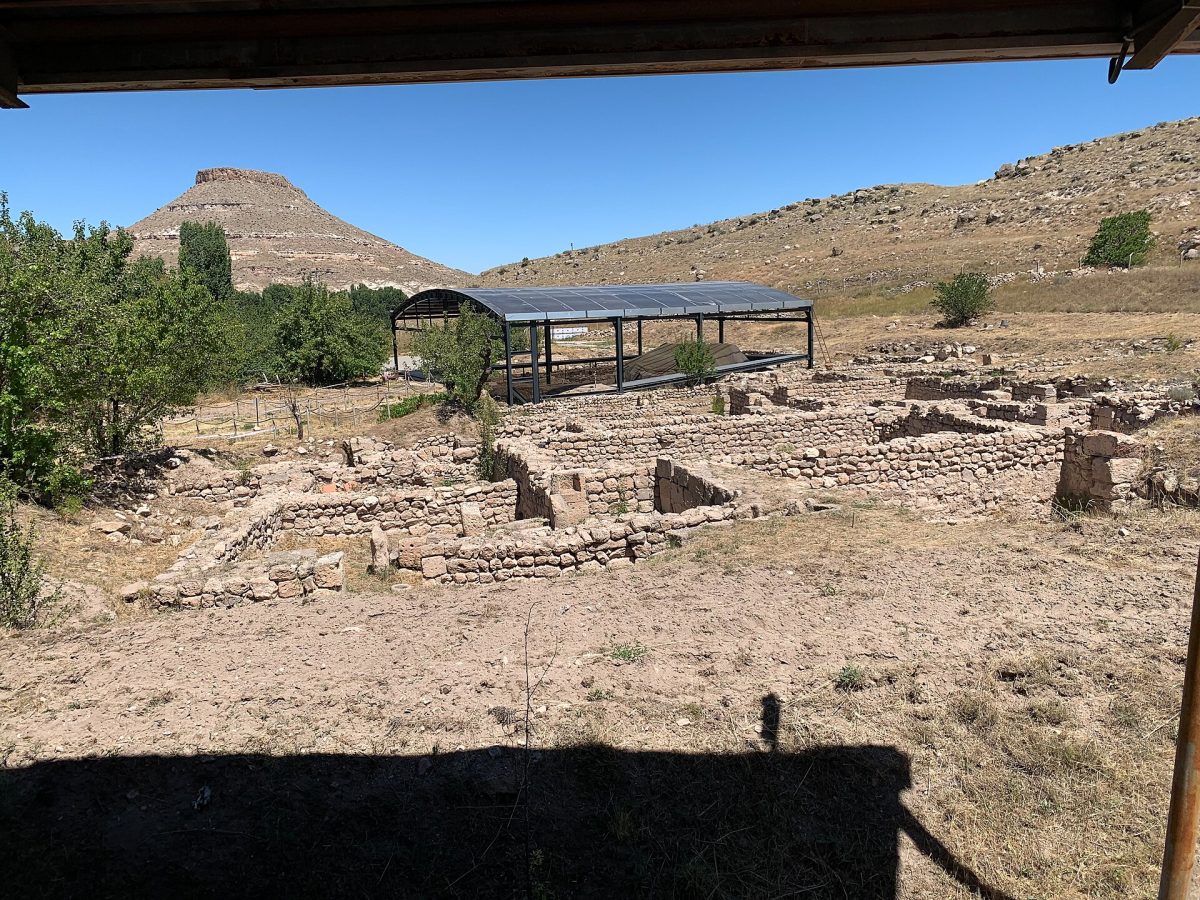
Photo: Robot8A, CC BY-SA 4.0
Nothing for Sobesos alone is sold online, and there is no ticket system worth planning around. The site has a small entrance with a custodian, and entry has generally been free or very cheap. You simply drive up, walk in and follow the walkways laid over the excavated floors.
Most visitors arrive in one of three ways. The simplest is a hired car, which lets you combine Sobesos with Mustafapaşa, the Keşlik monastery and the Soğanlı valley in one loop south of Ürgüp. The second is a taxi or private driver from Ürgüp or Göreme, agreed by the half-day; hotels can arrange this and the price is fixed in advance. The third is a guided day tour of southern Cappadocia, sometimes sold locally as a south or green route, which may include Sobesos among other stops; ask at your hotel or a local agency whether it is on the list, because many routes skip it.
There is no audio guide, and the information panels are short. If you want the mosaics explained, a private guide hired for the day in Ürgüp will usually stop here on request. For most people, the sensible plan is a self-drive half-day to the south with Sobesos as the first or last stop.
The heart of the site is a large building with several rooms floored in mosaic, now covered by a modern roof and crossed by wooden walkways. Look for the geometric borders, knots and interlaced bands in red, ochre, black and white, and for the small panels with plant motifs. The colours are best in the softer light of late afternoon.
Beside the mosaics, the excavators uncovered rooms read as part of a bath complex. Low brick pillars and channels under the floors show how hot air was carried beneath the warm rooms. Walk to the edge of the shelter to see the different floor levels and the basins, which give a sense of how a provincial Roman bath worked.
Live prices from GetYourGuide for tickets and tours that include this site. Free cancellation on most of them.
Part of the town was later reused for a Christian church, and its outline can be traced on the ground next to the main building. Graves found around it show that the site stayed in use into the early Byzantine period. Compare its plan with the rock-cut churches of Göreme, which belong to a later age.
Outside the roof, low stone walls and scattered blocks mark other buildings of the town, most of them still unexcavated. A short loop around the fence gives a view over the fields and the volcanic hills of southern Cappadocia. The scale is modest, and the whole outer area can be walked in a quarter of an hour.
The village itself, a few minutes away on foot, is a quiet farming settlement with old stone houses. Near it, the rock-cut Church of the Forty Martyrs keeps painted interiors from the 13th century; it is not always open, so ask in the village. Together with Sobesos it makes a short, unhurried stop on the road south.
Sobesos lay in the Roman province of Cappadocia, a farming and grazing region crossed by roads between central Anatolia and the Taurus mountains. The remains date mainly from the late Roman and early Byzantine centuries, roughly the 4th to the 6th century AD, when a modest town grew here with public buildings decorated in mosaic. A Christian church was later built on part of the site, and burials gathered around it. The town faded in later centuries and its stones disappeared under fields. It came to light by chance in 2002, and the Nevşehir Museum began excavations soon afterwards. The roofed mosaic building is the main excavated area; much of the town remains under the soil.
Sobesos is in Şahinefendi, about 30 km south of Ürgüp. The road runs through Mustafapaşa and then south across open farmland; the drive takes around 35 minutes, and the site is signposted near the village with a small parking area by the entrance. From Göreme allow about 50 minutes. There is no useful public bus, so the realistic options are a hired car, a taxi or a private driver. The nearest airports are Nevşehir Kapadokya and Kayseri, both with flights from Istanbul; Kayseri is about an hour and a half away by car. If you are going on to the Soğanlı valley, continue south from Şahinefendi for about half an hour.
Stay on the wooden walkways: the mosaics are fragile, and stepping on them or touching them is not allowed. Drones are not permitted without a permit, as at other Turkish archaeological sites. Bring water, a hat and sun cream, because there is no café on the site and very little shade outside the roofed area. Toilets may be limited to the custodian's building, so plan stops in Mustafapaşa or Ürgüp.
Sobesos is rarely busy. Most coach tours keep to Göreme, Uçhisar and the underground cities, so you may have the mosaics almost to yourself at any hour. Late morning works well if you are heading on to Soğanlı for lunch, while the afternoon brings warmer light into the shelter.
The best months are April to June and September to October, when the countryside is pleasant for driving and walking. July and August are hot and dry, though the visit is short and the roof shades the mosaics. Winter in Cappadocia is cold, with snow at times on the higher roads; hours can be shorter or irregular then, so check before you drive out. Because opening times are not well published, aim to arrive well before mid-afternoon. Allow 30 to 45 minutes on the site, or longer if you also visit the village church.
Sobesos fits a half-day loop south of Ürgüp. Mustafapaşa, the old Greek village of Sinasos with carved stone mansions, is about 25 minutes back towards Ürgüp. The Keşlik monastery near Cemil lies on the same road. The Soğanlı valley, with its rock-cut churches, is about 30 minutes further south and has simple restaurants.
207 km away
Catalhoyuk is a Neolithic town on the Konya plain in central Turkey, settled from about 7500 BC and one of the largest…
1 ticket or tour
334 km away
Mount Nemrut is a 2,150-metre summit in south-eastern Turkey crowned by the tomb sanctuary of King Antiochus I of…
15 tickets & tours
364 km away
Selge is a ruined Pisidian city high in the Taurus Mountains above the Koprulu Canyon, about 60 km inland from Manavgat…
9 tickets & tours
| Hours | Daylight hours, roughly 8 am to 5 pm; times are not well published, check locally |
|---|---|
| Closed | Usually open daily; hours can be irregular out of season |
| Entry fee | Free or a small fee at the gate |
| Time needed | 30 to 45 minutes |
| Best time | Late morning or afternoon; April to June and September to October |
| Booking | No booking; turn up and pay, if anything, at the gate |
| Access | Short level paths and wooden walkways under a roof; little shade outside the shelter |
| Getting there | Car or taxi from Ürgüp, about 30 km south via Mustafapaşa, around 35 minutes |
| Excavated | 2002 |
| Civilisation | Roman |
| Checked | October 2026 |
Daylight hours, roughly 8 am to 5 pm; times are not well published, check locally. Closed: Usually open daily; hours can be irregular out of season.
Entry fee: Free or a small fee at the gate.
Allow 30 to 45 minutes for Sobesos.
No booking; turn up and pay, if anything, at the gate.
Yes. GetYourGuide sells tickets and guided tours whose route includes Sobesos; live prices are shown on this page.
Late morning or afternoon; April to June and September to October.
Car or taxi from Ürgüp, about 30 km south via Mustafapaşa, around 35 minutes.
Short level paths and wooden walkways under a roof; little shade outside the shelter.
Worth it for well-kept late Roman mosaics and a calm half-hour away from the Göreme crowds. Skip it if you only have a day or two in Cappadocia and have not yet seen the rock-cut churches and valleys.