Ancient Monument · Asian · China
Terracotta Army
The Terracotta Army is a buried force of more than 8,000 life-size clay soldiers, with horses and chariots, made to guard the tomb of Qin Shi Huang, the first emperor of China, who died in 210 BC. Farmers digging a well found them in 1974; three pits are now roofed over as museum halls 35 km east of Xi'an.
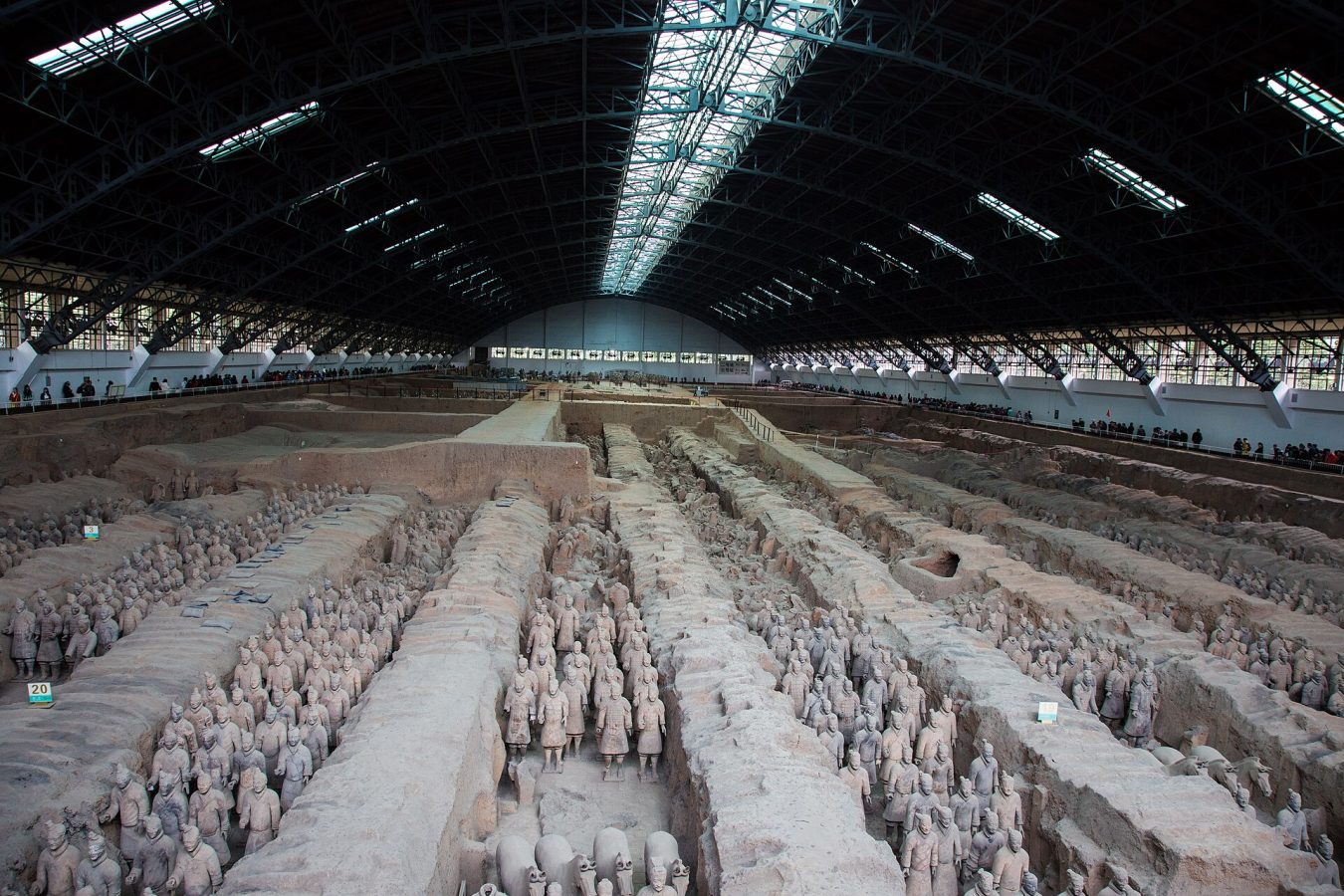
Photo: Jmhullot, CC BY 3.0
Terracotta Army tickets: which one for you
Our pick for each kind of visit, with live dates and prices from GetYourGuide. Free cancellation on most.
Best for: First visit, English-speaking guide
A small minibus from central Xi'an and a guide who explains what you are looking at in each pit, with tickets handled for you.
- On your own, at your own pace: Terracotta army entry ticket Just the entry ticket booked in advance against your passport, for travellers happy to take the metro and bus and explore without a group.
- A private half day: Private half day tour of xi an terracotta warriors Car, driver and guide to yourselves, leaving early enough to beat the coach groups and returning to Xi'an by lunchtime.
Tickets and tours: all the options
The official ticket for the Emperor Qinshihuang's Mausoleum Site Museum covers the three warrior pits, the exhibition hall and the Lishan Garden around the emperor's burial mound, linked by a free shuttle bus. Tickets are real-name and must be booked online in advance with your passport, which is also checked at the gate. Official guides can be hired at the entrance by the hour, and audio guides are available.
Most of what GetYourGuide sells adds transport and a guide, because the site is 35 km from the city. There are shared minibus tours with an English-speaking guide, private half-day and full-day tours by car, and combinations with the Huaqing Palace hot springs at the foot of Mount Li, sometimes with the evening song-and-dance show about the Tang emperor and his consort. Full days often add Xi'an's city wall, the Big Wild Goose Pagoda and the Muslim Quarter. Ticket-booking services exist mainly to deal with the Chinese-language booking systems. Most tours include entry, but check, and check whether lunch and shop stops are part of the day.
For a first visit, a guided small-group or private half day is the sensible choice: the halls have limited English signs, and a guide makes the pits far more interesting.
What to see at Terracotta Army
Pit 1
Start with the largest pit, a hangar-like hall over 200 metres long where some 2,000 restored warriors stand in eleven corridors, facing east in battle order with archers in front. Walk the raised gallery round the edge for different views of the faces, hairstyles and armour. At the far end, the restoration area shows broken figures being pieced together.
Pit 2 and the kneeling archer
A few minutes' walk away, Pit 2 is mostly still unexcavated, but it shows how the figures were found, crushed under fallen roof beams. The real interest is in the glass cases at the edge, where the best-preserved figures stand at eye level: a kneeling archer with traces of paint, a cavalryman with his horse, a general and a standing archer.
187 tickets and tours for Terracotta Army
Live dates and prices from GetYourGuide. Free cancellation on most tickets.
Pit 3
The smallest pit, with fewer than seventy figures and a chariot, is thought to have been the command post of the army. The figures face each other in a ceremonial guard rather than in battle order, and several have lost their heads. It is quick to see but explains how the army was organised.
Exhibition Hall and bronze chariots
The museum building shows the two bronze chariots and horses found west of the burial mound in 1980, each about half life size, with silver and gold fittings, umbrellas and reins cast in fine detail. Other cases show weapons, armour made of stone plates and the figures of officials, acrobats and musicians found in smaller pits.
Lishan Garden and tomb mound
The free shuttle takes you about 2 km west to the park around the emperor's tomb, a wooded hill about 50 metres high that has never been opened. Paths lead round the mound past excavated walls and pits. It is quieter than the warriors and gives a sense of the scale of the whole burial complex.
A short history
Ying Zheng became king of Qin at thirteen in 246 BC, and work on his tomb began soon after. By 221 BC he had conquered the rival states and ruled as Qin Shi Huang, the first emperor; according to the historian Sima Qian, some 700,000 labourers built the mausoleum. He died in 210 BC, and the army was buried in pits east of the tomb. Soon after the dynasty fell, rebels are thought to have burned the pits. In March 1974 farmers digging a well found fragments, and excavations revealed three pits; the museum opened over Pit 1 in 1979. UNESCO listed the mausoleum in 1987, and digging still continues.
Getting there
The museum is in Lintong, about 35 km east of central Xi'an. The easiest public route is metro line 9 from the city to Huaqingchi station, about an hour from the centre with a change, then a short bus or taxi ride to the museum. Tourist bus 5, also numbered 306, leaves from the east square of Xi'an railway station and takes about an hour; use only the official bus, not touts. Taxis and ride-hailing cars from the centre take about 50 minutes. Xi'an Xianyang airport is about 80 km away. From the car park and bus stop, a walk of about 15 minutes leads through a shopping street to the entrance.
Rules and what to bring
Bring your passport: it is needed to buy and use the ticket and at the security check. Flash photography, tripods and drones are not allowed, and touching the figures or climbing the barriers is strictly forbidden. Large bags may be refused, so travel light. There are toilets, drinking water and cafes in the visitor area and outside the pits. Wear comfortable shoes: the walks between halls, to the Lishan Garden shuttle and back to the car park are long.
When to go
The halls are busiest from about 10 am to 2 pm, when tour groups from Xi'an arrive. Be at the gate at opening, start in Pit 1 before the coaches, and use the afternoon for the smaller pits and the exhibition hall. Weekdays are much calmer than weekends.
Avoid Chinese national holidays if you can: the Golden Week at the start of October, the Spring Festival in January or February and the May Day holiday bring huge crowds, and the summer school holidays in July and August are busy and hot, often above 35 degrees outside. April, May, September and October are the most pleasant months. The halls are indoors, so rain matters little, but they are unheated and cold in winter, when visitor numbers are lowest. Allow three to four hours on site, plus about two hours for the return trip from Xi'an.
Combine it with
Huaqing Palace, with its hot springs, Tang dynasty pools and cable car up Mount Li, is about 10 minutes away and pairs naturally with the warriors. In Xi'an, the Shaanxi History Museum holds more Qin and Tang finds, and the city wall, Big Wild Goose Pagoda and Muslim Quarter fill a second day. The Han Yangling tomb museum lies near the airport.
At a glance
| Hours | Entry from 8.30 am; last entry 5 pm mid-Mar to mid-Nov, 4.30 pm in winter |
|---|---|
| Closed | Open daily |
| Entry fee | from CNY 120; full-time students CNY 60 |
| Time needed | 3 to 4 hours, half a day from Xi'an |
| Best time | At opening on a weekday; Apr–May and Sep–Oct, avoiding 1–7 Oct |
| Booking | Book online in advance with your passport; real-name timed tickets |
| Access | Indoor halls with ramps and viewing galleries; long walks between pits and from the car park |
| Getting there | Metro line 9 to Huaqingchi, then a short bus or taxi; tourist bus from Xi'an station, 1 hour |
| Founded | 246 BC (mausoleum begun 246 BC; army buried 210-209 BC) |
| Excavated | 1974 |
| Civilisation | Asian |
| Visitors | 11.2 million a year (2023) |
| UNESCO | Mausoleum of the First Qin Emperor |
| Website | bmy.com.cn |
| Checked | October 2026 |
Frequently asked questions
When is Terracotta Army open?
Entry from 8.30 am; last entry 5 pm mid-Mar to mid-Nov, 4.30 pm in winter. Open daily.
How much is the entry fee for Terracotta Army?
Entry fee: from CNY 120; full-time students CNY 60.
How long do you need at Terracotta Army?
Allow 3 to 4 hours, half a day from Xi'an for Terracotta Army.
Do I need to book Terracotta Army in advance?
Book online in advance with your passport; real-name timed tickets.
Can I book a ticket or tour for Terracotta Army online?
Yes. GetYourGuide lists 187 tickets and tours for Terracotta Army, with live dates and prices and free cancellation on most of them.
When is the best time to visit Terracotta Army?
At opening on a weekday; Apr–May and Sep–Oct, avoiding 1–7 Oct.
How do I get to Terracotta Army?
Metro line 9 to Huaqingchi, then a short bus or taxi; tourist bus from Xi'an station, 1 hour.
Is Terracotta Army accessible, and what is the terrain like?
Indoor halls with ramps and viewing galleries; long walks between pits and from the car park.
Is Terracotta Army worth visiting?
Worth it for the first sight of Pit 1, where ranks of warriors stretch into the distance, each with its own face. Skip or shorten it if you dislike crowds in enclosed halls, especially in Chinese holidays, or have only one day in Xi'an and prefer the city itself.
How old is Terracotta Army?
Terracotta Army dates from 246 BC (mausoleum begun 246 BC; army buried 210-209 BC). Excavations began in 1974.
Is Terracotta Army a UNESCO World Heritage Site?
Yes. Terracotta Army is part of the UNESCO World Heritage Site Mausoleum of the First Qin Emperor.