Ancient City · Roman · Tunisia
Uthina (Oudhna)
Uthina, now called Oudhna, is a Roman city on a low plateau about 30 km south of Tunis, founded as a colony for veterans under Augustus. Its amphitheatre, partly dug into the hill, once seated about 16,000 people, and a huge capitol, baths and mosaic-floored houses survive around it. Visitors are few, so you often have it to yourself.
Uthina (Oudhna) tickets: which one for you
Our pick for each kind of visit, with live dates and prices from GetYourGuide. Free cancellation on most.
Best for: Two Roman cities in a day
A private driver and guide from Tunis take you to Uthina and to Dougga, the best preserved Roman town in Tunisia, without managing transport.
- A varied day south of Tunis: Tunis uthina zaghouan and zriba el alia day trip Combines the ruins with the Roman water temple at Zaghouan and an old hilltop village, a good balance of history and landscape.
- Roman engineering enthusiasts: Uthina roman aqueduct water system tour Follows the water that fed Carthage, from the aqueduct to the cisterns and baths of Uthina, with a guide who explains how the system worked.
Tickets and tours: all the options
Uthina is run by Tunisia's heritage agency, and entry is a simple ticket paid at the gate in dinars; nothing for the site alone is sold online and no booking is needed. Signs are limited, in French and Arabic with some English, and there is no audio guide, so either read up before you go or come with a guide.
What is sold online are day trips from Tunis that include transport and usually a guide. The most useful kinds pair Uthina with Dougga, the great Roman town in the north-west, or with Zaghouan, where a Roman water sanctuary marks the source of the aqueduct to Carthage, and a hilltop village nearby. A specialised tour follows the aqueduct and water system to Uthina. From the resorts of Hammamet and Sousse, some long days combine the site with a wine tasting and Sidi Bou Said. Private tours with a driver are common and not expensive by European standards.
Check whether entry fees and lunch are included. If you have a hire car, driving from Tunis is easy and gives you the morning light; without one, a private day pairing Uthina with Dougga is the sensible choice.
What to see at Uthina (Oudhna)
Amphitheatre
Start in the north of the site at the amphitheatre, built under Hadrian and set into the slope so that only the upper arcades rise above ground. It measures about 113 by 90 metres around an arena of 58 by 35 metres. Walk down the vaulted gallery on the main axis to the rooms beneath the arena, where animals and fighters waited.
Capitol
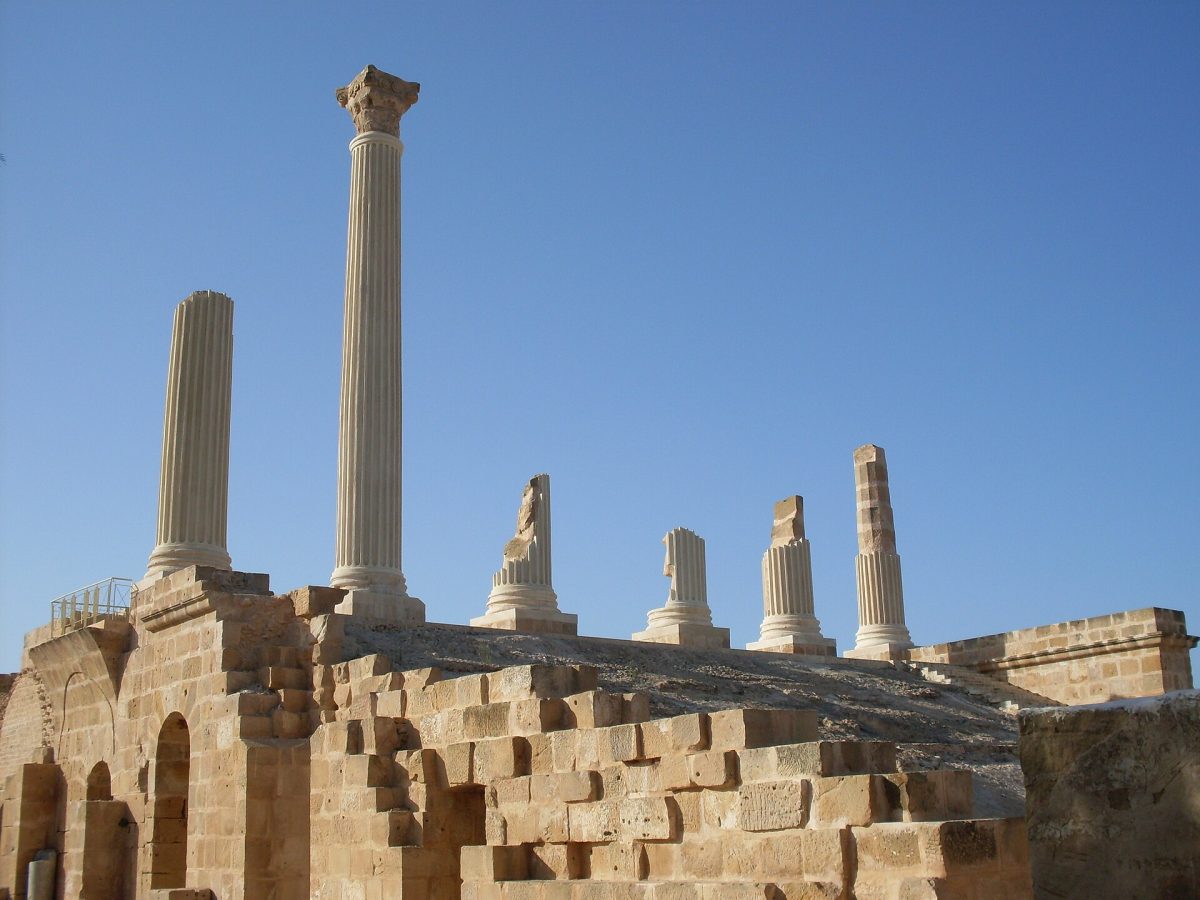
On the highest point of the plateau, a few minutes south, the capitol was one of the largest temples of Roman Africa. Little of the temple itself stands, but the massive vaulted substructures beneath its platform survive and can be entered. From the top there are wide views over the plain and the line of the aqueduct to Carthage.
4 tickets and tours for Uthina (Oudhna)
Live dates and prices from GetYourGuide. Free cancellation on most tickets.
Public baths
Below the capitol, the great public baths keep high walls of brick and rubble, vaulted service rooms and parts of the hot and cold halls. Look for the furnaces and the channels that carried water and heat. Their scale shows how prosperous the colony became in the 2nd and 3rd centuries, fed by the aqueduct passing nearby.
Houses of the Laberii and Ikarios
To the east, the foundations of large townhouses show courtyards, dining rooms and floors where mosaics were found, among them scenes of country life and of the god Dionysus giving wine to Ikarios. The finest originals were lifted and are now in the Bardo Museum in Tunis, but simpler geometric floors remain in place.
Cisterns and aqueduct arches
Finish at the large cisterns that stored the town's water, still vaulted and deep. On the drive back towards Tunis, stop beside the road to see a long stretch of the arches of the Zaghouan aqueduct marching across the plain, one of the longest aqueducts of the Roman world and the source of Carthage's water.
A short history
A settlement existed here in Punic times, and under Augustus it became a Roman colony for veterans of the Thirteenth Legion, in the province of Africa Proconsularis. Ptolemy and Pliny the Elder name it, and it appears on the Peutinger map. The town grew rich from the grain and olive lands of the Miliane valley, and in the 2nd century it gained its amphitheatre, capitol and baths, with houses floored in fine mosaics. It declined in late antiquity and was later used as a quarry and a fortress. Mosaics were taken to Tunis in the 1890s, and systematic excavation and restoration by the Tunisian heritage institute began in 1993.
Getting there
Uthina lies about 30 km south of central Tunis, in the farmland of the governorate of Ben Arous. By car, take the road south towards Zaghouan and follow the signs for Oudhna; the drive takes about 40 minutes, and there is parking at the gate. Tunis-Carthage airport is about 45 minutes away. Taxis from Tunis can be hired for half a day; agree the price, including waiting time, before you leave. Public transport is impractical, so most visitors come by hire car, private driver or tour. From Hammamet the drive is about an hour.
Rules and what to bring
Do not climb on walls or the amphitheatre arcades, and take care in the vaulted substructures, which are dark and uneven; a torch helps. Drones are tightly controlled in Tunisia and should not be flown without permission. There is little shade and no cafe, so bring water, a hat and snacks, and wear sturdy shoes. Toilets at the entrance may be basic. Dress modestly for the drive through rural towns.
When to go
Uthina sees very few visitors, so crowds are never the problem; heat and light are. Go in the morning, when the air is fresh and the low sun shows the texture of the brick and stone, or in the late afternoon in spring and autumn. Midday in summer is very hot on the open plateau, with temperatures above 35 degrees in July and August.
March to May is the best season, with green fields, wild flowers among the ruins and mild temperatures; October and November are also good. Winter is often pleasant but can be wet and windy, and the paths turn muddy after rain. During Ramadan opening hours may be shorter, so check locally before setting out. Allow about an hour and a half to two hours for the amphitheatre, capitol, baths and houses, more if you also stop for the aqueduct arches on the way back.
Combine it with
The arches of the Zaghouan aqueduct are a short drive away, and the Roman water temple at Zaghouan is about 40 minutes south. Thuburbo Majus, another Roman city with a fine capitol, is about 45 minutes west, and the Bardo Museum in Tunis holds the best mosaics from Uthina.
At a glance
| Hours | Daylight hours, roughly 8 am to 5 pm, later in summer; check locally |
|---|---|
| Closed | Usually open daily |
| Entry fee | Small fee in dinars at the gate |
| Time needed | 1.5 to 2 hours |
| Best time | Morning; March to May and October to November |
| Booking | Pay at the gate; no booking needed |
| Access | Open, uneven ground with slopes and loose stone, almost no shade; not suitable for wheelchairs |
| Getting there | Taxi or hire car from Tunis, about 40 minutes south; no practical public transport |
| Civilisation | Roman |
| Checked | October 2026 |
Frequently asked questions
When is Uthina (Oudhna) open?
Daylight hours, roughly 8 am to 5 pm, later in summer; check locally. Closed: Usually open daily.
How much is the entry fee for Uthina (Oudhna)?
Entry fee: Small fee in dinars at the gate.
How long do you need at Uthina (Oudhna)?
Allow 1.5 to 2 hours for Uthina (Oudhna).
Do I need to book Uthina (Oudhna) in advance?
Pay at the gate; no booking needed.
Can I book a ticket or tour for Uthina (Oudhna) online?
Yes. GetYourGuide lists 4 tickets and tours for Uthina (Oudhna), with live dates and prices and free cancellation on most of them.
When is the best time to visit Uthina (Oudhna)?
Morning; March to May and October to November.
How do I get to Uthina (Oudhna)?
Taxi or hire car from Tunis, about 40 minutes south; no practical public transport.
Is Uthina (Oudhna) accessible, and what is the terrain like?
Open, uneven ground with slopes and loose stone, almost no shade; not suitable for wheelchairs.
Is Uthina (Oudhna) worth visiting?
Worth it for a large Roman amphitheatre and capitol, close to Tunis and almost free of crowds. Skip or shorten it if you have only one day for Roman Tunisia: Dougga is grander and better preserved.