Perperikon
76 km away
Perperikon is a rock-cut sanctuary and fortified city on a 470-metre hill in the Eastern Rhodopes, 15 km north-east of…
3 tickets & tours
Theatre & Amphitheatre · Roman · Bulgaria
The Roman Stadium of Philippopolis is a 2nd-century AD stadium in the centre of Plovdiv, built under Hadrian when the city was capital of the province of Thrace. About 240 metres long and once seating some 30,000 people, it lies mostly under the main pedestrian street; its curved northern end is open to view on Dzhumaya Square.
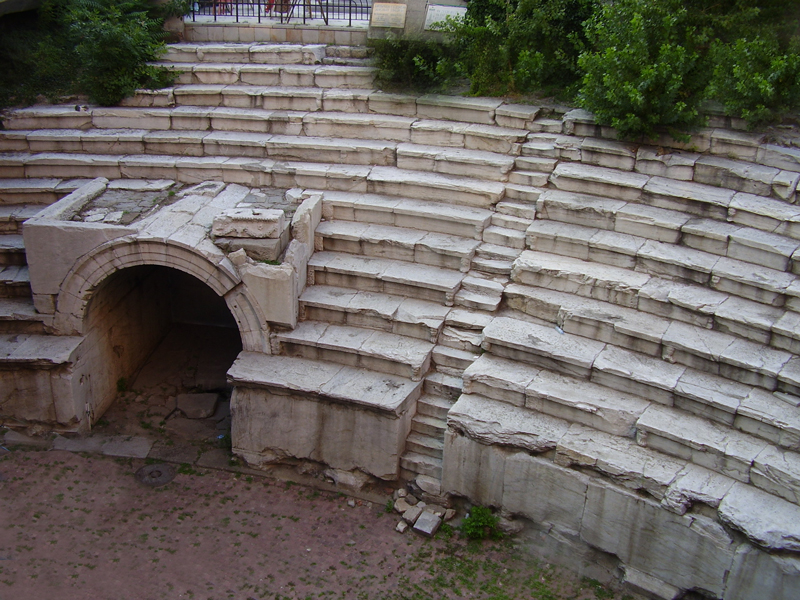
Photo: Kmrakmra, CC BY-SA 3.0
There is nothing to buy for the stadium alone. The exposed northern end sits in a sunken area of Dzhumaya Square, and you can look down on it from the square or walk down the steps to the lowest rows and the track for free. No tour is sold online specifically for the stadium.
A small visitor centre beside the ruins shows a short film that reconstructs the stadium and the games held in it, and charges a modest fee. It is the easiest way to picture the full length of the building, most of which is hidden under the shops of the main street.
Most visitors see the stadium as part of a walk through central Plovdiv. City walking tours, many of them run on a tip basis by local guides, usually start or pass here and continue to the Old Town, the Roman theatre and the Ottoman houses. Day trips from Sofia to Plovdiv include a stop on Dzhumaya Square, with transport and a guide, while the theatre and the old houses are paid separately. Some sites in Plovdiv are covered by combined tickets for the Old Town houses, but the stadium does not need one.
The sensible plan is a short free visit, and the film if you have children or want the full picture.
Start on Dzhumaya Square and look down at the curved northern end, the sphendone, where 14 rows of marble seats survive. The front of each seat block is carved with stylised lion paws. Walk down the steps to sit on the lowest row and look along the track that runs away under the modern street.
Below the seats, a covered vaulted corridor runs through the curve and once linked the track with the Roman road outside the city walls. It is one of the best preserved parts of the structure. Note the granite blocks of the outer walls, some still marked with masons' letters used during building.
Live prices from GetYourGuide for tickets and tours that include this site. Free cancellation on most of them.
Close to the lowest rows, some marble blocks carry Greek inscriptions marking reserved seats for local dignitaries. Look carefully, as the letters are worn. The highest row once had backrests, and the front of the bottom row was faced with large marble slabs fixed with iron cramps set in lead.
Next to the ruins, the small visitor centre shows a reconstruction film of the stadium as it was in the 2nd and 3rd centuries AD, with athletes, crowds and the games held for visiting emperors. It lasts only a few minutes and explains the scale far better than the exposed fragment alone.
Walk south along the main street and look into the basements of some shops, where further sections of the stadium are visible behind glass. Back on the square, the Dzhumaya Mosque, one of the oldest Ottoman buildings in the Balkans, stands right above the ruins and is open to respectful visitors outside prayer times.
The stadium was built in the early 2nd century AD, during the reign of Hadrian, when Philippopolis was the capital of the Roman province of Thrace. It was set unusually inside the walls, in a natural hollow between two of the city's hills. The track was one stadion, about 180 metres, and the building held up to 30,000 spectators. Inscriptions and coins record games modelled on the Pythian Games, renamed for the visits of Caracalla in 214 and Elagabalus in 218. In the 4th century an aqueduct crossed the site. The stadium was found in 1923, excavated more fully by Liliya Botusharova from the 1970s, and its surroundings were renovated in 2010 to 2013.
The stadium is in the heart of Plovdiv, on Dzhumaya Square at the northern end of the long pedestrian street, Knyaz Alexander I. From the central railway station it is a flat walk of about 15 minutes north along the main street. Trains and buses from Sofia take about two to two and a half hours, and the main bus stations are close to the railway station. Plovdiv airport, about 12 km south-east, has few flights, so most travellers fly into Sofia and continue by bus, train or car. Driving into the centre is not advisable: the area around the square is pedestrianised, and paid parking is available in the blue zones and car parks a few streets away.
Do not climb on the outer walls or walk on fenced parts of the track. Skateboarding and cycling on the marble rows are not allowed. When visiting the Dzhumaya Mosque next door, dress modestly, remove your shoes and avoid prayer times. There are no toilets at the ruins themselves, but cafes and restaurants line the square. In summer the sunken area becomes hot, so bring water.
Because the stadium is open to view from the square, you can come at any hour. Early morning is the quietest time, before the main street fills with shoppers and school groups gather for city tours. In the evening the ruins are lit and the cafes on the square are busy, which makes for a pleasant short stop on the way to dinner in the old town.
Plovdiv is hot in July and August, often above 33 degrees, and the stone bowl of the stadium holds the heat, so visit early or late in the day. Spring and autumn are the most comfortable seasons for walking the city. Winters are cold but rarely severe, and the visitor centre keeps shorter hours. Plovdiv hosts many festivals in summer and autumn, and the square is sometimes used for events, when the view may be partly blocked. Allow 15 to 30 minutes for the stadium itself, or half a day for central Plovdiv.
The Roman theatre, cut into the hill of the Old Town, is about 10 minutes away uphill and is the city's finest Roman monument. The Old Town's painted Revival-era houses lie around it. The Roman Odeon and the Eparchia mosaics are a short walk south, and the Regional Archaeological Museum holds finds from the stadium.
76 km away
Perperikon is a rock-cut sanctuary and fortified city on a 470-metre hill in the Eastern Rhodopes, 15 km north-east of…
3 tickets & tours
132 km away
Philippi is the ancient city founded by Philip II of Macedon in 356 BC on the Via Egnatia, 15 km north-west of Kavala…
8 tickets & tours
231 km away
Kokino is a Bronze Age hilltop sanctuary in northern North Macedonia, set at about 1,030 metres on the rocky summit of…
3 tickets & tours
| Hours | Visible from the square at any time; the small visitor centre keeps daytime hours |
|---|---|
| Closed | Open daily |
| Entry fee | Free to view; small fee for the visitor centre film |
| Time needed | 15 to 30 minutes |
| Best time | Morning or early evening; April to June and September to October |
| Booking | No booking needed |
| Access | Seen from the level square; steps down to the seats and track; the vaulted passage has stairs |
| Getting there | On Dzhumaya Square in central Plovdiv, a 15-minute walk from the central railway station |
| Founded | AD 150 (2nd century AD (midpoint)) |
| Civilisation | Roman |
| Website | ancient-stadium-plovdiv.eu |
| Checked | October 2026 |
Visible from the square at any time; the small visitor centre keeps daytime hours. Open daily.
Entry fee: Free to view; small fee for the visitor centre film.
Allow 15 to 30 minutes for Roman Stadium of Plovdiv.
No booking needed.
Yes. GetYourGuide sells tickets and guided tours whose route includes Roman Stadium of Plovdiv; live prices are shown on this page.
Morning or early evening; April to June and September to October.
On Dzhumaya Square in central Plovdiv, a 15-minute walk from the central railway station.
Seen from the level square; steps down to the seats and track; the vaulted passage has stairs.
Worth it for a quick, free look at marble Roman seating in the middle of Plovdiv's shopping street. Skip or shorten it if you want a complete monument: only the curved end is exposed, and the Roman theatre nearby is far more impressive.
Roman Stadium of Plovdiv dates from AD 150 (2nd century AD (midpoint)).
Plovdiv, Bulgaria
The Ancient Theatre of Plovdiv is one of the best preserved Roman theatres anywhere, built in the 1st century AD for…
No online ticket
Plovdiv, Bulgaria
Nebet Tepe is the rocky hill at the northern edge of Plovdiv Old Town where the city began, settled since about 4000…
No online ticket