Akrotiri
7 km away
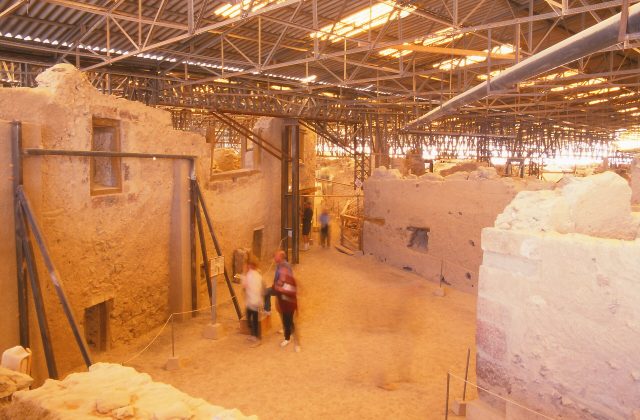
Akrotiri is the Bronze Age town on the south coast of Santorini that the great Theran eruption buried in volcanic ash…
18 tickets & tours
Ancient City · Greek · Greece
Ancient Thera is the ruined Greek city on the ridge of Mesa Vouno in Santorini, about 360 metres above the black-sand beaches of Kamari and Perissa. Founded by settlers from Sparta and later a base of the Ptolemaic fleet, it keeps an agora, a theatre, temples and houses spread along a single street, with views over both coasts.

Photo: Tomisti, CC BY-SA 3.0
There is nothing sold online for Ancient Thera alone. Entry is a standard state ticket bought at the gate on the hill, and it is inexpensive. A combined ticket covering several Santorini sites and museums has been sold in the past, so ask at the gate or at the museums in Fira if you plan to see Akrotiri too.
Getting up is the main question. From Kamari a narrow road with many hairpin bends climbs to the Sellada saddle, and in summer a local minibus runs from the village to the top several times a day for a fare. Taxis and rented cars can also go up, but parking at the top is very limited. Walkers use the old paths from Kamari or Perissa, a steep climb of 40 minutes to an hour.
Some island tours and hiking walks include Ancient Thera with a guide, often combined with the Perissa beaches or a wine tasting, and private guides can be booked on the island. The ticket is usually extra. The sensible plan is to go up early by minibus or on foot, buy the ticket at the gate and walk the street on your own with a good map.
Walk along the main street to the agora, a long open square on the ridge, about 110 metres long. On its western side lies the Basilike Stoa, a large hall with a row of Doric columns down the middle, rebuilt in the 1st century AD. Statues of the imperial family once stood in a room at its northern end.
Just below the main street, the small theatre was built into the slope and seated about 1,500 people, more than the city itself needed. Sit in the upper rows and look down past the stage to Perissa and the open sea. Performances here drew people from across the island and perhaps from neighbouring islands as well.
Live prices from GetYourGuide for tickets and tours that include this site. Free cancellation on most of them.
Near the theatre, on the slope, is a rock-cut sanctuary dedicated to Isis, Serapis and Anubis, set up in the Ptolemaic period when Egyptian soldiers served in the garrison. Niches for offerings are cut into the rock face. It shows how the fleet changed the religious life of the island town.
At the south-eastern end of the city lies the temple of Apollo Karneios, the most important sanctuary, with a terrace beside it where festival dances were performed. Old graffiti carved into the rock near the terrace record names of dancers and lovers. The view drops straight down to the coast from here.
At the very tip of the ridge, the gymnasium where young men trained includes a grotto dedicated to Hermes and Heracles, and baths added in Roman times. It is the furthest point of the site, so allow time for the walk back. The path along the cliff gives good views over both sides of the island.
Thera was founded by Dorian settlers from Sparta on this rocky ridge, and there are traces of settlement from the 9th century BC. Around 630 BC, after a long drought, the Therans sent colonists to found Cyrene in Libya. In the 3rd century BC the Ptolemies made the city the base of their Aegean fleet and rebuilt it on a grid with peristyle houses; the garrison left around 145 BC. The town remained prosperous in Roman times and was a bishop's seat in the Byzantine period, but after a volcanic eruption in 726 it was abandoned. Friedrich Hiller von Gaertringen excavated the city from 1895 to 1904, and later work uncovered the cemetery at Sellada.
Ancient Thera stands on Mesa Vouno, the mountain between Kamari and Perissa on the south-east coast of Santorini. From Fira, local buses reach Kamari in about 20 minutes. Santorini airport is only a few kilometres from Kamari, so a taxi is quick. From Kamari, the summer minibus or a car climbs the winding road to the Sellada saddle; drive carefully, as it is narrow and has sharp bends. From the small car park at the top it is about a 10-minute walk up to the gate. On foot, a stepped path climbs from the southern end of Kamari, and another climbs from Perissa; both take 40 minutes to an hour. Ferries from Piraeus and other islands arrive at Athinios port.
Stay on the paths and do not climb on walls or columns. Drones are not allowed without permission. There is almost no shade on the ridge, so bring a hat, sunscreen and plenty of water, as there is nothing to buy on top. Wear proper shoes with grip for the rocky paths. The wind can be strong, especially in summer, so keep a firm grip on hats and phones near the edges. There are basic toilets near the entrance.
The site is best visited early: arrive at opening, before the sun is high and while the air is still cool for the climb. By late morning the heat on the bare limestone is intense in summer, and there is no shelter on the ridge. Because the site usually closes in the afternoon, a sunset visit is not possible, but the morning light over the sea is fine.
April, May, June, September and October are the best months, mild and sometimes with wild flowers on the slopes. July and August are hot and very windy, though the site is rarely crowded even then, since most visitors to Santorini stay around Fira and Oia. In winter, opening hours are shorter and the site may close in bad weather. Allow two to three hours for the climb and the walk along the ridge, more if you hike up from Perissa.
The black-sand beaches of Kamari and Perissa lie directly below, good for a swim after the visit. The Archaeological Museum in Fira holds finds from the city and its cemetery. Akrotiri, the Bronze Age town buried by the great eruption, is about 25 minutes by car to the south-west.
7 km away
Akrotiri is the Bronze Age town on the south coast of Santorini that the great Theran eruption buried in volcanic ash…
18 tickets & tours
103 km away
The ancient theatre of Milos is a Greek theatre rebuilt in marble in Roman times, set on a hillside below the village…
1 ticket or tour
116 km away
Delos is the small island off Mykonos that the Greeks held sacred as the birthplace of Apollo and Artemis, and its…
35 tickets & tours
| Hours | Morning and early afternoon opening; shorter hours in winter; check before going up |
|---|---|
| Closed | Check locally; may close early in strong wind or bad weather |
| Entry fee | A small fee; reduced for students and seniors |
| Time needed | 2 to 3 hours with the climb |
| Best time | At opening; April to June and September to October |
| Booking | Pay at the gate; no booking needed |
| Access | Steep road or footpaths up; rough rocky paths on top with no shade; not suitable for wheelchairs |
| Getting there | Road and footpath from Kamari to the Sellada saddle, then a 10-minute walk up to the gate |
| Founded | 850 BC (9th century BC (midpoint)) |
| Excavated | 1895 |
| Civilisation | Greek |
| Elevation | 360 m above sea level |
| Checked | October 2026 |
Morning and early afternoon opening; shorter hours in winter; check before going up. Closed: Check locally; may close early in strong wind or bad weather.
Entry fee: A small fee; reduced for students and seniors.
Allow 2 to 3 hours with the climb for Ancient Thera.
Pay at the gate; no booking needed.
Yes. GetYourGuide sells tickets and guided tours whose route includes Ancient Thera; live prices are shown on this page.
At opening; April to June and September to October.
Road and footpath from Kamari to the Sellada saddle, then a 10-minute walk up to the gate.
Steep road or footpaths up; rough rocky paths on top with no shade; not suitable for wheelchairs.
Worth it for a quiet Greek city on a mountain ridge with sea views on both sides, far from the Santorini crowds. Skip or shorten it if you dislike heat and steep climbs, or if you only have time for one site and Akrotiri interests you more.
Ancient Thera dates from 850 BC (9th century BC (midpoint)). Excavations began in 1895.
Santorini, Greece
Akrotiri is the Bronze Age town on the south coast of Santorini that the great Theran eruption buried in volcanic ash…
18 tickets & tours

