Ancient Monument · Roman · Algeria
Timgad and the Arch of Trajan
The Arch of Trajan is the 12-metre triple gateway of Timgad, a Roman colony founded in AD 100 in the high plains of north-east Algeria. It opens on to one of the best-preserved Roman grid towns anywhere, with paved streets, a theatre, a forum and baths, and its central arch still shows the ruts of cart wheels.
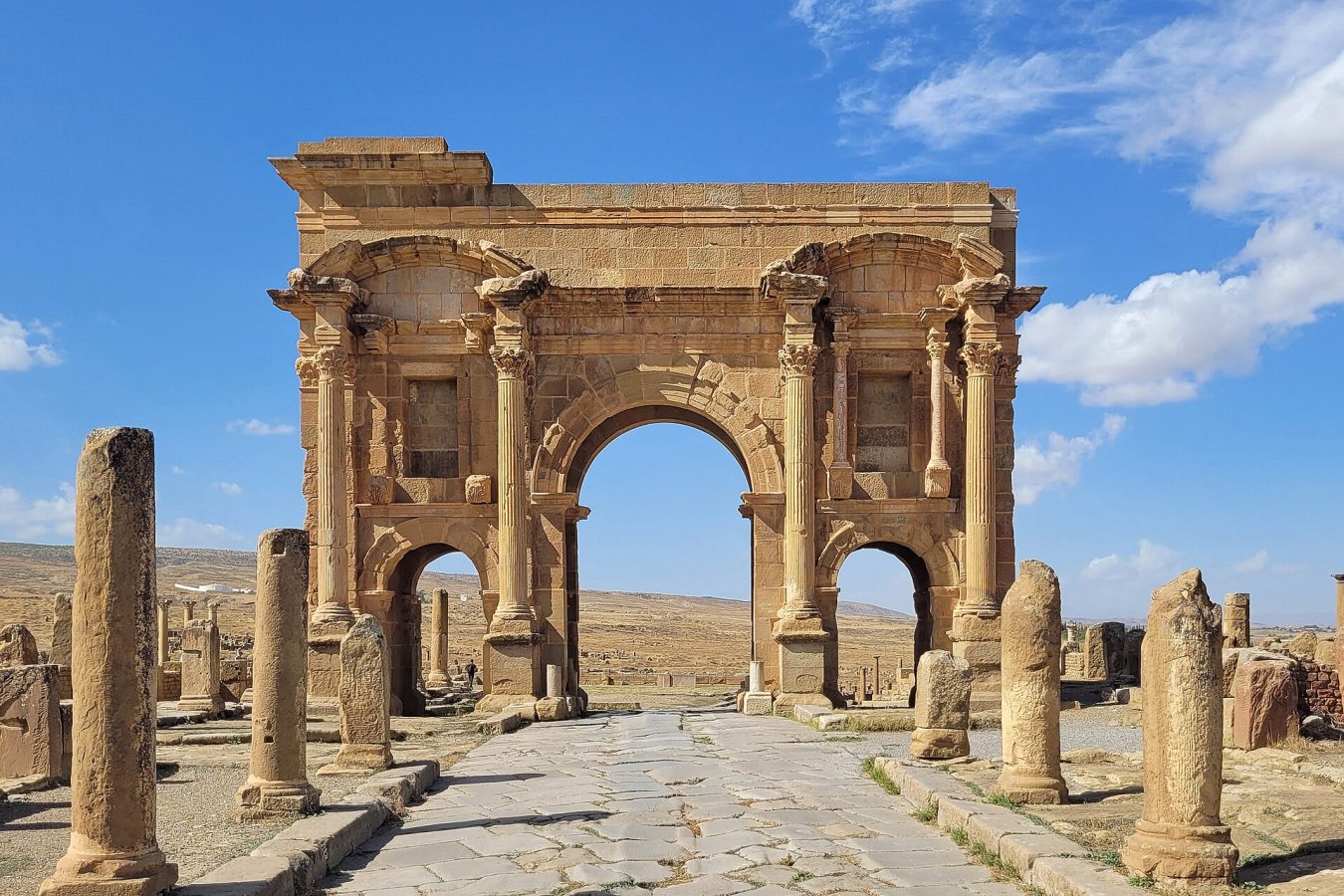
Photo: Bernard Gagnon, CC BY 4.0
Timgad and the Arch of Trajan tickets: which one for you
Our pick for each kind of visit, with live dates and prices from GetYourGuide. Free cancellation on most.
Best for: First visit, based in Batna
A local guide and tickets are arranged, and the guide explains the grid, the theatre and the arch so the town makes sense on a short visit.
- A day trip from Constantine: From constantine timgad unesco site day trip Covers the long drive across the high plains with a driver and guide, which is the easiest way to reach the site without hiring transport yourself.
- Touring eastern Algeria: East algeria tour constantine djemila timgad from algiers Several days from Algiers that link Timgad with Djemila and Constantine, with the transport, hotels and permits handled in one booking.
Tickets and tours: all the options
Entry to the Timgad site is paid at the gate, with a separate ticket for the museum next to the entrance. Nothing needs to be booked in advance for the site itself, and visitor numbers are low except on public holidays.
What is sold online are tours that solve the harder question of getting there. A guided tour from Batna includes tickets and a guide on site. Day trips from Constantine cover the drive of about two and a half hours each way, with a driver and guide; some start from or include Djemila. A two-day trip from Constantine adds a hotel night, and a tour from Bejaia, on the coast, makes a very long day with lunch included. Longer itineraries of eastern Algeria start in Algiers and combine Timgad with Djemila, Constantine and sometimes Lambaesis, handling transport and hotels throughout.
There are few signs on site, so a guide, local or from a tour, adds a great deal. Independent travel is possible but requires care with visas and, in some periods, police escorts for foreign visitors in the region. For most visitors a tour from Constantine or Batna is the sensible choice.
What to see at Timgad and the Arch of Trajan
Arch of Trajan
Start at the western edge of the town, where the triple arch stands at the start of the main street. The central opening, about 6 metres high, carried carts, whose wheels cut deep grooves in the paving; the side arches were for walkers. Look for the red marble columns, the curved pediments above the side niches and the inscription naming Trajan.
Decumanus and forum
Walk east along the colonnaded main street to the forum, a paved square in the centre of the grid, surrounded by the remains of a basilica, a council hall and shops. A speakers' platform and the bases of statues survive. One famous inscription carved on the steps describes the pleasures of hunting, bathing, playing and laughing as the good life.
5 tickets and tours for Timgad and the Arch of Trajan
Live dates and prices from GetYourGuide. Free cancellation on most tickets.
Theatre
Just south of the forum, the theatre is cut into a low hill and seated about 3,500 people. Several rows of seating and the stage area are well preserved, and the theatre is still used for an annual music festival. Climb to the top rows for the best view over the grid of streets and across the plains to the Aures mountains.
Library and markets
Across the main street from the forum, the public library, given by a local citizen in the 3rd century, has a semicircular reading room with niches for book cupboards, one of the few Roman libraries whose plan survives. Back near the arch, the market of Sertius has a semicircular court surrounded by stalls. Both show the comforts of a prosperous provincial town.
Capitol and Byzantine fort
South-west of the original grid stand the remains of the Capitol, a temple to Jupiter whose tall column bases hint at its size. Further south, the walls of the 6th-century Byzantine fort are the best-preserved structure on site. Finish at the museum by the entrance, which displays mosaics and statues from the houses and baths.
A short history
The emperor Trajan founded Thamugadi in AD 100 as a colony for veterans of the Third Augustan Legion, based at nearby Lambaesis. Laid out as a square with a strict grid, it grew far beyond its walls in the 2nd and 3rd centuries, gaining a theatre, baths, markets and a library. The arch, named after the founder, was built between the later 2nd and early 3rd centuries and received statues of Mars and Concord under Septimius Severus. After a period of Vandal rule and raids, the Byzantines built a fort in the 6th century, and the town was abandoned after the Arab conquest. Sand buried it until French excavations began in 1881. UNESCO listed it in 1982.
Getting there
Batna is the nearest city, with an airport served by flights from Algiers and a railway station on the line to Constantine. From Batna it is about 35 km east to Timgad, a drive of about 40 minutes; taxis can be hired for the return trip with waiting time, and shared taxis run to the modern town of Timgad next to the ruins.
From Constantine, with flights from Algiers and Europe, the road south via Batna or Ain Mlila takes about two and a half hours. By car, there is parking by the entrance. The ticket office is at the gate near the museum, and the arch lies a short walk west across the ruins.
Rules and what to bring
Do not climb the arch or the theatre walls, and do not remove fragments from the ground. Drones are not allowed without official permission, which is hard to obtain. Respect local customs: modest clothing is wise. The site is open and exposed, so bring water, a hat and sunscreen in summer and warm clothes in winter. Facilities are limited; food is available in the modern town of Timgad or in Batna.
When to go
Morning and late afternoon are the best hours. The site lies at about 1,000 metres on an open plateau, so in summer the midday sun is fierce, and in winter the wind is cold and snow is possible. Late afternoon light on the arch and the theatre is the best for photographs.
April to June and September to October bring mild days and green fields around the ruins. July and August are hot and dry. Visitor numbers are low most of the year, but Algerian families and school groups come on public holidays and weekends, Friday and Saturday. The Timgad music festival, held in the theatre in summer, draws large crowds and makes hotels in Batna harder to find. Allow two hours for the arch, the forum, the theatre and the library, and three with the museum and the Byzantine fort.
Combine it with
Lambaesis, the legionary base with its headquarters building and arches, lies between Batna and Timgad, about 30 minutes away. The Numidian royal tomb of Medracen is about an hour north. Djemila, another Roman town on the UNESCO list, is about three hours north-west, and Constantine, with its gorges and bridges, is two and a half hours north.
At a glance
| Hours | Daytime, roughly 8 am to late afternoon; check locally |
|---|---|
| Closed | Usually open daily; museum hours may differ |
| Entry fee | Small fee in DZD at the gate; museum extra |
| Time needed | 2 to 3 hours |
| Best time | Morning or late afternoon; April to June and September to October |
| Booking | Pay at the gate; book a tour from Constantine or Batna in advance |
| Access | Rough Roman paving, open ground with no shade, cold wind in winter; not suitable for wheelchairs |
| Getting there | About 35 km east of Batna by road, 40 minutes; Batna has flights from Algiers |
| Founded | AD 200 (c. 200 AD (late 2nd to early 3rd century)) |
| Civilisation | Roman |
| Height | 12 m (Arch of Trajan) |
| UNESCO | Timgad |
| Checked | October 2026 |
Frequently asked questions
When is Timgad and the Arch of Trajan open?
Daytime, roughly 8 am to late afternoon; check locally. Closed: Usually open daily; museum hours may differ.
How much is the entry fee for Timgad and the Arch of Trajan?
Entry fee: Small fee in DZD at the gate; museum extra.
How long do you need at Timgad and the Arch of Trajan?
Allow 2 to 3 hours for Timgad and the Arch of Trajan.
Do I need to book Timgad and the Arch of Trajan in advance?
Pay at the gate; book a tour from Constantine or Batna in advance.
Can I book a ticket or tour for Timgad and the Arch of Trajan online?
Yes. GetYourGuide lists 5 tickets and tours for Timgad and the Arch of Trajan, with live dates and prices and free cancellation on most of them.
When is the best time to visit Timgad and the Arch of Trajan?
Morning or late afternoon; April to June and September to October.
How do I get to Timgad and the Arch of Trajan?
About 35 km east of Batna by road, 40 minutes; Batna has flights from Algiers.
Is Timgad and the Arch of Trajan accessible, and what is the terrain like?
Rough Roman paving, open ground with no shade, cold wind in winter; not suitable for wheelchairs.
Is Timgad and the Arch of Trajan worth visiting?
Worth it for walking a complete Roman street grid almost alone, with the arch as the gateway. Skip or shorten it if travel in Algeria feels too complicated for one site, or if you have seen Leptis Magna or Ephesus and only have a day.
How old is Timgad and the Arch of Trajan?
Timgad and the Arch of Trajan dates from AD 200 (c. 200 AD (late 2nd to early 3rd century)).
Is Timgad and the Arch of Trajan a UNESCO World Heritage Site?
Yes. Timgad and the Arch of Trajan is part of the UNESCO World Heritage Site Timgad.