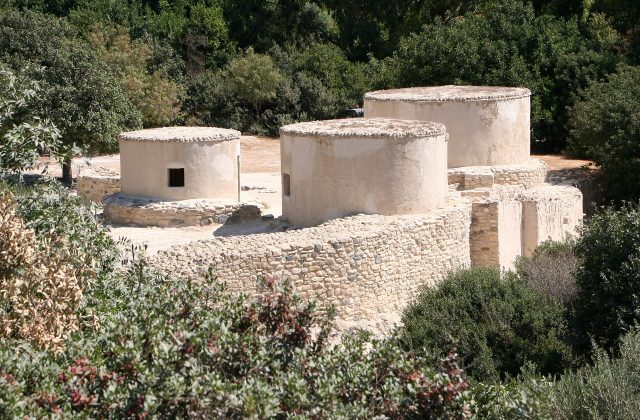
Choirokoitia (Khirokitia)
30 km away
Choirokoitia is a Neolithic village on a hillside above the Maroni river in southern Cyprus, founded around 7000 BC and…
2 tickets & tours
Ancient City · Near Eastern · Cyprus
Ancient Kition is the buried city-kingdom under modern Larnaca, settled in the Late Bronze Age and later ruled by Phoenician kings until 312 BC. Its main open site, Kathari, shows cyclopean walls of the 13th century BC and the foundations of five temples, one with ships scratched into its stones over 3,000 years ago.

Photo: JERRYE AND ROY KLOTZ MD, CC BY-SA 3.0
No tour is sold online for Kition alone, and the visit is simple: the Kathari site, also called Area II, has a small ticket office run by the Department of Antiquities, and the low fee is paid at the gate. A raised walkway lets you look down over the temples and walls without stepping on them.
The second excavated area, Bamboula, lies just behind the Larnaca District Archaeological Museum, where the ancient acropolis and harbour stood. It can be seen from the street and the paths around it, but much less survives there. The museum itself charges its own small fee and holds finds from both areas, including sculptures, pottery and Phoenician inscriptions.
Most visitors combine Kition with a walk through Larnaca, past the Church of Saint Lazarus and along the seafront promenade. Island tours from Limassol, Nicosia or Ayia Napa that cover Larnaca usually stop at Saint Lazarus and the salt lake rather than Kition, so if you want the ruins you will probably go independently. Private guides in Larnaca can include the site in a walking tour.
The sensible plan is to visit the museum first, then walk 15 minutes north to Kathari and pay at the gate.
From the entrance, the walkway runs alongside the city wall of the 13th century BC, built of huge stone blocks after an earlier mudbrick wall was replaced. Look at the scale of the lower courses, still standing to more than a metre in places. This wall belongs to the Late Bronze Age town built by settlers exploiting local copper.
Next comes the largest temple, built of large dressed blocks, measuring about 35 by 22 metres. On the south wall of Temple 1, look for faint outlines of ships carved into the stone in the Late Bronze Age. They are among the oldest images of seafaring in Cyprus and show how central the sea was to the city.
Live prices from GetYourGuide for tickets and tours that include this site. Free cancellation on most of them.
Above the Bronze Age foundations, the Phoenicians who arrived in the 9th century BC rebuilt the largest temple for their goddess Astarte. Rows of column bases mark the hall of their sanctuary. The overlap of the two building phases is visible from the walkway, so look for walls of different construction lying on top of one another.
Close to the temples were workshops where copper was smelted and worked, under the direct control of the sanctuary. Furnaces and slag were found here. Copper was the source of Cyprus's wealth in antiquity, and this link between temple and industry is one of the most interesting features of the site.
Walk about 500 metres south to the Bamboula hill behind the archaeological museum. Here stood the acropolis with a sanctuary of Heracles-Melqart, the city god, and the Phoenician harbour, where sheds for warships were found. Finish inside the museum, where the statues and inscriptions found at both sites are displayed.
Mycenaean Greeks settled Kition in the Late Bronze Age to work local copper. The town was destroyed around 1200 BC and soon rebuilt with a cyclopean wall and new temples. From the 10th century BC Phoenicians from Tyre settled here, and after about 850 BC they rebuilt the sanctuaries. Kition became one of the leading kingdoms of Cyprus, under Egyptian and then Persian overlordship. In 312 BC Ptolemy I killed its last king, Poumyathon, and burned the temples. Earthquakes in the 4th century AD destroyed the Roman town. Swedish archaeologists dug at Bamboula in 1929 and 1930, and Vassos Karageorghis excavated Kathari from 1959 to 1981.
Kition lies within the modern town of Larnaca, on the south-east coast of Cyprus. Larnaca International Airport is only about 5 km south of the centre: buses run to the town in about 20 minutes, and taxis take around 10 minutes. From the seafront promenade, the Kathari site is a walk of about 15 minutes north through the streets of the old town. Bamboula is just behind the Larnaca District Archaeological Museum, about 500 metres to the south. Intercity buses link Larnaca with Nicosia, Limassol and Ayia Napa, arriving near the seafront. By car, there is street parking nearby, but spaces in the centre fill quickly.
Stay on the raised walkway and do not climb down onto the walls or temple foundations. Drones need permission from the Department of Antiquities. There is little shade, so bring a hat and water in summer. Take care on the steps of the walkway, and keep children from leaning over the rails. Facilities at the site are basic, but cafes and restaurants are a short walk away in the centre of Larnaca.
Kition is rarely crowded, and even in high summer you may have the site almost to yourself. Heat is the main concern: Larnaca is very hot from June to September, with afternoon temperatures often above 32 degrees, and there is little shade over the ruins. Go at opening, or in the last hour before closing when the light is softer.
March to May and October to November are the best months, warm but comfortable for walking around the town. Winter is mild and green, though opening hours are shorter and occasional rain can be heavy. Larnaca hosts the Kataklysmos festival at Pentecost, when the seafront is busy but the site stays quiet. Allow 45 minutes to an hour at Kathari, and another hour for the museum and the Bamboula area, or half a day if you add the town.
The Larnaca District Archaeological Museum is a short walk south, and the 9th-century Church of Saint Lazarus is 15 minutes away near the seafront. The Hala Sultan Tekke mosque by the salt lake, with a Bronze Age town nearby, is 10 minutes by car. Choirokoitia, a Neolithic village, is about 30 minutes west.
30 km away
Choirokoitia is a Neolithic village on a hillside above the Maroni river in southern Cyprus, founded around 7000 BC and…
2 tickets & tours
38 km away
Salamis, on the east coast of Cyprus 6 km north of Famagusta, was the island's leading city-kingdom for more than…
12 tickets & tours
74 km away
Kourion is an ancient Greek and Roman city on a cliff 100 metres above the sea near Limassol, on the south coast of…
9 tickets & tours
| Hours | Daytime opening, usually morning to afternoon, later in summer; check winter hours |
|---|---|
| Closed | Usually closed on some public holidays such as 1 Jan, Easter Sunday and 25 Dec |
| Entry fee | A small fee at the gate |
| Time needed | 45 minutes to an hour |
| Best time | At opening or late in the day; March to May and October to November |
| Booking | Pay at the gate; no booking needed |
| Access | Raised walkways over the ruins, some steps; little shade; limited access for wheelchairs |
| Getting there | Kathari site is a 15-minute walk north of the Larnaca seafront; Bamboula is by the museum |
| Founded | 1250 BC (13th century BC (midpoint), Late Bronze Age town) |
| Excavated | 1929 |
| Civilisation | Near Eastern |
| Checked | October 2026 |
Daytime opening, usually morning to afternoon, later in summer; check winter hours. Closed: Usually closed on some public holidays such as 1 Jan, Easter Sunday and 25 Dec.
Entry fee: A small fee at the gate.
Allow 45 minutes to an hour for Ancient Kition.
Pay at the gate; no booking needed.
Yes. GetYourGuide sells tickets and guided tours whose route includes Ancient Kition; live prices are shown on this page.
At opening or late in the day; March to May and October to November.
Kathari site is a 15-minute walk north of the Larnaca seafront; Bamboula is by the museum.
Raised walkways over the ruins, some steps; little shade; limited access for wheelchairs.
Worth it for anyone interested in Bronze Age and Phoenician Cyprus, with temple foundations and ship graffiti in central Larnaca. Skip or shorten it if you want standing monuments, since the remains are low walls best understood after the Larnaca museum.
Ancient Kition dates from 1250 BC (13th century BC (midpoint), Late Bronze Age town). Excavations began in 1929.
Larnaca, Cyprus
Choirokoitia is a Neolithic village on a hillside above the Maroni river in southern Cyprus, founded around 7000 BC and…
2 tickets & tours

