Ancient City · Greek · Cyprus
Salamis
Salamis, on the east coast of Cyprus 6 km north of Famagusta, was the island's leading city-kingdom for more than a thousand years. Its excavated Roman gymnasium, baths with mosaics and a restored theatre stand among pine woods by the sea, with royal tombs of the 8th century BC just inland.
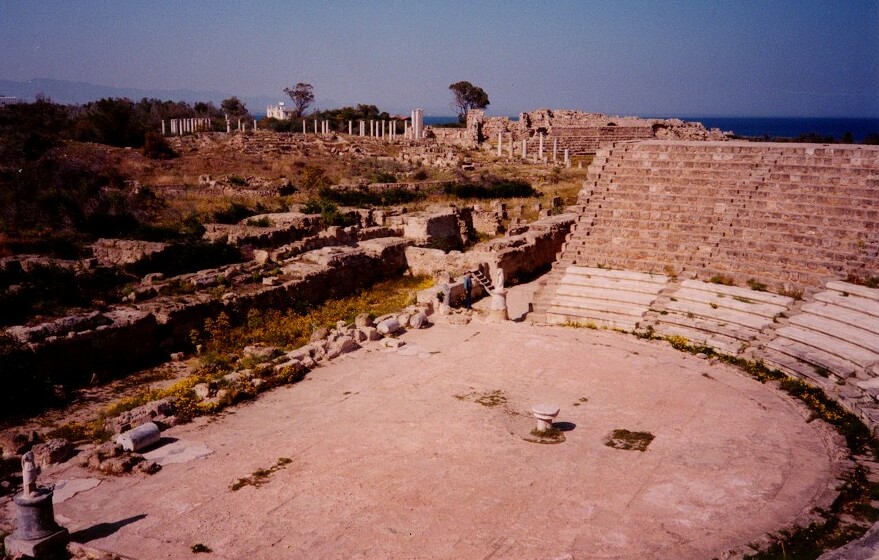
Photo: No machine-readable author provided. Gustavobw assumed (base, CC BY-SA 3.0
Salamis tickets: which one for you
Our pick for each kind of visit, with live dates and prices from GetYourGuide. Free cancellation on most.
Best for: First visit, from Ayia Napa
Transport across the checkpoint and a guide for Salamis and old Famagusta in one day, so you do not have to arrange car insurance or drive in the north.
- Based in Paphos: From paphos famagusta salamis varosha ghost town A long but organised day from the west of the island, adding the fenced ghost town of Varosha to the ruins.
- A private guide in Famagusta: Famagusta and salamis or ghosttown with a private guide A local guide who meets you on the spot and adjusts the visit, a good option if you are already staying in the north or crossing on your own.
Tickets and tours: all the options
Salamis lies in the north of Cyprus, run by the Turkish Cypriot administration, so the ticket is bought at the gate and priced in Turkish lira; card payment is not always possible. The main ticket covers the gymnasium, baths, theatre and the area of the forum. The royal tombs and their small museum, a few minutes inland by car, have their own ticket, and so does the Monastery of Saint Barnabas nearby.
There is no tour for Salamis alone. Day trips from Larnaca, Ayia Napa, Protaras, Limassol and Paphos cross the Green Line and combine the ruins with the old walled city of Famagusta and its Venetian fortifications, and often the abandoned resort of Varosha. Group tours use a coach or minibus with a guide; some are in Italian, Polish and other languages. Private tours with a car and guide are also sold. Lunch is usually included or offered at a set price, while entry fees are often extra; bring your passport, as it is checked at the crossing.
The sensible choice for most visitors in the south is a guided day trip covering Salamis and Famagusta. If you are staying in the north or renting a car there, a visit on your own takes half a day.
What to see at Salamis
Gymnasium and palaestra
From the car park, walk straight to the gymnasium, the most impressive part of the site. A large courtyard is surrounded by re-erected marble columns, and around the pool at its eastern side stand headless statues of gods and athletes. Look for the inscriptions on the column bases and the latrines in one corner, with seating for dozens of people.
Roman baths
Next to the gymnasium, the bath complex keeps high brick walls, heated rooms with tile pillars and a large sweating hall. In one of the side niches fragments of wall mosaic survive, showing figures from myth in blue and gold tesserae, and painted plaster can be seen in places. The scale of the rooms shows the wealth of the Roman city.
12 tickets and tours for Salamis
Live dates and prices from GetYourGuide. Free cancellation on most tickets.
Theatre
A short walk south brings you to the theatre, built in the reign of Augustus and once seating about 15,000 people. The lower rows have been restored with new stone, and the orchestra and the base of the stage building are clear. Climb to the top rows for a view over the woods and the sea, and towards the old city of Famagusta.
Kampanopetra Basilica
Follow the paths east towards the shore to reach the remains of a large early Christian basilica of the 4th century, with a marble floor laid in geometric patterns. Nearby, the walls of later houses and the city's sea-front show how Salamis, renamed Constantia, survived as a Christian city until the Arab raids of the 7th century.
Forum and Temple of Zeus
Further south, the great stone agora, one of the largest of the Roman world, stretches between columns towards a raised platform at its southern end where the Temple of Zeus stood. Little is upright now, but walking its length gives a sense of the city's size. A large water cistern near its northern end once supplied the town.
A short history
Salamis grew from the 11th century BC near the earlier harbour town of Enkomi, and legend credited its founding to Teucer, a hero of the Trojan War. Its kings paid tribute to Assyria, and their tombs, with sacrificed horses and chariots, recall rites described by Homer. Under Evagoras I, around 400 BC, it led the Greek cities of Cyprus. It became Roman, was rebuilt after earthquakes in the 4th century AD as Constantia, and was abandoned after Arab raids in the 7th century, when people moved to Famagusta. British excavators worked here in the 1880s and the Cyprus Department of Antiquities from 1952 until 1974, when work stopped.
Getting there
Salamis is about 6 km north of Famagusta, on the coast road to Bogaz, with a signposted turning and a car park by the ticket office. From Famagusta a taxi takes about 10 minutes. From the south, most visitors cross the Green Line at the Deryneia or Agios Nikolaos checkpoints near Ayia Napa, about 30 minutes away, or come from Nicosia in about an hour. Hire cars from the south need separate insurance for the north, bought at the crossing. Passports or identity cards are checked at every crossing. The nearest airports are Larnaca, about 1 hour away, and Ercan in the north. The royal tombs lie about 2 km inland.
Rules and what to bring
Do not climb on the columns or statues, and stay off the mosaic floors and the edges of the baths. Drones are not allowed. Much of the site is open to the sun, though pine woods give some shade towards the shore, so bring water, a hat and sunscreen. A small cafe and toilets are near the entrance, and the beach next to the site has restaurants. Carry cash, as cards are not always accepted at the gate.
When to go
Spring and autumn are the best seasons: from March to May the site is green and covered in wild flowers, and in October and November the sea is still warm enough to swim afterwards. From June to September temperatures in the afternoon often pass 35 degrees, so come early or after about 4 pm. Winter is mild, with some rain, and the site is very quiet.
Day tours from the south usually reach Salamis in mid-morning before going on to Famagusta, so the gymnasium is busiest between 10 am and noon. Even then the site rarely feels crowded, because it is large and spread out. Weekends and Turkish holidays bring more local families, especially to the beach. Crossing the checkpoints can add delays at busy times. Allow two to three hours for the main ruins, plus an hour for the royal tombs and the Monastery of Saint Barnabas.
Combine it with
The Monastery of Saint Barnabas, with its icon collection and archaeology museum, is about 3 km inland, near the royal tombs. The walled city of Famagusta, with its Venetian walls, Othello's Tower and a Gothic cathedral turned mosque, is 10 minutes away, and the Bronze Age site of Enkomi is a short drive south-west.
At a glance
| Hours | Daytime hours, to about 5 pm in winter and later in summer; check locally |
|---|---|
| Closed | Open daily |
| Entry fee | Small fee at the gate in Turkish lira; royal tombs extra |
| Time needed | 2 to 3 hours |
| Best time | Morning or late afternoon; March to May and October to November |
| Booking | Pay at the gate; book day tours from the south a few days ahead |
| Access | Sandy paths and uneven stone across a wide site; shade from pines in parts; limited wheelchair access |
| Getting there | Taxi or car from Famagusta, about 10 minutes; from Larnaca about 1 hour |
| Founded | 1050 BC (11th century BC (midpoint)) |
| Abandoned | AD 650 |
| Civilisation | Greek |
| Checked | October 2026 |
Frequently asked questions
When is Salamis open?
Daytime hours, to about 5 pm in winter and later in summer; check locally. Open daily.
How much is the entry fee for Salamis?
Entry fee: Small fee at the gate in Turkish lira; royal tombs extra.
How long do you need at Salamis?
Allow 2 to 3 hours for Salamis.
Do I need to book Salamis in advance?
Pay at the gate; book day tours from the south a few days ahead.
Can I book a ticket or tour for Salamis online?
Yes. GetYourGuide lists 12 tickets and tours for Salamis, with live dates and prices and free cancellation on most of them.
When is the best time to visit Salamis?
Morning or late afternoon; March to May and October to November.
How do I get to Salamis?
Taxi or car from Famagusta, about 10 minutes; from Larnaca about 1 hour.
Is Salamis accessible, and what is the terrain like?
Sandy paths and uneven stone across a wide site; shade from pines in parts; limited wheelchair access.
Is Salamis worth visiting?
Worth it for a large Greek and Roman city by the sea, with statues, mosaics and few crowds. Skip or shorten it if crossing the Green Line from the south feels like too much effort for a half-day visit.
How old is Salamis?
Salamis dates from 1050 BC (11th century BC (midpoint)). It was abandoned in AD 650.