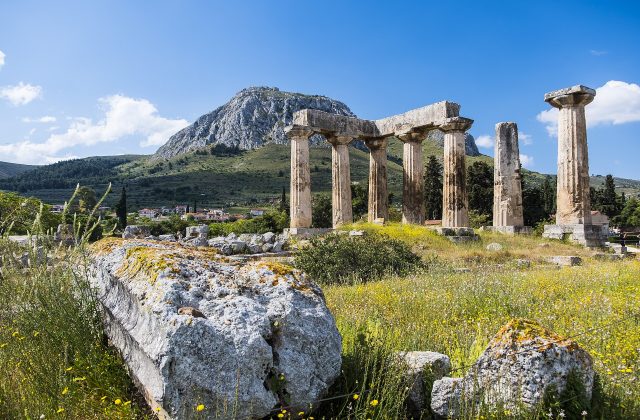
Ancient Corinth
14 km away
Ancient Corinth is the excavated centre of one of the richest cities of ancient Greece, sacked by Rome in 146 BC and…
39 tickets & tours
Ancient City · Greek · Greece
The Heraion of Perachora is a sanctuary of Hera set around a small cove at the tip of the Perachora peninsula, about 14 km north-west of Corinth across the gulf. Used from perhaps the 9th century BC until 146 BC, it keeps the foundations of a rare three-aisled temple, an altar, an early two-storey stoa and cisterns beside clear water for swimming.
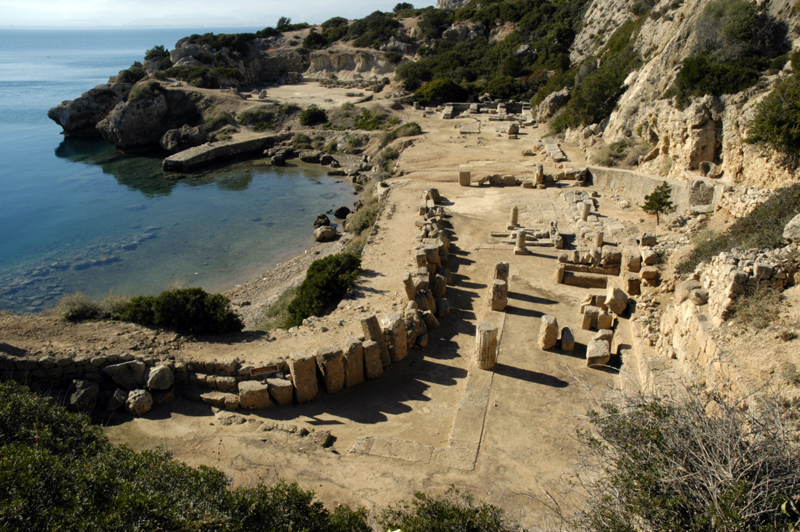
Photo: Nefasdicere at English Wikipedia, CC BY 2.5
There is nothing sold online for the Heraion alone, and no tour visits it on a fixed schedule. The site has no large ticket office, and entry has generally been free or very cheap; if a guard is present, any fee is paid on arrival.
Almost everyone comes by car, often combining the visit with a swim in the cove below the sanctuary and lunch at the fish tavernas on Lake Vouliagmeni, which you pass on the way. Local taxis from Loutraki can take you there and wait, which is the only option without a car, since buses go no further than Perachora village.
Day trips from Athens to the Corinth area usually focus on the Corinth Canal, Ancient Corinth and Acrocorinth, and do not include Perachora. A private driver or guide hired in Athens or Loutraki can add the Heraion to a day that also covers the canal, with transport and commentary, but entry fees at other sites are extra.
The sensible plan is to rent a car, drive out in the morning, walk the sanctuary on your own using the information boards, and finish with a swim in the cove or at the lake.
From the parking area, walk down to the cove, where the foundations of the 6th-century BC Doric temple lie near the water. Its interior was unusually divided into three aisles. Look for the circular scorch marks where a limekiln later burned the temple marble into lime for the Isthmus wall of the 5th century AD.
About 15 metres east of the temple stand the remains of the altar of the early 4th century BC, decorated with a frieze of triglyphs and metopes. Ionic columns were added at its corners later, perhaps to hold a canopy. From here the sanctuary climbs gently along the ridge towards the east.
Live prices from GetYourGuide for tickets and tours that include this site. Free cancellation on most of them.
Immediately east of the altar are the foundations of a two-storey stoa of the late 4th century BC, shaped like an L. Its lower floor used Doric columns and the upper floor Ionic ones, the earliest known example of this combination. It offered shade and shelter to pilgrims who came by sea from Corinth.
Further east lies a large cistern about 21 metres long with rounded ends, its roof once supported on stone piers. A settling tank and channels brought water here from the hills. Immediately south of it are the dining rooms where worshippers shared meals after sacrifices, with cuttings for the legs of couches.
Return west past the temple to the polygonal court cut into the rock beside the cove, perhaps an agora of the 6th century BC. Then climb the path to the lighthouse on the cape for a view of the Corinthian Gulf, the sanctuary below and the mountains of the Peloponnese.
Cult activity at the cove began perhaps in the 9th century BC, when an apsidal house-temple stood near the water. In the 6th century BC a Doric temple of Hera Akraia replaced it, and in the 4th century BC an altar, a two-storey stoa, cisterns and dining rooms were added. The sanctuary was probably controlled by Corinth, across the gulf, and legends link it with Medea and the tyrant Periander. Worship ended when Mummius sacked Corinth in 146 BC, and in Roman times houses were built over parts of it. The British archaeologist Humfry Payne excavated the site in the early 1930s, recovering many votive offerings.
The Heraion is at the western tip of the Perachora peninsula, about 20 km by road from Loutraki and roughly 90 minutes from Athens by car. From Athens, take the motorway towards Corinth, cross the canal and turn off to Loutraki, then follow the signs through Perachora village to Lake Vouliagmeni. The road continues along the lake to a small car park above the sanctuary. Buses from Athens and Corinth reach Loutraki, and local buses run to Perachora village, but not beyond, so you need a taxi for the last stretch. Athens airport is about 1 hour 45 minutes by car.
Do not climb on the temple foundations or move stones. The paths are rocky and steep in places, so wear proper shoes rather than sandals. There is no shade and no shop at the site: bring water, a hat and sunscreen. Swimming in the cove is popular, but the rocks are sharp and sea urchins are common, so water shoes help. Drones are not allowed without permission.
The Heraion is quiet most of the year, but on summer weekends and Greek public holidays families from Athens and Loutraki come to swim in the cove, and the small car park fills by late morning. Weekdays are calmer. In the morning the light on the water is clear and the air is cooler for walking; late afternoon is also good, with sunset over the gulf from the lighthouse.
April to June is ideal, with flowers on the slopes and comfortable temperatures. July and August are hot, often above 33 degrees, and the bare rock reflects the heat, so visit early and then swim. September and October are warm enough for swimming and much quieter. Winter is mild but windy, and the site may close earlier. Allow one to two hours for the ruins, more with a swim.
Lake Vouliagmeni, a lagoon with fish tavernas, is passed on the way. Loutraki, the spa town, is 25 minutes back by car, and the Corinth Canal is 10 minutes beyond it. Ancient Corinth, with its temple of Apollo and museum, and the fortress of Acrocorinth are about 40 minutes by road.
14 km away
Ancient Corinth is the excavated centre of one of the richest cities of ancient Greece, sacked by Rome in 146 BC and…
39 tickets & tours
27 km away
The Ancient Stadium of Nemea is the race track where the Nemean Games, one of the four great athletic festivals of…
3 tickets & tours
34 km away
Mycenae is the hilltop citadel of the Bronze Age kings who dominated Greece around 1350 BC and gave their name to…
57 tickets & tours
| Hours | Daytime access; times vary by season, so check locally before driving out |
|---|---|
| Closed | Check locally; may close on major public holidays |
| Entry fee | Free or a small fee, depending on the season |
| Time needed | 1 to 2 hours, more with a swim |
| Best time | Morning or late afternoon; April to June and September to October |
| Booking | No booking needed |
| Access | Rocky paths and steps down to the cove; no shade; uneven ground; not wheelchair accessible |
| Getting there | About 20 km by road west of Loutraki via Perachora and Lake Vouliagmeni; car or taxi needed |
| Founded | 850 BC (9th century BC (midpoint)) |
| Abandoned | 146 BC |
| Excavated | 1930 |
| Civilisation | Greek |
| Checked | October 2026 |
Daytime access; times vary by season, so check locally before driving out. Closed: Check locally; may close on major public holidays.
Entry fee: Free or a small fee, depending on the season.
Allow 1 to 2 hours, more with a swim for Heraion of Perachora.
No booking needed.
Yes. GetYourGuide sells tickets and guided tours whose route includes Heraion of Perachora; live prices are shown on this page.
Morning or late afternoon; April to June and September to October.
About 20 km by road west of Loutraki via Perachora and Lake Vouliagmeni; car or taxi needed.
Rocky paths and steps down to the cove; no shade; uneven ground; not wheelchair accessible.
Worth it for a quiet sanctuary on a rocky cape where you can see early Greek temple foundations and swim in the cove afterwards. Skip or shorten it if you need impressive standing ruins or easy public transport, as the remains are low and the site is remote.
Heraion of Perachora dates from 850 BC (9th century BC (midpoint)). It was abandoned in 146 BC. Excavations began in 1930.

