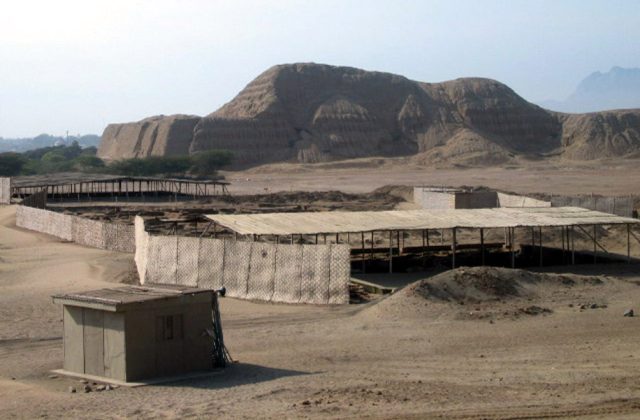
Huaca del Dragon (Huaca Arco Iris)
Trujillo, Peru
Huaca del Dragon, also called Huaca Arco Iris, is an adobe temple platform on the north side of Trujillo, built before…
No online ticket
Ancient City · Andean · Peru
Chan Chan was the capital of the Chimu kingdom on the desert coast of northern Peru, and it is the largest city built of mud brick in the Americas. Its ruins spread over about 20 square kilometres just west of Trujillo. One restored royal compound shows high adobe walls carved with fish, birds and waves, and has been a UNESCO site since 1986.
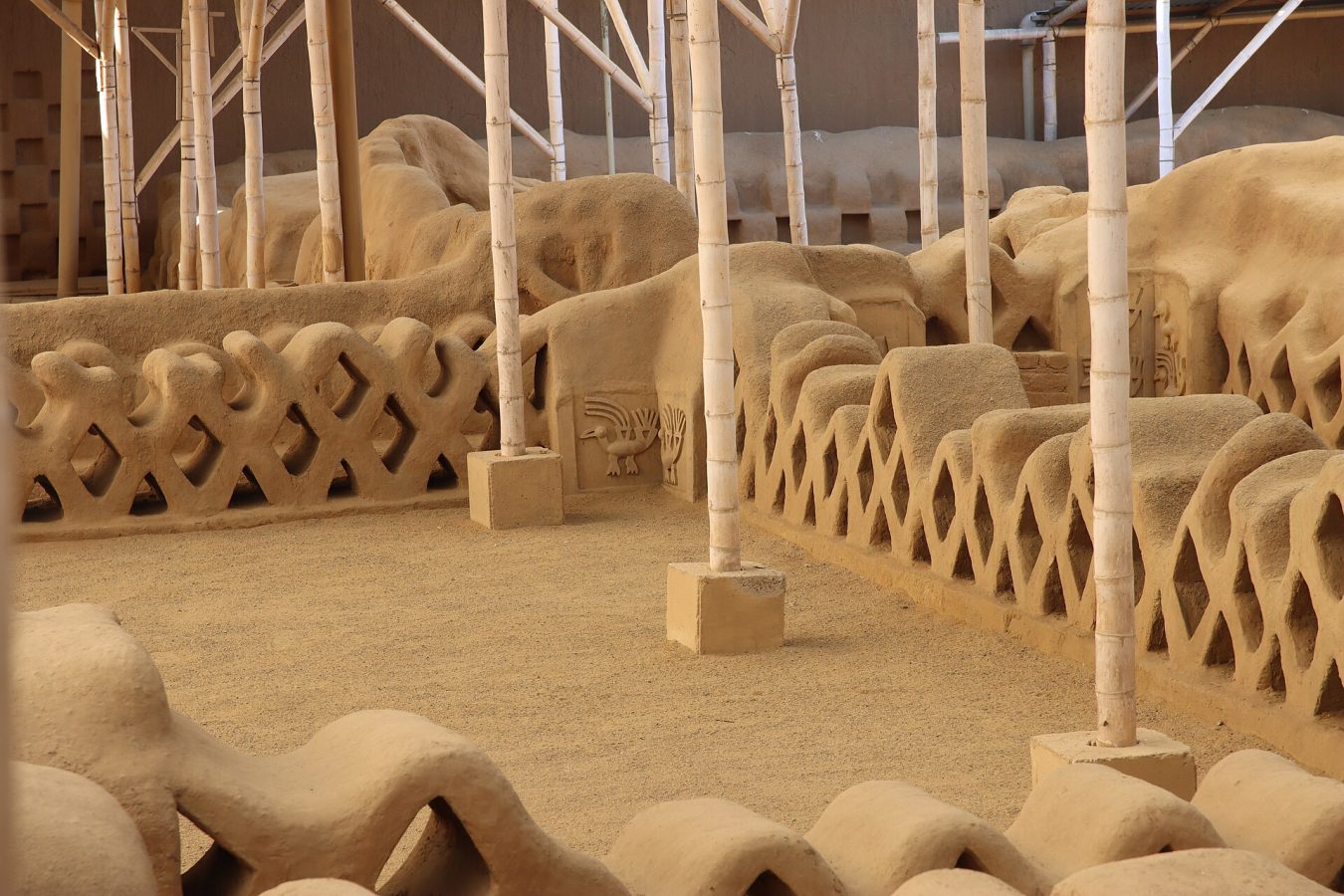
Photo: Draceane, CC BY-SA 4.0
Our pick for each kind of visit, with live dates and prices from GetYourGuide. Free cancellation on most.
Best for: First visit, the Trujillo classics
Covers Chan Chan, the Moche temple of Huaca de la Luna and Huanchaco beach in one guided day with transport, the efficient way to see the region's highlights.
Visitors buy a single ticket at the Tschudi complex or at the site museum. It covers the restored Tschudi palace, the site museum on the main road, and two smaller Chimu temples, Huaca Esmeralda and Huaca Arco Iris, which lie closer to Trujillo. The ticket is valid for the same day or two, so you can split the visits. Licensed local guides wait at the entrance of the palace and are inexpensive; they are worth hiring because signs are limited.
Most tours sold online start in Trujillo or Huanchaco. The half-day version covers Chan Chan and the beach at Huanchaco, sometimes with the museum or Huaca Arco Iris. Full-day tours add the Moche temples of Huaca del Sol and Huaca de la Luna south of the city, which are a different and older culture. Some tours end with lunch, a ceviche tasting or a display of Peruvian paso horses, and others include a horse ride. Cruise ships dock at Salaverry, and shore excursions run from there. Transport and guide are normally included; entry tickets and lunch vary.
If you are based in Huanchaco, a taxi and a guide at the gate are enough. If you have one day in Trujillo, the full-day tour with both cultures is the best use of time.
Start at the site museum on the main road from Trujillo, where models and finds explain the layout of the city and the Chimu way of life. It helps to see the size of the whole site before visiting a single compound. Look for the plans of the ten walled enclosures and the textiles and ceramics recovered during excavation.
A short drive towards the sea brings you to the Tschudi compound, one of the royal enclosures, with walls up to about 10 metres high. Inside, the great ceremonial plaza is lined with walls decorated in a lattice pattern of fish and pelicans. The ramp at the end once led to the platform where rulers appeared before the assembled crowd.
Live dates and prices from GetYourGuide. Free cancellation on most tickets.
From the plaza, walkways lead through narrow corridors to a maze of courtyards and small U-shaped rooms, thought to be offices controlling stored goods. The walls here carry the finest carved friezes: waves, nets, sea otters and birds, repeated in long bands. Some sections are original and others restored, and the guides point out the difference.
At the far side of the compound lies a large walk-in reservoir, fed by groundwater and now green with reeds, which shows how the city supplied water in the desert. Near it rises the royal burial platform, where the ruler was buried with offerings and with young women sacrificed for the funeral. The platform was looted long ago, but its cells are still visible.
On the same ticket, drive towards Trujillo to Huaca Arco Iris, also called Huaca del Dragon, a small stepped temple enclosed by a thick wall. Its adobe walls are covered with restored reliefs of a double-headed serpent or rainbow arching over figures. It is compact, quiet and best combined with Huaca Esmeralda, a little nearer the centre.
The Chimu built Chan Chan at the mouth of the Moche Valley from around AD 850 to 900, and it became the capital of a coastal state that eventually stretched along about 1,000 km of the Peruvian shore. Each ruler seems to have built a new walled compound, used as palace, storehouse and tomb, while craftsmen lived in crowded quarters outside. Around 1470 the Inca conquered the kingdom and took its artisans to Cusco. Spanish treasure hunters later stripped the burial platforms. The Tschudi compound is named after a 19th-century Swiss naturalist. UNESCO listed the city in 1986 and placed it on its list of sites in danger, because rain and wind erode the adobe.
Chan Chan lies between Trujillo and the beach town of Huanchaco. Combis and buses on the Trujillo to Huanchaco road pass the turn-off to the Tschudi compound; ask the driver to stop and walk about 15 to 20 minutes along a dirt track, which is exposed and best done in a group. A taxi from the centre of Trujillo or from Huanchaco takes 10 to 15 minutes and can wait while you visit, which is safer and quicker. Trujillo airport is close to Huanchaco, about 10 minutes from the site, with daily flights from Lima. Long-distance buses from Lima take around nine hours. Cruise ships dock at Salaverry, about 30 minutes south.
Stay on the walkways and do not touch or lean on the adobe walls, which crumble easily. Drones need permission from the Ministry of Culture. Bring a hat, sun cream and water: there is no shade, and the sun and dry wind are strong even when the sky is grey. The access tracks from the main road have a reputation for petty theft, so walk them in daylight, ideally not alone. Toilets are at the entrance.
The site opens at 9 am, and the first hours are the best: the air is cooler, the wind is lighter and the friezes show their relief well in the low sun. Tour groups from Trujillo arrive mid-morning, but even then the Tschudi compound rarely feels crowded. By early afternoon the heat reflected off the sandy courtyards is tiring, so keep the museum and Huaca Arco Iris for later.
The climate is dry all year. From May to November the sky is often overcast and mild, while December to April is sunny and hot. Every few years El Nino brings heavy rain, which damages the walls and can close parts of the site. Weekends and Peruvian holidays bring more local visitors. Allow about two hours for the museum and the Tschudi compound, and half a day if you add Huaca Arco Iris and Huaca Esmeralda.
Huanchaco, with its reed boats and seafood restaurants, is 10 minutes away and the natural place for lunch. The Moche temples of Huaca del Sol and Huaca de la Luna, with painted friezes, are 30 minutes south of Trujillo. The colonial centre of Trujillo, with its colourful mansions around the Plaza de Armas, fills an evening.
| Hours | 9 am to 4 pm |
|---|---|
| Closed | Site museum closed on Mondays; check the palace locally |
| Entry fee | from PEN 10; one ticket covers four Chimu sites |
| Time needed | 2 hours; half a day with the huacas |
| Best time | At opening, before midday heat and wind; May to November |
| Booking | Pay at the gate; no need to book ahead |
| Access | Flat sandy paths and wooden walkways; no shade; mostly manageable with a sturdy pushchair |
| Getting there | About 5 km west of Trujillo on the Huanchaco road; 15 minutes by taxi or combi |
| Founded | AD 850 (c. AD 850) |
| Excavated | 1969 |
| Civilisation | Andean |
| Area | 14.1 km² |
| UNESCO | Chan Chan Archaeological Zone |
| Website | chanchan.gob.pe |
| Checked | October 2026 |
9 am to 4 pm. Closed: Site museum closed on Mondays; check the palace locally.
Entry fee: from PEN 10; one ticket covers four Chimu sites.
Allow 2 hours; half a day with the huacas for Chan Chan.
Pay at the gate; no need to book ahead.
Yes. GetYourGuide lists 30 tickets and tours for Chan Chan, with live dates and prices and free cancellation on most of them.
At opening, before midday heat and wind; May to November.
About 5 km west of Trujillo on the Huanchaco road; 15 minutes by taxi or combi.
Flat sandy paths and wooden walkways; no shade; mostly manageable with a sturdy pushchair.
Worth it for the scale and the delicate sea-themed friezes of a desert capital, an easy half day from Trujillo or Huanchaco. Skip or shorten it if you expect stone ruins; only one compound is open and much of the city is eroded mounds.
Chan Chan dates from AD 850 (c. AD 850). Excavations began in 1969.
Yes. Chan Chan is part of the UNESCO World Heritage Site Chan Chan Archaeological Zone.
Trujillo, Peru
Huaca del Dragon, also called Huaca Arco Iris, is an adobe temple platform on the north side of Trujillo, built before…
No online ticket
Trujillo, Peru
The Huaca del Sol, near Trujillo on the north coast of Peru, is the largest adobe pyramid built in the pre-Columbian…
No online ticket