Ancient City · Maya · Honduras
Copan
Copan, in western Honduras near the border with Guatemala, was the capital of a Classic Maya kingdom from the 5th to the 9th century AD. It is known for the finest sculpture in the Maya world: carved stelae, altars and a stairway inscribed with the longest Maya text yet found. The ruins lie beside the small town of Copan Ruinas.
Copan tickets: which one for you
Our pick for each kind of visit, with live dates and prices from GetYourGuide. Free cancellation on most.
Best for: A day trip from Guatemala City
Transport across the border and a guide at the ruins in one long day, for travellers who cannot spare a night in Copan Ruinas.
- A day trip from San Salvador: From san salvador copan ruins guided day tour A guided walk of the plazas and acropolis with transport from El Salvador, handling the border crossing and the long drive so you can focus on the sculpture.
Tickets and tours: all the options
The main ticket, bought at the visitor centre at the entrance, covers the Great Plaza, the ball court, the Hieroglyphic Stairway and the acropolis. Separate tickets are sold for the tunnels dug by archaeologists under the acropolis and for the Sculpture Museum near the entrance, which holds the original stelae and a full-size copy of a painted temple. Fees are in US dollars or Honduran lempiras. Licensed guides wait by the gate and can be shared by a small group; they add a lot, since the carvings carry dates, kings' names and stories.
The tours sold online are long day trips from Guatemala City and San Salvador that include transport, the border crossing and a guided walk at the ruins. They mean ten hours or more on the road for a few hours on site, and entry fees are often extra. Shared shuttles also link Copan Ruinas with Guatemala and the Honduran coast for those travelling on.
The sensible way to see Copan is to stay at least one night in Copan Ruinas, a pleasant cobbled town, and visit the ruins at opening with a guide. Add the Sculpture Museum in the same visit and the residential quarter of Las Sepulturas in the afternoon.
What to see at Copan
Great Plaza and stelae
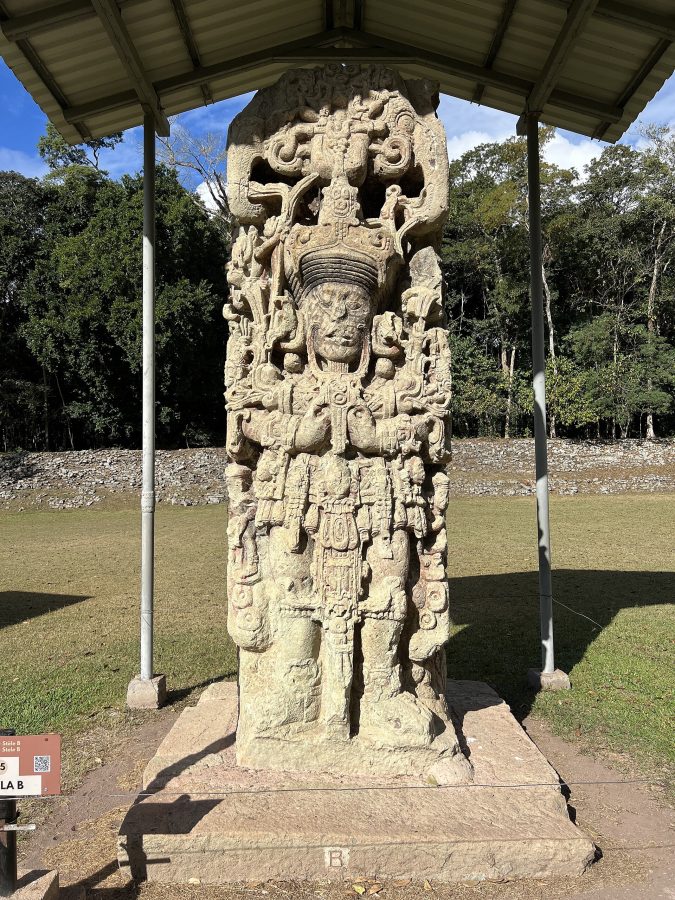
Beyond the entrance path, where scarlet macaws feed in the trees, the Great Plaza is a wide lawn dotted with tall carved stelae. Most show the 13th king, Uaxaclajuun Ub'aah K'awiil, often called 18 Rabbit, in deep relief and elaborate headdresses, with glyphs on the sides and altars at their feet. Walk around each one to see the carving.
Hieroglyphic Stairway
South of the plaza, past the ball court, a broad stairway climbs a temple pyramid. Its risers carry more than two thousand glyphs, the longest Maya inscription known, recording the history of the dynasty. Seated rulers are carved on the centre of the steps. A canopy now shelters it from rain, and climbing it is not allowed.
4 tickets and tours for Copan
Live dates and prices from GetYourGuide. Free cancellation on most tickets.
Ball court
Between the plaza and the stairway lies one of the most elegant ball courts in the Maya world, with sloping sides and carved macaw heads used as markers along the top of each wall. It was rebuilt several times, and the final version was dedicated in the 8th century. Stand at either end to see the full length.
Acropolis and Altar Q
Climb the steps to the acropolis, a raised complex of temples and courts built over earlier ones. In the West Court, Altar Q shows all sixteen kings of the dynasty seated around its sides, from the founder handing power to the last ruler. The one in place is a copy. From the East Court look down over the river.
Sculpture Museum
Back near the entrance, the museum is entered through a mouth-shaped tunnel and holds the original stelae, facade sculpture and a full-size painted copy of Rosalila, a temple found intact inside the acropolis. Seeing the carvings protected from weather, and the bright colours they once had, makes the outdoor ruins far easier to understand.
Las Sepulturas
About 2 km east along the road, Las Sepulturas was the residential quarter of noble families, with low courts and benches carved with glyphs. It is included in the main ticket and usually almost empty. The flat walk or a tuk-tuk ride takes about 20 minutes, and the shady forest makes it a good end to the day.
A short history
The valley was settled for more than two thousand years, but Copan became a major kingdom when K'inich Yax K'uk' Mo', a ruler with links to Tikal, founded a new dynasty in the early 5th century AD. Sixteen kings followed. In 738 the 13th king was captured and killed by his former vassal, the ruler of Quirigua, but building resumed within decades. At its peak the valley held some 20,000 people. Royal monuments ceased in the early 9th century and the city was largely empty by the early 10th. John Lloyd Stephens and Frederick Catherwood made it famous in 1841. UNESCO listed Copan in 1980.
Getting there
The ruins lie about 1.5 km east of Copan Ruinas, a walk of 20 minutes along the main road, or a short tuk-tuk ride. The town is about 12 km from the El Florido border crossing with Guatemala. Tourist shuttles run from Antigua and Guatemala City in about five to six hours. From San Pedro Sula, with Honduras's busiest airport, direct buses take about three hours. Day tours from San Salvador travel through Guatemala and take five hours or more each way. By car, the road from the border is paved and there is a car park at the site entrance. Carry your passport for the border.
Rules and what to bring
Climbing on the stelae, altars and the Hieroglyphic Stairway is forbidden, and some temple stairs are closed. Do not touch the carvings. Drones need a permit. Bring water, insect repellent, a hat and good shoes for the acropolis steps. Large bags may need to be left at the entrance. There are toilets and a small cafe at the visitor centre, and many restaurants in town.
When to go
Copan is never as crowded as Tikal or Chichen Itza, but day tours from Guatemala and El Salvador arrive in late morning. Arriving at the 8 am opening gives cool air, active macaws and the plazas to yourself; the mid-afternoon hours before closing are also quiet. The tunnels can be busier at midday.
The dry season, November to April, is the most comfortable, with sunny days at an altitude of about 600 metres. March and April are the hottest months, and smoke from crop burning can cloud the views. From May to October afternoon rain is common, though mornings are often dry and the valley is green. Easter week brings many Honduran and Guatemalan visitors. Allow three to four hours for the main site and museum, and a full day if you add the tunnels and Las Sepulturas.
Combine it with
Quirigua, across the border in Guatemala, has the tallest Maya stelae and is about three hours away. Near town, a bird park rescues scarlet macaws, and hot springs lie about an hour's drive into the hills. Copan Ruinas has a small archaeological museum on its central square.
At a glance
| Hours | 8 am to 4 pm |
|---|---|
| Closed | Open daily |
| Entry fee | Fee in USD; tunnels and sculpture museum cost extra |
| Time needed | 3 to 4 hours; a full day with tunnels |
| Best time | At 8 am or after 2 pm; November to April for the dry season |
| Booking | Pay at the gate; book guides at the entrance or in town |
| Access | Flat lawns and gravel in the plazas; steep steps on the acropolis; good tree shade in places |
| Getting there | Walk or tuk-tuk from Copan Ruinas town, about 1.5 km along the road |
| Founded | AD 426 (dynasty founded AD 426; occupied earlier) |
| Abandoned | AD 950 |
| Excavated | 1891 |
| Civilisation | Maya |
| Elevation | 600 m above sea level |
| UNESCO | Maya Site of Copan |
| Checked | October 2026 |
Frequently asked questions
When is Copan open?
8 am to 4 pm. Open daily.
How much is the entry fee for Copan?
Entry fee: Fee in USD; tunnels and sculpture museum cost extra.
How long do you need at Copan?
Allow 3 to 4 hours; a full day with tunnels for Copan.
Do I need to book Copan in advance?
Pay at the gate; book guides at the entrance or in town.
Can I book a ticket or tour for Copan online?
Yes. GetYourGuide lists 4 tickets and tours for Copan, with live dates and prices and free cancellation on most of them.
When is the best time to visit Copan?
At 8 am or after 2 pm; November to April for the dry season.
How do I get to Copan?
Walk or tuk-tuk from Copan Ruinas town, about 1.5 km along the road.
Is Copan accessible, and what is the terrain like?
Flat lawns and gravel in the plazas; steep steps on the acropolis; good tree shade in places.
Is Copan worth visiting?
Worth it for the most refined Maya sculpture anywhere and an easy town to stay in, with scarlet macaws over the plaza. Skip or shorten it if you want towering pyramids rising over the jungle, which Tikal or Calakmul show far better.
How old is Copan?
Copan dates from AD 426 (dynasty founded AD 426; occupied earlier). It was abandoned in AD 950. Excavations began in 1891.
Is Copan a UNESCO World Heritage Site?
Yes. Copan is part of the UNESCO World Heritage Site Maya Site of Copan.