Tomb & Necropolis · Asian · South Korea
Daereungwon Tomb Complex
Daereungwon is a walled park in central Gyeongju containing 23 grassy burial mounds of Silla kings, queens and nobles, raised mostly between the 4th and 6th centuries AD. One of them, Cheonmachong, can be entered and shows how the tombs were built. Around a million people a year walk among the mounds, which yielded gold crowns now in the national museum.
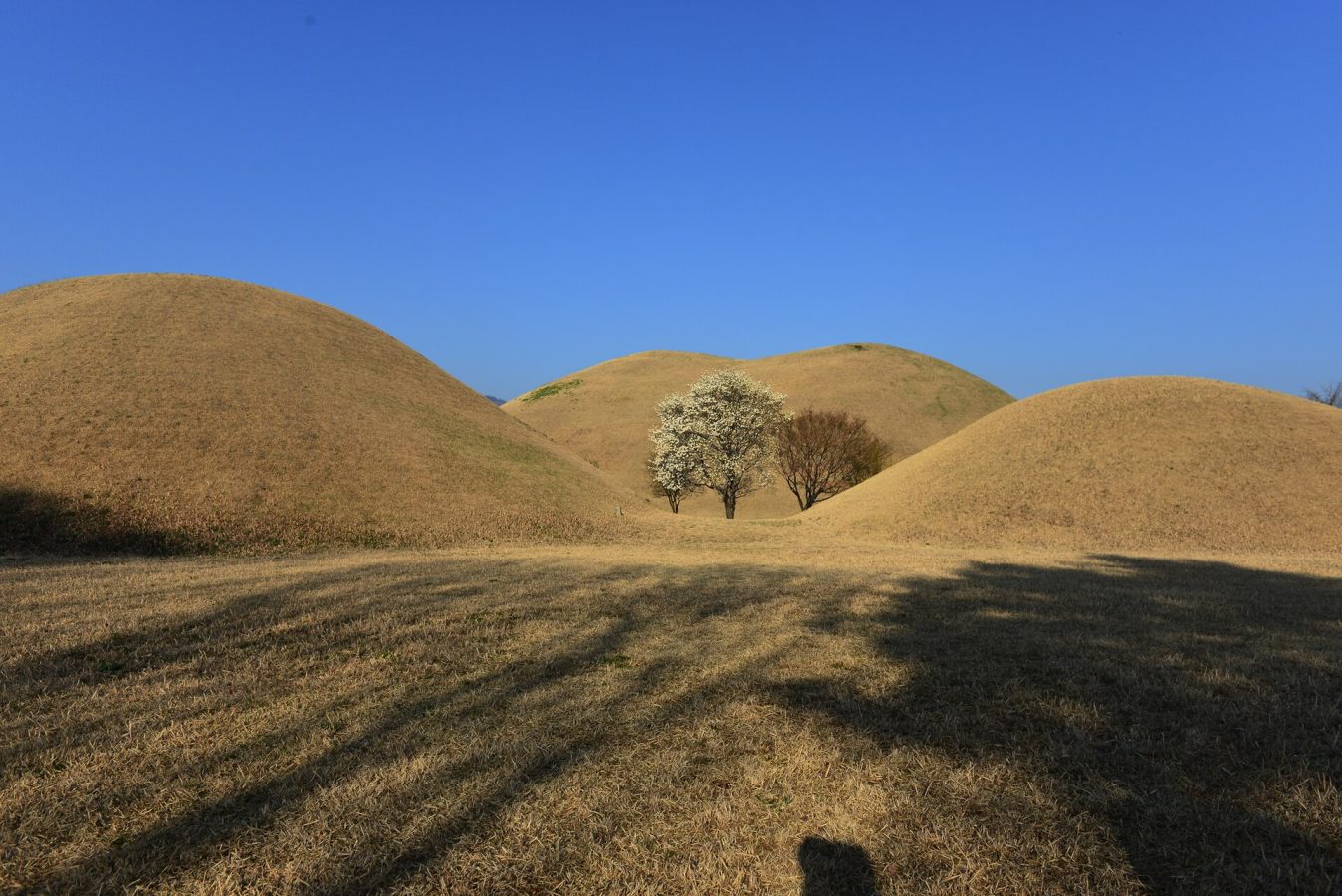
Photo: 손묵광, CC BY-SA 4.0
Tickets and tours: which to book
Nothing for Daereungwon alone is sold online, and entry is simple. The park has a ticket gate on its main side facing the old centre, and admission is either free or a few thousand won depending on current policy; Cheonmachong, the one tomb you can enter, is reached from inside the park. Information panels are in Korean and English, and a free volunteer guide service is sometimes available at the gate.
Most people visit independently while staying in Gyeongju for a night or two, walking from their hotel and combining the mounds with the nearby Cheomseongdae observatory and Wolji pond. Bicycles are widely hired in the centre and suit the flat roads between the historic sites.
The city runs a hop-on style tour bus with guides on some routes, linking Daereungwon with Bulguksa, Seokguram and the national museum, which is useful without a car. Day trips from Busan, about an hour and a half away, are also arranged by agencies and usually include transport, a guide and two or three of the main sites, with lunch extra.
The sensible plan is to stay in Gyeongju itself, visit Daereungwon at dusk on foot, and keep the following morning for Bulguksa.
What to see at Daereungwon Tomb Complex
Cheonmachong, the Heavenly Horse Tomb
From the main gate, follow the path to Cheonmachong, excavated in 1973 and fitted with a viewing hall inside the mound. You walk around a cutaway of the wooden burial chamber with its heap of river stones and earth above, and see replicas of the gold crown and the painting of a flying white horse on a birch-bark saddle flap.
Hwangnamdaechong twin mound
A few minutes further in, Hwangnamdaechong is the largest tomb in the park, two joined mounds more than 20 metres high, built for a king and his queen in the 5th century. Excavated in the 1970s, it yielded tens of thousands of objects, including a gold crown from the queen's mound. The path loops around its full length.
Tickets and tours that include Daereungwon Tomb Complex
Live prices from GetYourGuide for tickets and tours that include this site. Free cancellation on most of them.
Magnolia tree between the mounds
On the west side of the park, a single magnolia tree stands between two mounds and has become the most photographed spot in Gyeongju. In late March and early April, when it blooms, there is a queue for pictures. At other times of year the view across the rounded mounds is still the classic image of the city.
Tomb of King Michu
Near the south-west corner, the walled and gated mound attributed to King Michu, the first Silla ruler of the Kim line in the 3rd century, has a small shrine gate in front. Unlike the other mounds it cannot be approached closely. The tradition linking it to Michu is old, and it was honoured by later Silla kings.
Pond and the north paths
Finish by walking the northern paths past the smaller mounds of nobles and a quiet pond with pines and willows. In the evening, lamps light the mounds from below. Leave by the north-east exit onto Hwangnidan-gil, the street of restored hanok houses with cafés and bakeries selling Gyeongju bread.
A short history
The mounds of Daereungwon were built for the rulers and aristocracy of Silla, the kingdom whose capital was Gyeongju, mostly between the 4th and 6th centuries AD. The dead were laid in wooden chambers, often below ground, which were then covered with river stones and earth. This structure kept looters out, so many tombs survived intact until modern times. Excavation began under Japanese rule, with Geumgwanchong in 1921 and several others in the 1920s, and continued after 1945 with Houchong, Machong and, in 1973, Cheonmachong and Hwangnamdaechong. Gold crowns, belts and glassware from these digs are now national treasures. A pair of gilt-bronze shoes was found in 2020. The park has been a designated Historic Site since 2011.
Getting there
From Seoul, KTX trains reach Singyeongju station in about two hours; from there city buses run to central Gyeongju in about 30 minutes, and taxis take around 20. Express and intercity buses from Seoul, Busan and Daegu arrive at the terminals on the west side of the old centre, a 15-minute walk from Daereungwon. Gimhae airport in Busan is the nearest international airport, with a limousine bus to Gyeongju in about an hour and a half. Drivers can use the public car park beside the park's main gate, which fills on spring weekends. Many visitors simply walk or cycle from guesthouses around Hwangnidan-gil.
Rules and what to bring
Do not climb the mounds or walk on the grass slopes, which are royal tombs and are patrolled. Drones are not permitted over the park. Inside Cheonmachong, photography without flash is usually allowed, but keep to the walkway. Toilets are by the gates, and there are benches throughout. Food is not sold inside, but Hwangnidan-gil, next to the north-east exit, has plenty of cafés and snack stalls.
When to go
Early morning is the calmest time, with mist sometimes lying between the mounds and only joggers and walkers about. From late morning, school groups and coach tours arrive, and the paths around Cheonmachong get busy. Dusk is popular too: when the lamps come on, the mounds glow against the sky and the cafés outside fill up.
The best months are early April, when cherry blossoms line the roads of Gyeongju and the magnolia flowers, and late October to early November, when the trees turn red and gold. Both are peak seasons, and weekends then are crowded. Summer is hot and humid, with the monsoon rains in July, and winter is cold and dry, with very few visitors.
Allow one to one and a half hours, including Cheonmachong, and longer if you stop for photographs at the magnolia tree.
Combine it with
Cheomseongdae, the 7th-century stone observatory, is a ten-minute walk south-east, and Donggung Palace and Wolji Pond, lit at night, are 15 minutes beyond it. The Gyeongju National Museum, which holds the gold crowns, is a short taxi ride away. Bulguksa temple is about 40 minutes by bus.
At a glance
| Hours | From morning into the evening, mounds lit after dark; check current hours for Cheonmachong |
|---|---|
| Closed | Open daily |
| Entry fee | Low fee in KRW or free grounds; check on arrival |
| Time needed | 1 to 1.5 hours |
| Best time | Early morning or dusk; early April for blossom, late October for autumn colour |
| Booking | No booking; pay or walk in at the gate |
| Access | Flat paved and gravel paths; easy for wheelchairs and pushchairs |
| Getting there | A 15-minute walk from Gyeongju bus terminals; buses from Singyeongju KTX station about 30 minutes |
| Civilisation | Asian |
| Visitors | 1 million a year (2023) |
| UNESCO | Gyeongju Historic Areas |
| Checked | October 2026 |
Frequently asked questions
When is Daereungwon Tomb Complex open?
From morning into the evening, mounds lit after dark; check current hours for Cheonmachong. Open daily.
How much is the entry fee for Daereungwon Tomb Complex?
Entry fee: Low fee in KRW or free grounds; check on arrival.
How long do you need at Daereungwon Tomb Complex?
Allow 1 to 1.5 hours for Daereungwon Tomb Complex.
Do I need to book Daereungwon Tomb Complex in advance?
No booking; pay or walk in at the gate.
Can I book a ticket or tour for Daereungwon Tomb Complex online?
Yes. GetYourGuide sells tickets and guided tours whose route includes Daereungwon Tomb Complex; live prices are shown on this page.
When is the best time to visit Daereungwon Tomb Complex?
Early morning or dusk; early April for blossom, late October for autumn colour.
How do I get to Daereungwon Tomb Complex?
A 15-minute walk from Gyeongju bus terminals; buses from Singyeongju KTX station about 30 minutes.
Is Daereungwon Tomb Complex accessible, and what is the terrain like?
Flat paved and gravel paths; easy for wheelchairs and pushchairs.
Is Daereungwon Tomb Complex worth visiting?
Worth it for the strange, calm landscape of royal mounds and the inside view of a Silla tomb in Cheonmachong. Skip or shorten it if you dislike park-like sites: in an hour you will have seen the essentials.
Is Daereungwon Tomb Complex a UNESCO World Heritage Site?
Yes. Daereungwon Tomb Complex is part of the UNESCO World Heritage Site Gyeongju Historic Areas.