Ancient City · Greek · Turkey
Ephesus
Ephesus is the best-preserved Graeco-Roman city on the Aegean coast of Turkey, 3 km from the town of Selcuk. A marble street runs downhill for about 2 km past temples, fountains, the two-storey facade of the Library of Celsus and a theatre for some 24,000 people, and the roofed Terrace Houses keep wall paintings and mosaics of wealthy Roman homes.
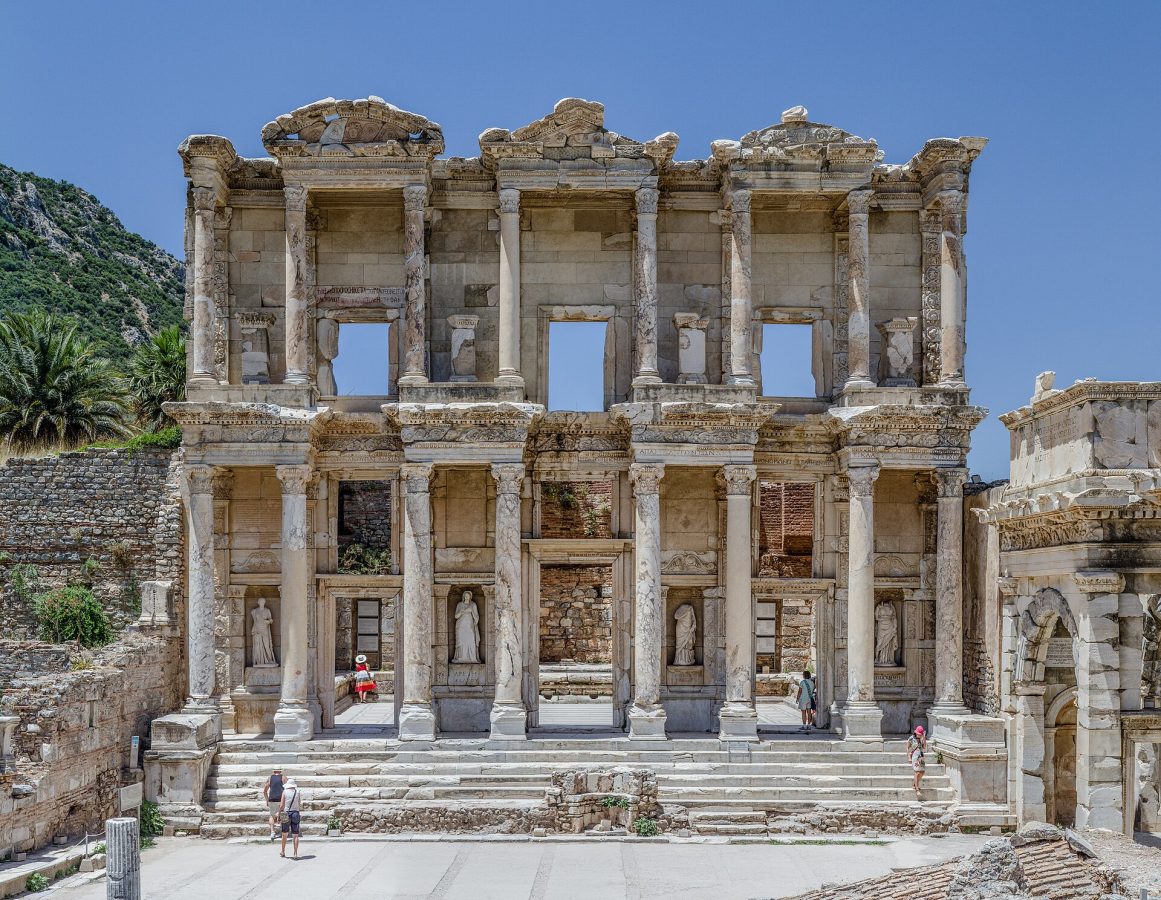
Photo: Benh LIEU SONG, CC BY-SA 3.0
Ephesus tickets: which one for you
Our pick for each kind of visit, with live dates and prices from GetYourGuide. Free cancellation on most.
Best for: Already in Selcuk, two to three hours
A guide who meets you at the gate and walks the city from top to bottom, explaining the inscriptions and buildings that signs on the site barely cover.
- Cruise passengers at Kusadasi: Kusadasi port ephesus and terrace houses skip-the-line Pickup at the port, a guide and pre-arranged entry to the city and the Terrace Houses, with the timing built around your ship's sailing.
- A day trip from Istanbul: Daily ephesus tour from istanbul Return flights to Izmir, a transfer and a guided visit in one booking; a long day, but the only way to see Ephesus without staying on the coast.
Tickets and tours: all the options
The basic ticket covers the ancient city between its upper and lower gates and the new Ephesus Experience Museum. The Terrace Houses, a roofed excavation halfway down the main street, need a separate ticket bought at their own entrance, and the Ephesus Museum in Selcuk is also paid separately. Turkey's Museum Pass for the Aegean region covers the city and the museum and suits people visiting several sites. Audio guides are available at the gates, and licensed guides wait outside them.
Most products on GetYourGuide include transport, because few visitors stay in Selcuk. The commonest is a half-day or full-day guided tour from Kusadasi, often timed for cruise ships, with pickup at the port or hotel; longer versions add the single standing column of the Temple of Artemis, the House of the Virgin Mary on the hill above, lunch and the village of Sirince. Day tours also run from Izmir, Bodrum and Marmaris, and from Istanbul by plane, and some combine Pamukkale over two days. Many tours stop at a leather or carpet shop; check whether the entry fees and the Terrace Houses are included, because together they now cost more than many tours.
The sensible choice for most visitors is a small-group or private guided walk of about three hours starting at the upper gate, with the Terrace Houses included.
What to see at Ephesus
State Agora and Odeon
Start at the upper gate, by the road to Magnesia, and walk downhill. The first area is the civic centre of the Roman city: the long open square of the State Agora, the small marble Odeon where the council met, with its curved rows of seats intact, and the base of the town hall where the sacred flame was kept.
Curetes Street and Terrace Houses
The marble Curetes Street slopes down past honorary statues, the Fountain of Trajan and the delicate arched front of the Temple of Hadrian. On the right, a modern roof covers the Terrace Houses, where wealthy families lived on the hillside; walkways lead past wall paintings, marble panels and mosaic floors still being pieced together by restorers. The public latrines are opposite.
263 tickets and tours for Ephesus
Live dates and prices from GetYourGuide. Free cancellation on most tickets.
Library of Celsus
At the foot of Curetes Street stands the reconstructed two-storey facade of the library, built in the early 2nd century AD by a son of the governor Celsus, whose tomb lies beneath it. Statues of the four virtues fill the niches. The ornate Gate of Mazaeus and Mithridates beside it leads into the large commercial agora.
Marble Street and Great Theatre
Turn right along Marble Street, still marked with deep wheel ruts, to the Great Theatre cut into Mount Pion. It held about 24,000 people, and the Acts of the Apostles describe a riot here against Paul. Climb the upper rows for the best view of the city and of the colonnaded Harbour Street running towards the vanished sea.
Harbour Street and lower gate
The broad Harbour Street, once lit at night and lined with shops, runs west towards the silted harbour; only the first stretch is open. From the theatre continue north past the stadium and the remains of the Church of Mary, where the Council of Ephesus met in 431, to the lower gate and its car park.
A short history
Ionian Greek settlers founded Ephesus in the 10th century BC near an older Anatolian town, and it grew rich around the Temple of Artemis, one of the Seven Wonders, completed around 550 BC. In about 290 BC Lysimachus moved the city to its present valley. Under Rome, from 129 BC, it was capital of the province of Asia and one of the largest cities of the east; Paul lived here and church councils met here in the 5th century. Goths sacked it in 263, earthquakes followed, and the silting harbour slowly left it inland, so the population moved to Ayasuluk hill. Austrian archaeologists have excavated since 1895, and UNESCO listed the site in 2015.
Getting there
Selcuk is the base town, 3 km from the ruins. Trains from Izmir airport and the city centre reach Selcuk in about an hour and a quarter, and minibuses run from Kusadasi, 20 km away, in about 30 minutes. From Selcuk, taxis and occasional minibuses go to the lower gate on the Kusadasi road, or a walk of about 40 minutes along a tree-lined road. The best plan is a taxi to the upper gate, a walk downhill through the city, then a taxi or minibus back from the lower gate; drivers wait at both. Adnan Menderes airport at Izmir is about an hour by car. Both gates have paid car parks, and some taxi drivers offer a return for a fixed price.
Rules and what to bring
Do not climb on the facades or sit on the carved fragments, and keep off roped areas. Drones need a permit. The marble paving is very slippery when worn or wet, so wear shoes with grip. Bring a hat, sunscreen and plenty of water: shade is almost absent, though there are fountains, toilets and cafes near both gates and a toilet halfway down. Large bags are not allowed in the Terrace Houses.
When to go
Ephesus is busiest from about 9.30 am to 2 pm, when coaches and cruise groups from Kusadasi arrive; on days with several ships in port the main street can be shoulder to shoulder at the library. Arriving at opening, or after 4 pm in summer, makes a great difference, and the low sun on the library facade late in the day is the best light for photographs.
April, May, late September and October are the most comfortable months, with spring flowers between the stones in April. In July and August temperatures often pass 35 degrees and the white marble reflects the heat, so keep the walk to the early morning. Winter is quiet and mild, with occasional rain, and closing is earlier. Turkish holidays bring large domestic crowds. Allow two and a half hours for the city and another hour for the Terrace Houses.
Combine it with
In Selcuk, the Ephesus Museum holds the statues of Artemis and finds from the Terrace Houses, and the Basilica of St John and the castle on Ayasuluk hill are a 10-minute walk from it. The lone column of the Temple of Artemis is on the way to the ruins. The House of the Virgin Mary is 15 minutes by car, and the hill village of Sirince 20 minutes.
At a glance
| Hours | 8 am to about 6 pm, to 9.30 pm Wed–Sat in summer; 8 am to 5.30 pm from mid-October to March |
|---|---|
| Closed | Open daily; afternoon only on the first day of religious holidays |
| Entry fee | from EUR 40; under-8s free; Terrace Houses extra |
| Time needed | 2.5 to 4 hours |
| Best time | At opening or after 4 pm; April, May, late September and October |
| Booking | Pay at the gate or online; cards accepted; no need to book ahead |
| Access | Long walk on worn marble with slopes and steps, almost no shade; a step-free route covers the main street |
| Getting there | Taxi or minibus from Selcuk, 3 km and about 10 minutes, to the lower or upper gate |
| Founded | 950 BC (10th century BC (midpoint)) |
| Excavated | 1895 |
| Civilisation | Greek |
| Visitors | 2.6 million a year (2024) |
| UNESCO | Ephesus |
| Website | muze.gov.tr/en/museums/ephesus-archaeological-site |
| Checked | October 2026 |
Frequently asked questions
When is Ephesus open?
8 am to about 6 pm, to 9.30 pm Wed–Sat in summer; 8 am to 5.30 pm from mid-October to March. Open daily; afternoon only on the first day of religious holidays.
How much is the entry fee for Ephesus?
Entry fee: from EUR 40; under-8s free; Terrace Houses extra.
How long do you need at Ephesus?
Allow 2.5 to 4 hours for Ephesus.
Do I need to book Ephesus in advance?
Pay at the gate or online; cards accepted; no need to book ahead.
Can I book a ticket or tour for Ephesus online?
Yes. GetYourGuide lists 263 tickets and tours for Ephesus, with live dates and prices and free cancellation on most of them.
When is the best time to visit Ephesus?
At opening or after 4 pm; April, May, late September and October.
How do I get to Ephesus?
Taxi or minibus from Selcuk, 3 km and about 10 minutes, to the lower or upper gate.
Is Ephesus accessible, and what is the terrain like?
Long walk on worn marble with slopes and steps, almost no shade; a step-free route covers the main street.
Is Ephesus worth visiting?
Worth it for walking a complete Roman street from the upper gate down to the library and theatre. Skip or shorten it at midday in July and August, when the marble glares and cruise groups fill the street; come at opening or in the last two hours.
How old is Ephesus?
Ephesus dates from 950 BC (10th century BC (midpoint)). Excavations began in 1895.
Is Ephesus a UNESCO World Heritage Site?
Yes. Ephesus is part of the UNESCO World Heritage Site Ephesus.