Hierapolis and Pamukkale
10 km away
Hierapolis is a Roman spa city built on top of the white travertine terraces of Pamukkale in south-western Turkey,…
194 tickets & tours
Ancient City · Greek · Turkey
Laodicea on the Lycus, just outside Denizli in south-western Turkey, was one of the richest Roman cities of Asia Minor and the home of one of the seven churches of the Book of Revelation. Since 2002 excavators have re-erected whole colonnaded streets, two theatres, temples and a large early church, and the site is still much quieter than Pamukkale 10 km away.
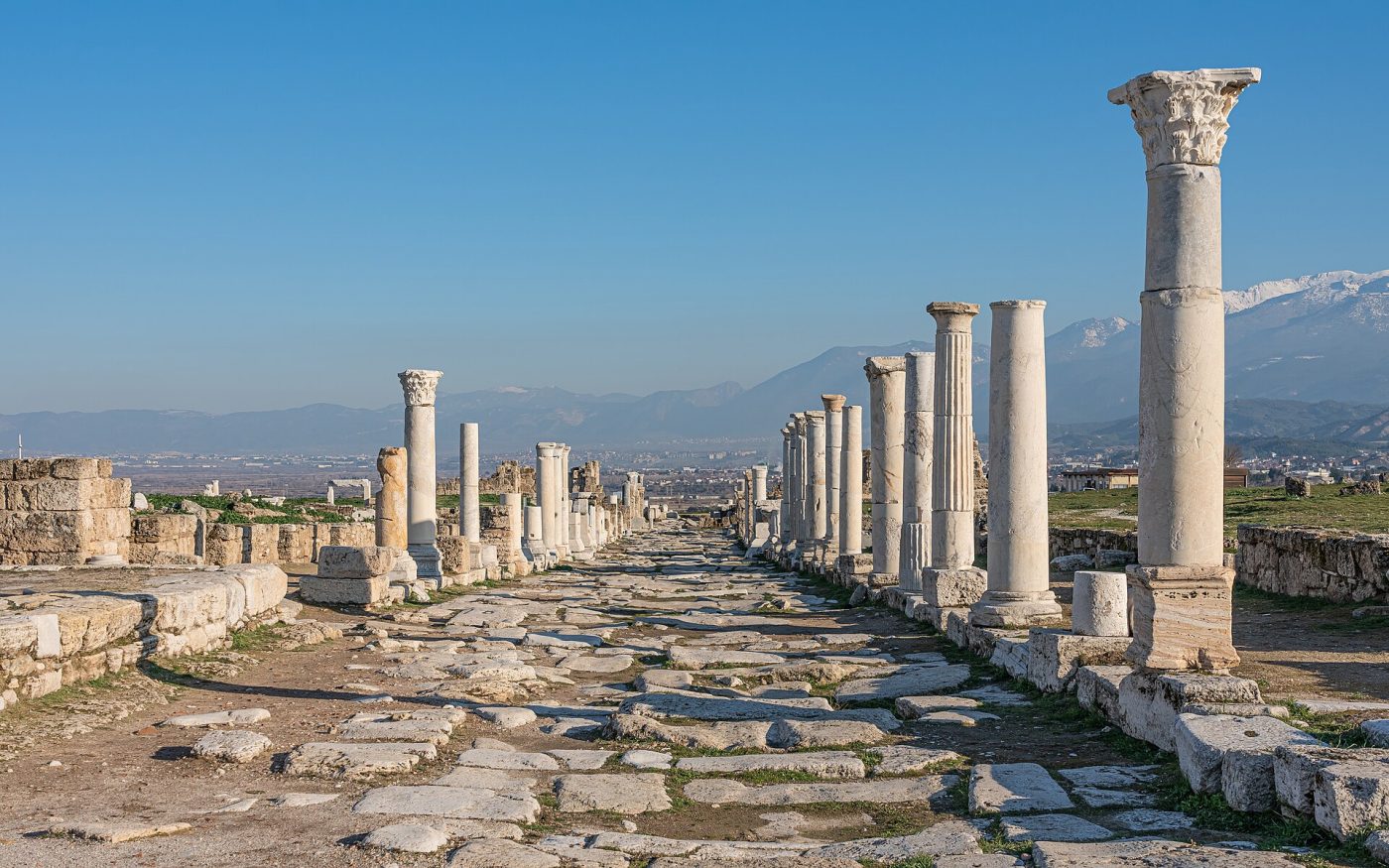
Photo: A.Savin, FAL
Nothing is sold online for Laodicea on its own. Entry is a simple gate ticket bought at the visitor centre, and the site is included in the Museum Pass Turkey and the regional pass for the Aegean, which pays off if you also visit Hierapolis, Aphrodisias or Ephesus. Prices for foreign visitors in Turkey have risen sharply in recent years and are now often quoted in euros, so check before you go.
Most visitors arrive on their own by taxi or car, or as one stop on a day tour of the Pamukkale area. Tours sold from Pamukkale village, Denizli and from coast resorts such as Kusadasi, Bodrum and Antalya usually cover the Hierapolis ruins and the travertine terraces, with a shorter visit to Laodicea added on some itineraries; transport and a guide are included, while lunch and entry fees vary. Pilgrimage groups following the seven churches of Revelation make it a fixed stop.
There is no audio guide, but signs in English are good and the main buildings are well explained. For most people the best plan is to visit independently in the morning, then move on to Pamukkale for the afternoon and sunset on the terraces.
From the visitor centre walk to Syria Street, the main colonnaded avenue, where dozens of columns have been set back on their bases along a marble pavement. It runs between shops, fountains and squares towards the Syria Gate in the east. Look for the inscribed pedestals and the drainage channels under the paving, and the view of the snowy Honaz mountain beyond.
A few minutes north of the main street stands the large early church, built in the 4th century and now protected by a modern roof. Inside, walk on raised walkways over coloured marble floors and geometric mosaics, past the baptistery and the apse. It is the main reason pilgrims come, as Laodicea was one of the seven churches of Revelation.
Live prices from GetYourGuide for tickets and tours that include this site. Free cancellation on most of them.
Near the centre, Temple A stands on a high podium inside a colonnaded courtyard, with its front columns re-erected. It was later used for the imperial cult and as an archive, and finds included statues and inscribed documents. The surrounding sacred precinct and the nearby monumental fountains show how much public money this wool-trading city had.
Laodicea had two theatres. The West Theatre faces the Lycus valley; the North Theatre, larger and recently restored, has rows of seating set into the hillside on the northern edge of the city. Climb to the top rows for the view south over the ruins and north across the plain towards the white terraces of Pamukkale.
At the southern end lies the long stadium, one of the largest in Anatolia, with the remains of a gymnasium and baths beside it. Its seating is overgrown, so the scale is the thing to notice. To the west, the remains of the Ephesus Gate mark the road that led to the coast, which merchants used to carry the city's black wool.
A Seleucid king, Antiochus II, founded Laodicea between 261 and 253 BC on an older settlement and named it after his wife Laodice. After 133 BC it passed to Rome and grew rich on banking, trade and black wool, and it had a well-known medical school. An earthquake destroyed it in AD 60, and the citizens rebuilt it without imperial help. It became an early Christian centre and the seat of a bishop. Byzantine emperors fought the Seljuks for it in the 12th century, and it was finally abandoned after Turkish and Mongol raids. Pamukkale University has excavated and restored it since 2002; it joined the UNESCO tentative list in 2013.
Laodicea is about 6 km north of central Denizli, close to the village of Eskihisar and the main road to Pamukkale. Denizli Cardak airport, with flights from Istanbul and Ankara, is about an hour away by car or airport shuttle. Denizli also has a large bus station with coaches from Izmir, Antalya, Istanbul and the coast, and a railway station with trains from Izmir. From the bus station, minibuses and dolmus towards Pamukkale can drop you at the Laodicea turn-off, from where the visitor centre is a walk of about 1 km; a taxi takes about 15 minutes. By car, follow the signs from the Pamukkale road and use the free car park at the entrance.
Stay on the marked paths and walkways, do not climb on columns or the restored walls, and do not step on the mosaic floors in the church. Drones need permission. There is almost no shade on the long walk between buildings, so bring a hat, sunscreen and more water than you think, and wear firm shoes for the marble and gravel. Toilets and drinks are at the visitor centre; Denizli and Pamukkale have plenty of places to eat.
Spring and autumn are the best seasons. From April to June the fields are green and the snow lingers on Honaz Dagi behind the city, and September and October bring settled weather. In July and August afternoon temperatures in the Lycus valley often pass 35 degrees, and the open site becomes punishing, so arrive at opening or come for the last hours of the day. Winter is mild and quiet but can be wet and grey.
Laodicea is rarely crowded. Day-tour coaches heading for Pamukkale sometimes stop in the late morning, and church groups come throughout the season, but even at peak times the site absorbs them easily. Hierapolis and the travertines are far busier, so many people do Laodicea first and save Pamukkale for late afternoon and sunset. Allow two to three hours to walk the main streets, church and theatres.
Pamukkale, with the white travertine terraces and the ruins of Hierapolis, is about 15 minutes north by car and makes the natural pair for the same day. The unexcavated mound of Colossae lies about 20 minutes east, the ruins of Tripolis about 40 minutes north, and Aphrodisias, with its stadium and museum, is about 1.5 hours to the west.
10 km away
Hierapolis is a Roman spa city built on top of the white travertine terraces of Pamukkale in south-western Turkey,…
194 tickets & tours
37 km away
Aphrodisias is the ancient city of Aphrodite in the hills of Caria, western Turkey, famous across the Roman world for…
1 ticket or tour
120 km away
Kaunos is an ancient port city on the Dalyan river in south-west Turkey, once a busy harbour on the border between…
1 ticket or tour
| Hours | About 8 am to 7 pm in summer and 8 am to 5 pm in winter; check current hours |
|---|---|
| Closed | Open daily |
| Entry fee | A gate fee; covered by the Museum Pass Turkey |
| Time needed | 2 to 3 hours |
| Best time | Early morning or late afternoon; April to June and September to October |
| Booking | Pay at the gate; no booking needed |
| Access | Long distances on paved Roman streets and gravel; little shade; some ramps but many uneven sections |
| Getting there | Taxi or dolmus from Denizli, about 15 minutes; the site is near the Pamukkale road |
| Founded | 261 BC (founded 261-253 BC by Antiochus II) |
| Excavated | 2002 |
| Civilisation | Greek |
| Website | laodikeia.pau.edu.tr |
| Checked | October 2026 |
About 8 am to 7 pm in summer and 8 am to 5 pm in winter; check current hours. Open daily.
Entry fee: A gate fee; covered by the Museum Pass Turkey.
Allow 2 to 3 hours for Laodicea.
Pay at the gate; no booking needed.
Yes. GetYourGuide sells tickets and guided tours whose route includes Laodicea; live prices are shown on this page.
Early morning or late afternoon; April to June and September to October.
Taxi or dolmus from Denizli, about 15 minutes; the site is near the Pamukkale road.
Long distances on paved Roman streets and gravel; little shade; some ramps but many uneven sections.
Worth it for a well-restored Roman city with few crowds, easily paired with Pamukkale on the same day. Shorten it if you have only one day and want time in the Hierapolis ruins and travertines instead.
Laodicea dates from 261 BC (founded 261-253 BC by Antiochus II). Excavations began in 2002.