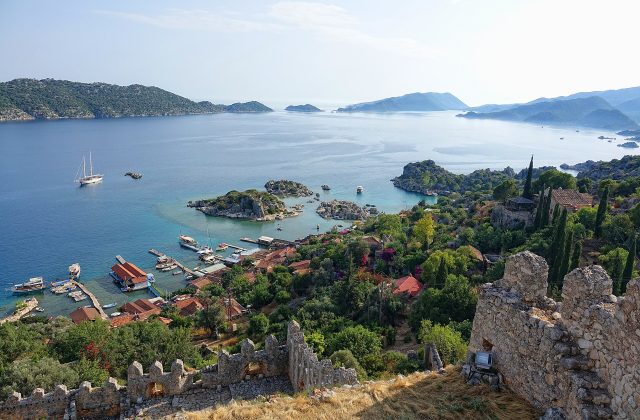
Kekova Sunken City
Demre, Turkey
Kekova is an uninhabited island off the Lycian coast of southern Turkey whose northern shore holds the half-submerged…
5 tickets & tours
Ancient City · Greek · Turkey
Myra is the ancient Lycian city on the edge of modern Demre, where a cliff face is carved with dozens of rock-cut tombs in the form of temple fronts above a large Roman theatre. Saint Nicholas was bishop here in the 4th century, and his church in the town centre makes Myra a stop for pilgrims as well as for lovers of ruins.

Photo: Ingo Mehling, CC BY-SA 3.0
Our pick for each kind of visit, with live dates and prices from GetYourGuide. Free cancellation on most.
Best for: Staying in Antalya
A guided day with transport along the coast, the tombs and the church of Saint Nicholas, and a boat over the sunken ruins of Kekova with lunch on board.
The ruins of Myra and the church of Saint Nicholas in Demre are separate sites run by the Turkish Ministry of Culture, each with its own ticket paid at the gate in euros. The Museum Pass for the Mediterranean region or the whole of Turkey covers both, as well as the Museum of Lycian Civilizations at Andriake. Nothing needs to be booked ahead, and independent visitors can see all three in half a day.
The tours sold online are almost all full-day trips that combine Myra and the church with a boat trip around the island of Kekova, where the walls of a Lycian town lie under shallow water. They start from Antalya, Kemer and Alanya, which means two and a half to four hours on the road each way, or from Kas and Kalkan, which are much closer. Most include hotel transport, a guide, the boat and lunch; entry tickets are often extra, so check the price. Private versions add flexibility, and some long-distance tours from Alanya leave before dawn.
If you are staying in Kas or Kalkan, a small-group tour is the easiest way to combine Myra with Kekova. From Antalya, a guided day trip saves the long drive, but if you have a car, going alone and starting early is better.
From the ticket office the path leads straight to the cliff behind the theatre, where dozens of Lycian tombs are cut into the rock in the form of houses and temple fronts, with carved beams, doors and porches. The best view is from the theatre itself or the path below. Look for faded reliefs of figures on some facades.
Below the tombs, the large theatre is built partly against the hillside and keeps much of its seating, its vaulted outer corridors and fragments of the stage building. It was destroyed by an earthquake in AD 141 and rebuilt. Look for carved theatre masks among the fallen blocks near the stage, and the inscribed seats in the lower rows.
Live dates and prices from GetYourGuide. Free cancellation on most tickets.
About 1.5 km east, up the Demre stream, a second group of rock tombs lines another cliff and is reached by a separate road. It includes the Lion Tomb, also known as the Painted Tomb, which the traveller Charles Fellows saw in 1840 still coloured red, yellow and blue. Few tours stop here, so expect to be alone.
In the centre of Demre, about 2 km south of the theatre, the church of Saint Nicholas stands below street level under a protective roof. Most of it dates from the 8th century onward, with a floor of coloured marble inlay, fragments of frescoes and the empty sarcophagus where the saint was buried before his bones were taken to Bari in 1087.
Five kilometres south-west at the coast, Andriake was Myra's harbour. Its Roman granary of Hadrian's reign, 56 metres long, now houses the Museum of Lycian Civilizations, with finds from across the region. Around it lie the restored harbour market, a deep cistern and a large heap of murex shells from purple dye production.
Myra was probably founded by the Lycians on the river Myros and was Hellenized by the 3rd century BC. Strabo counted it among the largest towns of the Lycian League, and under Rome it became the capital of the province of Lycia in the 4th century. Saint Nicholas was its bishop at the time of the Council of Nicaea in 325, and his tomb made the town a place of pilgrimage. Arab raiders sacked it in 809, and merchants from Bari took the saint's relics in 1087. River silt later buried much of the city. The theatre and baths have been partly excavated, and work at Andriake has continued since 2009.
Myra lies on the northern edge of Demre, on the coast road between Antalya and Kas. Buses from Antalya's main bus station reach Demre in about two and a half to three hours, and minibuses from Kas take about an hour. From the bus station in Demre the ruins are about 2 km north, a walk of around 25 minutes on a flat road through greenhouses, or a short taxi ride. The church of Saint Nicholas is in the town centre, close to the bus station. Antalya airport is the nearest major airport, about three hours by road; Dalaman is further west. Drivers will find parking at the entrance, with cafes and souvenir stalls along the approach.
Climbing up to the tombs or onto the theatre walls is not allowed, and parts of the cliff are fenced because of falling rock. Drones need official permission. Bring a hat, sunscreen and water: the plain is hot from May to October and there is almost no shade by the theatre. In the church, dress modestly and keep your voice down if a service is under way. Toilets are at the entrance, and cafes line the road outside.
Myra is a stop on many boat-and-ruins tours, and their coaches usually arrive between about 10 am and 1 pm, filling the small site and the church at the same time. At opening, or in the late afternoon, you may have the theatre almost to yourself, and the low sun lights the tomb facades.
April to June and September to October are the most pleasant months for walking on the plain. July and August are very hot, so start early and save the church, which is shaded, for midday. Winter is mild and quiet, though the site closes earlier and rain is common. On 6 December, the feast of Saint Nicholas, Orthodox pilgrims and clergy gather at the church for a liturgy, and Demre becomes very busy. Allow an hour for the ruins and another for the church, and half a day if you add Andriake.
The church of Saint Nicholas and the Museum of Lycian Civilizations at Andriake can both be seen on the same morning, ten minutes apart by car. Boats to Kekova and the castle village of Simena leave from the harbour at Andriake and from Ucagiz, 30 minutes east. Kas, with its own Lycian theatre and tombs, is about an hour west.
| Hours | 8.30 am to 7 pm Apr–Oct, 8.30 am to 5.30 pm Nov–Mar; last tickets 30 minutes before closing |
|---|---|
| Closed | Open daily |
| Entry fee | from EUR 13; under-8s free; church of Saint Nicholas extra |
| Time needed | About an hour, two with the church |
| Best time | At opening or after 4 pm; Apr–Jun and Sep–Oct |
| Booking | Pay at the gate; no need to book ahead |
| Access | Flat paved path to the theatre; tombs seen from below; hot and shadeless; pushchairs fine on the main path |
| Getting there | Bus from Antalya or Kas to Demre, then a 25-minute walk or a short taxi ride north |
| Civilisation | Greek |
| Checked | October 2026 |
8.30 am to 7 pm Apr–Oct, 8.30 am to 5.30 pm Nov–Mar; last tickets 30 minutes before closing. Open daily.
Entry fee: from EUR 13; under-8s free; church of Saint Nicholas extra.
Allow About an hour, two with the church for Myra.
Pay at the gate; no need to book ahead.
Yes. GetYourGuide lists 23 tickets and tours for Myra, with live dates and prices and free cancellation on most of them.
At opening or after 4 pm; Apr–Jun and Sep–Oct.
Bus from Antalya or Kas to Demre, then a 25-minute walk or a short taxi ride north.
Flat paved path to the theatre; tombs seen from below; hot and shadeless; pushchairs fine on the main path.
Worth it for the cliff of Lycian house tombs above the theatre and the church of Saint Nicholas. Skip or shorten it if you have only a few hours on the coast and prefer the sea: the ruins take about an hour, and a Kekova boat may suit you better.
Demre, Turkey
Kekova is an uninhabited island off the Lycian coast of southern Turkey whose northern shore holds the half-submerged…
5 tickets & tours