Sacsayhuaman
Cusco, Peru
Sacsayhuaman is the Inca stronghold on the hill above Cusco, famous for zigzag terrace walls of polished limestone…
41 tickets & tours
Ancient City · Andean · Peru
Tipón is an Inca royal estate 22 km south-east of Cusco, laid out in the 15th century on a hillside between about 3,250 and 3,960 metres. Its thirteen monumental terraces are still watered by the original spring-fed canals and fountains, which makes it the clearest place around Cusco to see Inca hydraulic engineering at work.
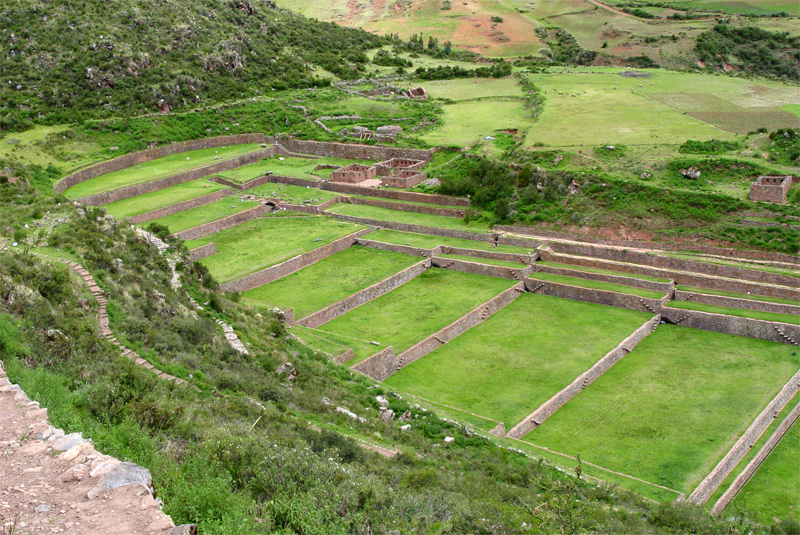
Photo: Tencho, CC BY-SA 3.0
Our pick for each kind of visit, with live dates and prices from GetYourGuide. Free cancellation on most.
Best for: First visit, half a day from Cusco
A shared minibus and a local guide cover Tipón, the Wari town of Pikillacta and the painted church of Andahuaylillas in one morning, with no bus changes or uphill walk.
Entry to Tipón is not sold as a single ticket. The site is covered by the Cusco tourist ticket, the boleto turistico, either in the partial circuit that also includes Pikillacta and several museums in Cusco and is valid for two days, or in the full version that adds Saqsaywaman and the Sacred Valley sites. The partial ticket can be bought at the gate, so independent visitors need nothing booked in advance.
Almost every tour on GetYourGuide is a south valley excursion from Cusco that combines Tipón with the Wari ruins of Pikillacta and the church of Andahuaylillas, known for its painted interior. Shared tours take about half a day by minibus with a local guide; the tourist ticket and the church entry are usually extra, so check before paying. Private versions with a driver and guide cost more but allow a longer stay at the terraces. Some itineraries add a bakery stop in Oropesa, a lunch of roast guinea pig in Tipón village, a farm visit or a quad-bike ride in the hills above Huasao. There are also plain transfers that drive you up and wait.
For most people the shared half-day tour is the sensible choice: Tipón is awkward to reach by public transport, and a guide explains the water system, which is the reason to come.
From the car park, walk down into the shallow ravine where thirteen broad terraces step down between about 3,380 and 3,460 metres. Their retaining walls, of finely fitted basalt and andesite, reach five metres in places and curve round the ends in a U shape. Stand at the bottom and look up to see how water drops from one level to the next.
At the head of the terraces, on the eleventh level, a natural spring emerges into a stone fountain restored in 1999. The flow is split into two jets, then four, and rejoined to feed the canals, all year round and without pumps. Seven underground conduits collect the groundwater behind it. Watch how the channels are shaped to keep the jets steady.
Live dates and prices from GetYourGuide. Free cancellation on most tickets.
A few terraces lower, on the south-east side of the eighth level, a smaller fountain is fed by an underground channel from the main spring. Its jet falls into a carved basin before running on to the fields. The careful stonework suggests ritual rather than farming use, and it is the most photographed corner of the site in the morning light.
Follow the path uphill along the main canal, which brings water from the Pukara river to the upper terraces. One of the three Inca canals crossing the upper park runs along the top of an intact stone aqueduct. Nearby lie the residential sectors of Sinkunakancha and Patallaqta, where elite houses received water through branches of the same system.
For those with energy, a steep track climbs north to the ceremonial sector of Intiwatana and the hill of Cruzmoqo at the top of the park. The hill served as a signal and observation point on the road towards the Sacred Valley, and its rocks carry many petroglyphs. Allow extra time and water, as few visitors come up here.
The hillside was occupied long before the Incas, from around 1000 BC through the Wari and Killke periods. The local Pinagua people, who called the place Muyna, were finally subdued by Pachacuti in the middle of the 15th century, and Tipón became an Inca estate for the ruling elite, built under Pachacuti or his son Topa Inca Yupanqui. Its springs, fertile soil and several microclimates may also have made it a place for testing crops. Excavation and restoration began in the 1970s and continue today. The 239-hectare park was declared a national archaeological park in 1984, and in 2006 American civil engineers listed it as a historic engineering landmark.
Tipón lies just off the main road from Cusco to Puno, near Oropesa, about 22 km south-east of the city. Local buses and shared minibuses towards Urcos leave from Avenida de la Cultura in Cusco and can drop you at the Tipón turn-off in around 40 minutes. From there a paved road climbs about 4 km to the gate; walking takes well over an hour at this altitude, so most people take one of the taxis waiting in the village. A taxi from central Cusco for the return trip, with waiting time, is the simplest independent option. Cusco airport is on the same side of the city, so the drive from there takes about 40 minutes. There is free parking at the entrance.
Stay on the marked paths and do not walk along the canal edges or climb the terrace walls, which are fragile in places. Drones need a permit from the Ministry of Culture. The site lies above 3,300 metres, so walk slowly, drink water and bring a hat, sunscreen and a warm layer, as the weather changes fast. There are toilets near the entrance but no café inside; food is sold in Tipón village below.
Mornings are the best time. The light on the terraces is soft before 11 am, the air is clear and the site is often almost empty, because south valley tours from Cusco usually arrive in the late morning and leave after an hour. In the afternoon cloud and wind tend to build, and in the wet season showers are frequent.
The dry season from May to September brings sunny days and cold nights, and it is also the busiest period around Cusco, though Tipón itself rarely feels crowded. June is lively because of the Inti Raymi festival in Cusco. From December to March rain makes the paths muddy and slippery, but the terraces are greener and the canals run fuller. Allow two hours for the terraces and fountains, and three or more if you want to climb to Cruzmoqo and the petroglyphs.
Pikillacta, a large Wari walled town covered by the same tourist ticket, is about 15 minutes further along the road towards Puno. Another 15 minutes on, the church of San Pedro in Andahuaylillas has some of the finest colonial wall paintings in Peru. On the way back, the bakeries of Oropesa sell the large round loaves the village is known for.
| Hours | About 7 am to 5.30 pm all year |
|---|---|
| Closed | Open daily |
| Entry fee | Cusco tourist ticket: PEN 130 full or PEN 70 partial |
| Time needed | 2 to 3 hours |
| Best time | Morning, before 11 am; May–Sep, the dry season |
| Booking | No booking; buy the tourist ticket at the gate or in Cusco |
| Access | Steep paths and stone steps at about 3,400 metres; no shade; not suitable for wheelchairs or pushchairs |
| Getting there | Bus from Cusco towards Urcos to the Tipón turn-off, about 40 minutes, then 4 km uphill |
| Founded | 1450 (15th century AD (midpoint)) |
| Civilisation | Andean |
| Area | 2.4 km² |
| Checked | October 2026 |
About 7 am to 5.30 pm all year. Open daily.
Entry fee: Cusco tourist ticket: PEN 130 full or PEN 70 partial.
Allow 2 to 3 hours for Tipón.
No booking; buy the tourist ticket at the gate or in Cusco.
Yes. GetYourGuide lists 28 tickets and tours for Tipón, with live dates and prices and free cancellation on most of them.
Morning, before 11 am; May–Sep, the dry season.
Bus from Cusco towards Urcos to the Tipón turn-off, about 40 minutes, then 4 km uphill.
Steep paths and stone steps at about 3,400 metres; no shade; not suitable for wheelchairs or pushchairs.
Worth it for working Inca canals and fountains, a half day away from the Sacred Valley crowds. Skip or shorten it if the altitude still bothers you, or if you have already seen Moray and Machu Picchu and want a rest from terraces.
Tipón dates from 1450 (15th century AD (midpoint)).
Cusco, Peru
Sacsayhuaman is the Inca stronghold on the hill above Cusco, famous for zigzag terrace walls of polished limestone…
41 tickets & tours
Cusco, Peru
Waqrapukara is a remote fortress-sanctuary in Acomayo Province, south of Cusco, built around a rock outcrop with two…
39 tickets & tours
Cusco, Peru
Maukallaqta is an Inca stone complex in the hills of Paruro province, south of Cusco, linked by tradition to the place…
3 tickets & tours