Ancient Monument · Roman · France
Pont du Gard
The Pont du Gard is the three-tiered Roman aqueduct bridge over the river Gardon near Remoulins in southern France, built in the 1st century AD to carry water to Nimes. At about 49 metres high and 274 metres long it is the tallest surviving Roman aqueduct bridge, and it has been a UNESCO World Heritage Site since 1985.
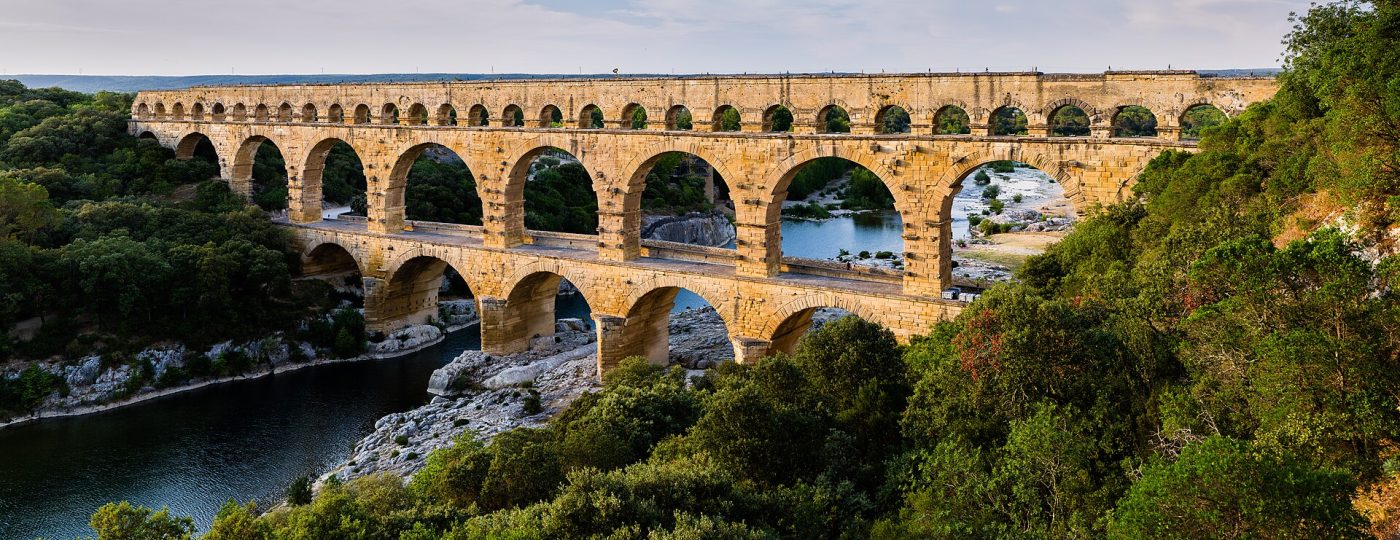
Photo: Benh LIEU SONG (Flickr), CC BY-SA 3.0
Pont du Gard tickets: which one for you
Our pick for each kind of visit, with live dates and prices from GetYourGuide. Free cancellation on most.
Best for: On your own, at your own pace
The standard entry bought in advance, which covers the museum, the film and the walking trails, so you can drive in and go straight to the bridge.
- Photographers and early risers: Pont du gard exclusive sunrise ticket with audio tour Entry at dawn before the general opening, with an audio guide, when the stone turns gold and the riverbanks are almost empty.
- A Roman day from Avignon: From avignon roman tour to pont du gard nimes orange Transport and a guide for the bridge plus the arena at Nimes and the theatre at Orange, the three great Roman sites of the area in one day.
Tickets and tours: all the options
The site is run by a public body. Walking or cycling in to the bridge and the marked trails is free, and drivers pay a flat charge per car. A separate ticket covers the museum about the aqueduct, a short film and a children's discovery area, which close from November to February; under-18s go in free. Tickets are sold at the visitor centre and online. Guided visits along the covered water channel on the top tier are sold separately in season, in small groups, and are the only way to get up there.
Tour operators mostly sell the bridge as one stop on a longer day. Day trips from Avignon combine it with Nimes and Orange, or with Uzes, or with Saint-Remy and Les Baux, with a minibus and a driver-guide; some add wine tastings. There are private tours from Aix-en-Provence and Avignon, a dawn entry with an audio guide, and walks that follow the line of the aqueduct from Uzes.
With a car, parking and the museum ticket are all you need, and the bridge is easy to understand without a guide. Without one, a Roman-themed day trip from Avignon is the most efficient choice, though the time at the bridge itself is often only an hour.
What to see at Pont du Gard
Left bank and visitor centre
Most visitors arrive on the left bank, where the visitor centre holds the museum on the aqueduct. Models, reconstructions and a section of the channel explain how the water travelled 50 km from springs near Uzes to Nimes. Spend half an hour here first; a level path of about 400 metres then leads through the trees to the bridge.
Crossing the lower tier
The road bridge added beside the lowest tier in the 18th century lets you walk across the river. From the middle, look up at the six great arches of the first level and the projecting stones the Romans left to hold scaffolding. The blocks were laid without mortar, and some still carry carved numbers and letters used by the builders.
9 tickets and tours for Pont du Gard
Live dates and prices from GetYourGuide. Free cancellation on most tickets.
View from the river
Take the steps down to the pebble beaches on either bank for the classic view of all three tiers reflected in the Gardon. Downstream on the right bank is the best angle for photographs. In summer you can swim in the river here; the water is cold and the current changes after rain, so watch for flags and signs.
Top tier and water channel
Only guided groups can enter the covered channel on the third tier, where the water ran. Inside you walk on Roman paving under stone slabs, and the walls are crusted with limestone deposits that slowly choked the flow. The gradient here is so gentle that the floor drops only a few centimetres over the whole length.
Memoires de Garrigue trail
On the right bank, a marked trail of about 1.5 km climbs through holm oaks and terraced fields restored with olives, vines and cereals, showing how the countryside was farmed since Roman times. Higher paths lead to viewpoints over the bridge and to sections of the buried aqueduct. Wear proper shoes: the stony tracks are steep in places.
A short history
The bridge was part of an aqueduct of about 50 km built in the middle of the 1st century AD to bring spring water from near Uzes to the Roman colony of Nemausus, now Nimes. It carried an estimated 40,000 cubic metres a day with a fall of only 2.5 cm across the bridge. Lack of maintenance after the 4th century let limestone deposits clog the channel, and the flow stopped by the 6th century. Local lords then used the structure as a toll bridge, and a road bridge was added beside it in 1743. Restorations followed from the 19th century. The site joined the UNESCO list in 1985, and traffic was removed from the bridge in 2000.
Getting there
The Pont du Gard is about 25 km north-east of Nimes and 25 km west of Avignon, just outside Remoulins. Regional buses run from the Nimes bus station towards Uzes and stop at the site in about 40 minutes; buses from Avignon take about 50 minutes and run less often, especially on Sundays, so check timetables before you go. The nearest train stations are Nimes and Avignon Centre. By car, leave the A9 motorway at Remoulins and follow signs for about 5 km; there are large car parks on both the left bank, near the visitor centre, and the right bank. Nimes airport and Avignon airport are both within 40 minutes by road. Cycling from Uzes along quiet roads is a pleasant option.
Rules and what to bring
Climbing on the stones and walking along the upper tiers without a guide are forbidden, and drones are not allowed without permission. Swimming is allowed in the Gardon away from the piers, but there are no lifeguards outside the summer season, and jumping from the bridge is banned. Bring water, sunscreen and sandals for the pebbles. Picnics are fine on the banks, and the visitor centre has a café, a restaurant and toilets.
When to go
July and August are the busiest months, when families from the campsites and holiday homes of Provence fill the riverbanks from late morning, and the car parks can be full by noon. Come before 10 am or after 5 pm, when the heat drops and the evening light falls on the upstream face of the bridge. In summer the bridge is lit at night, and evening shows are sometimes held.
May, June and September are ideal: the river is warm enough for a quick swim by June, the crowds are smaller and the trails are pleasant to walk. In spring and autumn the river can rise sharply after storms in the Cevennes, and the beaches may be closed. Winter is quiet and mild, but the museum is closed from November to February. Allow two hours for the museum and the bridge, and three or more to add the trail, a picnic and a swim.
Combine it with
Nimes, 30 minutes away by car, has the Roman arena, the Maison Carree temple and the Musee de la Romanite, which explains how the aqueduct fed the town. Uzes, 20 minutes north, has the springs at the start of the aqueduct and a Saturday market. Avignon and its papal palace are about 30 minutes east, and canoe trips down the Gardon start at Collias.
At a glance
| Hours | Site daily 8 am to midnight; museum Mar–Oct from 9 am to 6 pm, 7 pm or 8 pm by season |
|---|---|
| Closed | Site open daily; museum closed Nov–Feb and on Monday mornings |
| Entry fee | Site free; parking EUR 9 per car; museum EUR 8 |
| Time needed | 2 to 3 hours |
| Best time | Early morning or early evening; May, June and September |
| Booking | No booking for the site; book guided tours online in July and August |
| Access | Paved, mostly level paths to both ends of the bridge; steps and steep trails beyond; shade under trees |
| Getting there | Bus from Nimes or Avignon to the Pont du Gard stop, about 40 to 50 minutes |
| Founded | AD 50 (1st century AD (midpoint)) |
| Civilisation | Roman |
| Height | 49 m (Aqueduct bridge, three tiers) |
| UNESCO | Pont du Gard (Roman Aqueduct) |
| Website | pontdugard.fr |
| Checked | October 2026 |
Frequently asked questions
When is Pont du Gard open?
Site daily 8 am to midnight; museum Mar–Oct from 9 am to 6 pm, 7 pm or 8 pm by season. Closed: Site open daily; museum closed Nov–Feb and on Monday mornings.
How much is the entry fee for Pont du Gard?
Entry fee: Site free; parking EUR 9 per car; museum EUR 8.
How long do you need at Pont du Gard?
Allow 2 to 3 hours for Pont du Gard.
Do I need to book Pont du Gard in advance?
No booking for the site; book guided tours online in July and August.
Can I book a ticket or tour for Pont du Gard online?
Yes. GetYourGuide lists 9 tickets and tours for Pont du Gard, with live dates and prices and free cancellation on most of them.
When is the best time to visit Pont du Gard?
Early morning or early evening; May, June and September.
How do I get to Pont du Gard?
Bus from Nimes or Avignon to the Pont du Gard stop, about 40 to 50 minutes.
Is Pont du Gard accessible, and what is the terrain like?
Paved, mostly level paths to both ends of the bridge; steps and steep trails beyond; shade under trees.
Is Pont du Gard worth visiting?
Worth it for the sheer scale of Roman engineering and a swim or picnic beside the river below. Skip or shorten it if you only want ruins to explore, since one bridge and a museum fill about two hours.
How old is Pont du Gard?
Pont du Gard dates from AD 50 (1st century AD (midpoint)).
Is Pont du Gard a UNESCO World Heritage Site?
Yes. Pont du Gard is part of the UNESCO World Heritage Site Pont du Gard (Roman Aqueduct).