Palace, Villa & Baths · Roman · United Kingdom
Roman Baths, Bath
The Roman Baths in Bath are the remains of the temple and bathing complex that grew around a hot spring in the town of Aquae Sulis from the 1st century AD. Over a million litres of water at 46 degrees still rise here every day, filling the lead-lined Great Bath below a Georgian terrace.
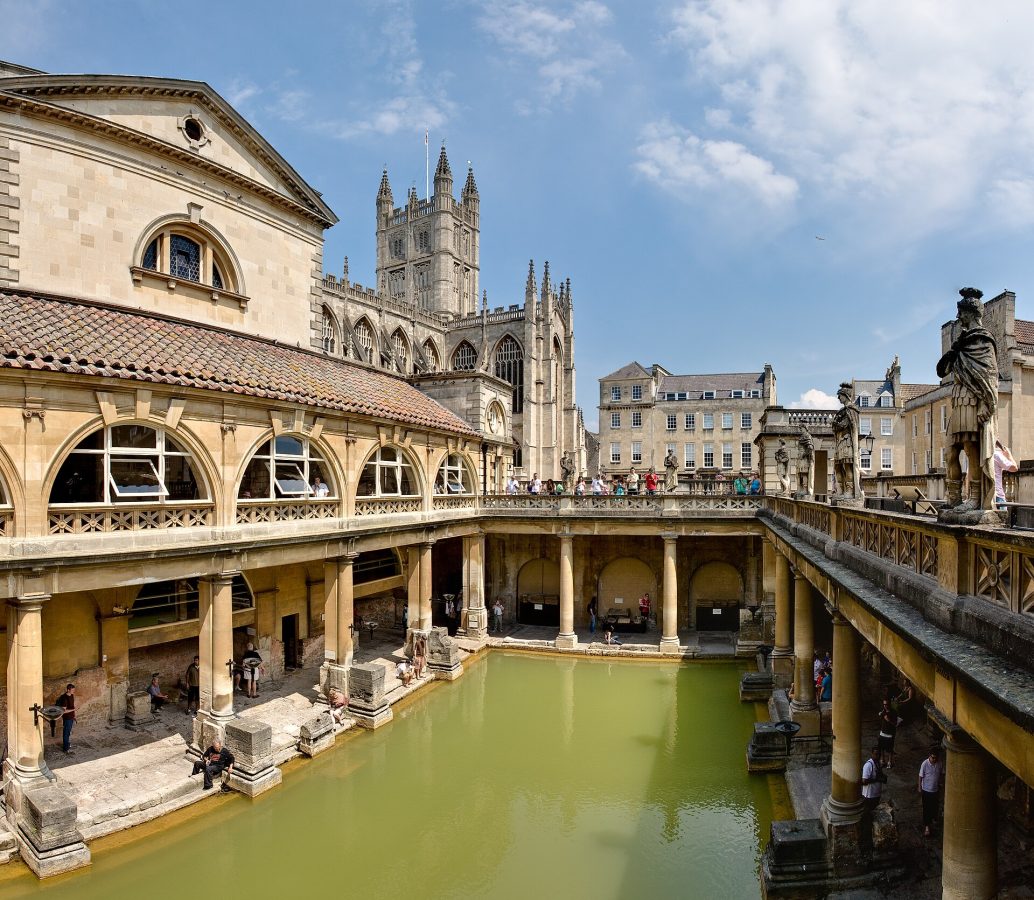
Photo: Diliff, CC BY 2.5
Roman Baths, Bath tickets: which one for you
Our pick for each kind of visit, with live dates and prices from GetYourGuide. Free cancellation on most.
Best for: First visit, two to three hours
The standard ticket for a chosen day, with the multilingual audio guide included, so you can walk straight in and take the route at your own pace.
- Baths and the Georgian city: Bath roman baths and city walking tour Adds a guided walk past the Royal Crescent, the Circus and Pulteney Bridge to the baths visit, so you see the Roman and Georgian city in one morning.
- A day trip from London: Stonehenge and roman baths full day tour from london Coach and guide from London to Stonehenge and Bath in one day, with time in the baths; the easiest way to see both without a car.
Tickets and tours: all the options
The museum sells dated tickets, and prices change with the season and day of the week; buying online is cheaper than at the door. The ticket includes the audio guide in several languages, with versions for children, and the costumed characters who appear on busy days. Residents of Bath with the local Discovery Card enter free. From late July to the end of August evening openings let you see the Great Bath lit by torches.
On GetYourGuide the choices are the entry ticket, city walking tours that include the baths, and many coach day trips from London or Oxford combining Bath with Stonehenge, Windsor, Lacock or the Cotswolds. On these day trips you usually get around two to three hours in Bath, enough for the baths or a quick walk, but not both. Check whether entry is included or optional; several tours add it as an extra at a reduced price. For most visitors the best option is a dated ticket booked a few days ahead and an early start; from London, a combined day trip with Stonehenge makes sense if you have only one day.
What to see at Roman Baths, Bath
Terrace above the Great Bath
The visit begins on the Victorian terrace at street level, lined with statues of Roman emperors and governors of Britain added in the 1890s. From here you look down on the green water of the Great Bath and the Abbey tower behind. Everything above the level of the column bases was built in the 19th century.
Temple pediment and courtyard
Downstairs, the museum displays the carved temple pediment with its fierce male head among snakes and wings, often called the Gorgon. Beyond, the temple courtyard lies under the modern Pump Room, with the base of the great altar where sacrifices were made. Projections show the temple as it once stood.
18 tickets and tours for Roman Baths, Bath
Live dates and prices from GetYourGuide. Free cancellation on most tickets.
Sacred Spring
Next comes the Sacred Spring itself, where the hot water rises bubbling and steaming from the ground into a reservoir. The Romans threw coins and offerings into it, and thousands have been recovered. Look for the red colour of the stones, stained by iron in the water, and the overflow channel that still carries water to the river.
Curse tablets and Minerva
Close by, the museum shows the gilded bronze head of the goddess Sulis Minerva, found in 1727, and the small lead sheets on which people wrote curses against thieves, asking the goddess for revenge. Many name stolen cloaks, gloves or coins. Translations are displayed beside them, and they are among the most human objects in Roman Britain.
Great Bath
Then walk down to the edge of the Great Bath, the large pool lined with lead from the Mendip Hills and still filled with spring water. The columns and walls around it are Roman at the base, and the stone steps where bathers sat survive. The water is not safe to touch.
East and West Baths and Pump Room
Either side of the Great Bath are smaller baths: heated rooms with floors raised on stacks of tiles, a cold circular plunge pool and a Roman swimming bath. The route ends at a fountain where you can taste spa water, and at the Pump Room restaurant upstairs.
A short history
The hot spring was a sacred place of the native Britons, dedicated to the goddess Sulis. Soon after the Roman conquest, in about AD 60 to 70, the Romans built a temple to Sulis Minerva beside it and, over the next three centuries, a large bathing complex around the spring, the centre of the town of Aquae Sulis. After Roman rule ended in the 5th century the buildings decayed. Medieval and Georgian Bath built new baths on the site, and the Pump Room opened in the 1790s. The temple pediment was found in 1790, and the Great Bath was uncovered in the 1870s and 1880s. The City of Bath has been on the UNESCO list since 1987.
Getting there
Trains from London Paddington reach Bath Spa in about 1 hour 20 minutes, and there are frequent services from Bristol, which takes about 15 minutes. From the station, walk north along Manvers Street and Stall Street for about ten minutes to Abbey Churchyard, where the entrance is beside the Abbey. Bristol airport is about 40 minutes away by car or by direct bus. National Express coaches from London stop at the bus station next to the railway station. Driving in central Bath is slow and parking is expensive, so use one of the three park-and-ride sites on the edge of the city, with buses every 10 to 15 minutes.
Rules and what to bring
Do not touch the water or put your hands in it: it comes straight from the ground and is not treated. Large bags and suitcases are not admitted, so leave luggage at your hotel. Eating is not allowed in the galleries, and flash may be restricted in some areas. The stone around the Great Bath is often wet and slippery. Toilets are near the start, a café and shop are near the exit, and the Pump Room serves meals.
When to go
The museum is busiest from about 10.30 am to 3 pm, when coach tours from London and school groups arrive, and at weekends and in school holidays all day. Arrive at opening, when the steam rises from the pool in the cool morning air, or come after 4 pm when the coach day trips have left for London.
Bath has mild weather all year, and as the visit is mostly indoors, rain is not a problem, though the Great Bath is open to the sky. From late July to August late evening openings allow a visit by torchlight with smaller crowds. In winter the steam over the pool is most visible, and the Christmas market around the Abbey in late November and December fills the centre with visitors. Allow two hours for the audio guide route, more if you listen to every commentary, and half a day if you add the Abbey and the Pump Room.
Combine it with
Bath Abbey stands next door, and the Thermae Bath Spa, a five-minute walk away, lets you bathe in the same spring water on a rooftop pool. The Royal Crescent and the Circus are a 15-minute walk north. Stonehenge is about an hour by car, and the village of Lacock is 30 minutes away.
At a glance
| Hours | 9 am to 6 pm; evening openings to 8 or 10 pm from late July to August; last entry an hour before closing |
|---|---|
| Closed | 25 and 26 Dec |
| Entry fee | from GBP 26.50 weekdays, 29 weekends online; varies by season |
| Time needed | 2 to 3 hours |
| Best time | At 9 am or after 4 pm; weekdays outside school holidays |
| Booking | Book a dated ticket online for weekends, school holidays and summer |
| Access | Indoors; lifts and ramps reach most levels; some steps and uneven Roman floors; wet paving around the Great Bath |
| Getting there | Train from London Paddington to Bath Spa, about 1 hour 20 minutes, then a 10-minute walk |
| Founded | AD 60 (AD 60-70 (temple); baths built up over 300 years) |
| Civilisation | Roman |
| UNESCO | City of Bath |
| Website | romanbaths.co.uk |
| Checked | October 2026 |
Frequently asked questions
When is Roman Baths, Bath open?
9 am to 6 pm; evening openings to 8 or 10 pm from late July to August; last entry an hour before closing. Closed: 25 and 26 Dec.
How much is the entry fee for Roman Baths, Bath?
Entry fee: from GBP 26.50 weekdays, 29 weekends online; varies by season.
How long do you need at Roman Baths, Bath?
Allow 2 to 3 hours for Roman Baths, Bath.
Do I need to book Roman Baths, Bath in advance?
Book a dated ticket online for weekends, school holidays and summer.
Can I book a ticket or tour for Roman Baths, Bath online?
Yes. GetYourGuide lists 18 tickets and tours for Roman Baths, Bath, with live dates and prices and free cancellation on most of them.
When is the best time to visit Roman Baths, Bath?
At 9 am or after 4 pm; weekdays outside school holidays.
How do I get to Roman Baths, Bath?
Train from London Paddington to Bath Spa, about 1 hour 20 minutes, then a 10-minute walk.
Is Roman Baths, Bath accessible, and what is the terrain like?
Indoors; lifts and ramps reach most levels; some steps and uneven Roman floors; wet paving around the Great Bath.
Is Roman Baths, Bath worth visiting?
Worth it for the steaming Great Bath, the temple finds and the clearest picture of Roman religion anywhere in Britain. Skip or shorten it if you dislike indoor crowds and narrow passageways at weekends, or prefer to bathe in the spa water next door.
How old is Roman Baths, Bath?
Roman Baths, Bath dates from AD 60 (AD 60-70 (temple); baths built up over 300 years).
Is Roman Baths, Bath a UNESCO World Heritage Site?
Yes. Roman Baths, Bath is part of the UNESCO World Heritage Site City of Bath.