Roman Theatres of Fourvière
27 km away
The Ancient Theatre of Fourvière is the Roman theatre of Lugdunum, cut into the hill above Lyon around 15 BC and…
1 ticket or tour
Theatre & Amphitheatre · Roman · France
The Roman theatre of Vienne is one of the largest in Gaul, built into the slope of Mont Pipet above the town in the 1st century AD. Its stone seating, cut into the hillside, once held around 13,000 spectators. Restored after its rediscovery in the 1920s, it now hosts the Jazz a Vienne festival every summer.

Photo: User:Otourly, CC BY-SA 3.0
Nothing for the theatre alone is sold online, and there is no need to book a daytime visit. Tickets are sold at the entrance, and the theatre is part of a group of monuments and museums run by the city of Vienne. A city pass gives entry to several of them, including the theatre, the archaeological collections and other museums, and is valid for a few days, so it is the best value if you plan to see more than one site.
The theatre is also a concert venue. During the Jazz a Vienne festival, from late June to mid-July, evening concerts are held in the theatre, and tickets must be bought in advance from the festival. The theatre may close to daytime visitors on some days while stages are set up, so check before you go.
The Vienne tourist office runs guided tours of the Roman town in season, which include the theatre, the Temple of Augustus and Livia and the Cybele garden. Day trips from Lyon by train are easy and cheap. For most visitors the sensible plan is the city pass, the theatre in the morning and the Gallo-Roman museum at Saint-Romain-en-Gal in the afternoon.
Enter at the bottom and climb into the cavea, the great semicircle of seats cut into the slope of Mont Pipet. The theatre is about 130 metres across, and the seating rises steeply in tiers. Sit in the upper rows to appreciate the scale, and look down at the orchestra and the stage, where the acoustics are still excellent.
Go down to the orchestra, the semicircle in front of the stage, where traces of the marble paving survive. The stage wall has mostly gone, but its foundations and some decorated blocks survive. The low front wall of the stage was decorated with carved reliefs, and pieces of it are kept in the city's collections.
Live prices from GetYourGuide for tickets and tours that include this site. Free cancellation on most of them.
Climb to the top of the seating for the view over the roofs of Vienne, the cathedral and the river Rhone, with the hills beyond. From here you see how the Roman town was laid out between the hill and the river. It is a good place to rest and to imagine the theatre full of spectators.
After the visit, follow the lanes up behind the theatre to the summit of Mont Pipet, where a chapel and a statue of the Virgin look over the town. The climb takes about 10 minutes. From the top you see the whole curve of the theatre below you, and the Roman street plan of Vienne laid out towards the river.
Vienne was the chief town of the Allobroges and became an important Roman colony in Gaul. The theatre was built in the 1st century AD on the slope of Mont Pipet, probably around the reign of Claudius, and could hold around 13,000 spectators. It was used for plays and festivals until the late Roman period, then abandoned and buried under houses and gardens. Its remains were rediscovered in the early 20th century, and excavations began in 1922. The architect Jules Formige led the clearing and restoration until 1938, rebuilding part of the seating. It is a classified historic monument and has been the main stage of the Jazz a Vienne festival since the 1980s.
Vienne is about 30 km south of Lyon on the Rhone. Trains from Lyon Part-Dieu and Perrache take about 20 to 30 minutes and run frequently. From Vienne station, walk north through the old town to the theatre, about 10 minutes uphill. By car, use the car parks near the river or the old town, as parking near the theatre is limited. Lyon Saint-Exupery airport is about 45 minutes away by car. Regional buses also link Vienne with surrounding towns and villages.
Do not climb on walls outside the seating, and take care on the steep steps, which can be slippery after rain. Drones are not allowed. Bring water, a hat and sun cream in summer, as there is little shade in the cavea. There are no cafes inside, but the old town is a few minutes away. During concerts, festival rules on bags and seating apply.
The theatre is rarely crowded outside the festival season. School groups visit on weekday mornings during term, and day visitors from Lyon come at weekends. Mornings are quiet and cool, while late afternoon light falls on the seating and gives good photographs.
The best months are April to June and September, when the weather is mild. July is festival time: Jazz a Vienne fills the theatre with evening concerts, and the town is lively, but daytime visits may be limited. August can be hot, often over 30 degrees, and the seating has no shade, so go early. Winter is quiet, with shorter hours and Monday closures. Allow about an hour for the theatre, and a full day for the other Roman sites of Vienne.
The Temple of Augustus and Livia is a 10-minute walk away in the old town, and the Cybele garden lies between them. Across the Rhone, the Gallo-Roman museum at Saint-Romain-en-Gal shows mosaics and a Roman quarter, about 15 minutes on foot. Lyon's Roman theatres at Fourviere are 30 minutes away by train.
27 km away
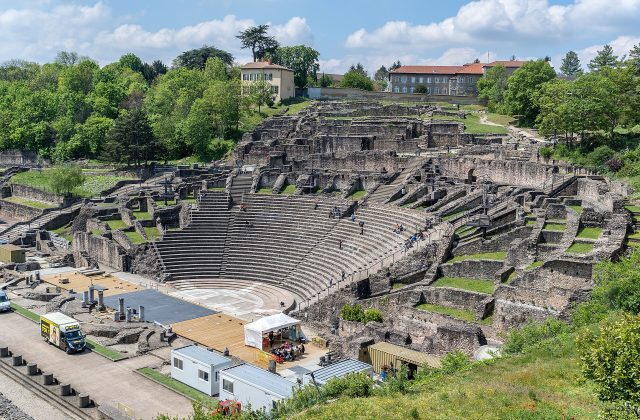
The Ancient Theatre of Fourvière is the Roman theatre of Lugdunum, cut into the hill above Lyon around 15 BC and…
1 ticket or tour
155 km away
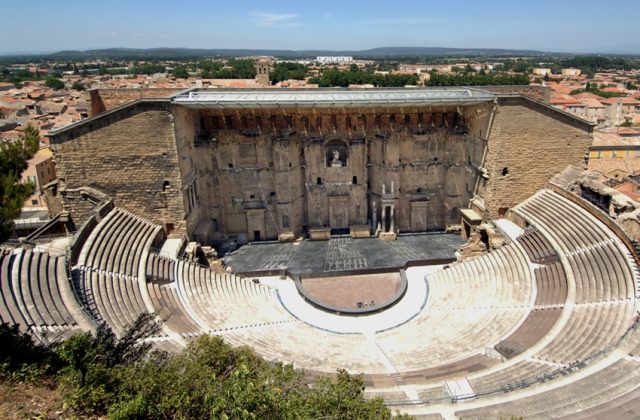
The Roman Theatre of Orange, built under Augustus early in the 1st century AD, is the only Roman theatre in Europe that…
1 ticket or tour
177 km away
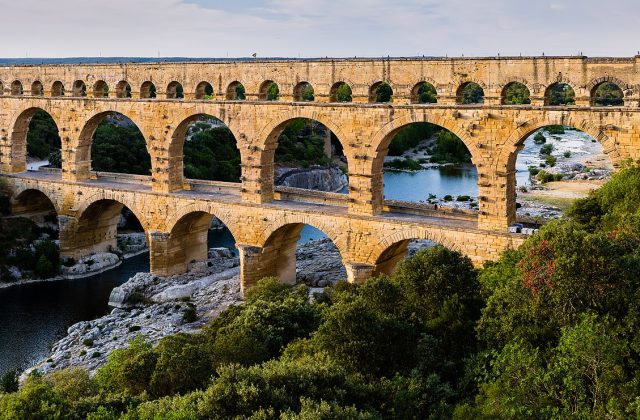
The Pont du Gard is the three-tiered Roman aqueduct bridge over the river Gardon near Remoulins in southern France,…
9 tickets & tours
| Hours | Roughly 9.30 am to 6 pm in summer; shorter, with a lunch break, in winter |
|---|---|
| Closed | Mondays in the low season and some public holidays |
| Entry fee | A few euros; city museum pass covers several sites |
| Time needed | About an hour |
| Best time | Morning or late afternoon; April to June and September |
| Booking | Pay at the gate; book festival concerts well ahead |
| Access | Steep stone steps and terraces; limited access for wheelchairs; little shade |
| Getting there | A 10-minute walk from Vienne station; trains from Lyon Part-Dieu take about 20 minutes |
| Founded | AD 50 (1st century AD (midpoint)) |
| Excavated | 1922 |
| Civilisation | Roman |
| Checked | October 2026 |
Roughly 9.30 am to 6 pm in summer; shorter, with a lunch break, in winter. Closed: Mondays in the low season and some public holidays.
Entry fee: A few euros; city museum pass covers several sites.
Allow About an hour for Roman Theatre of Vienne.
Pay at the gate; book festival concerts well ahead.
Yes. GetYourGuide sells tickets and guided tours whose route includes Roman Theatre of Vienne; live prices are shown on this page.
Morning or late afternoon; April to June and September.
A 10-minute walk from Vienne station; trains from Lyon Part-Dieu take about 20 minutes.
Steep stone steps and terraces; limited access for wheelchairs; little shade.
Worth it for one of the largest Roman theatres in France, with fine views over Vienne and the Rhone from the top rows. Skip or shorten it if you have seen Orange: the stage wall there is far better preserved.
Roman Theatre of Vienne dates from AD 50 (1st century AD (midpoint)). Excavations began in 1922.