Ancient City · Roman · Morocco
Volubilis
Volubilis is the best-preserved Roman town in Morocco, spread across a ridge below the Zerhoun hills between Meknes and the holy town of Moulay Idriss. Its triumphal arch, basilica and many houses with mosaic floors still in place cover about 42 hectares. It grew rich on olive oil and was listed by UNESCO in 1997.
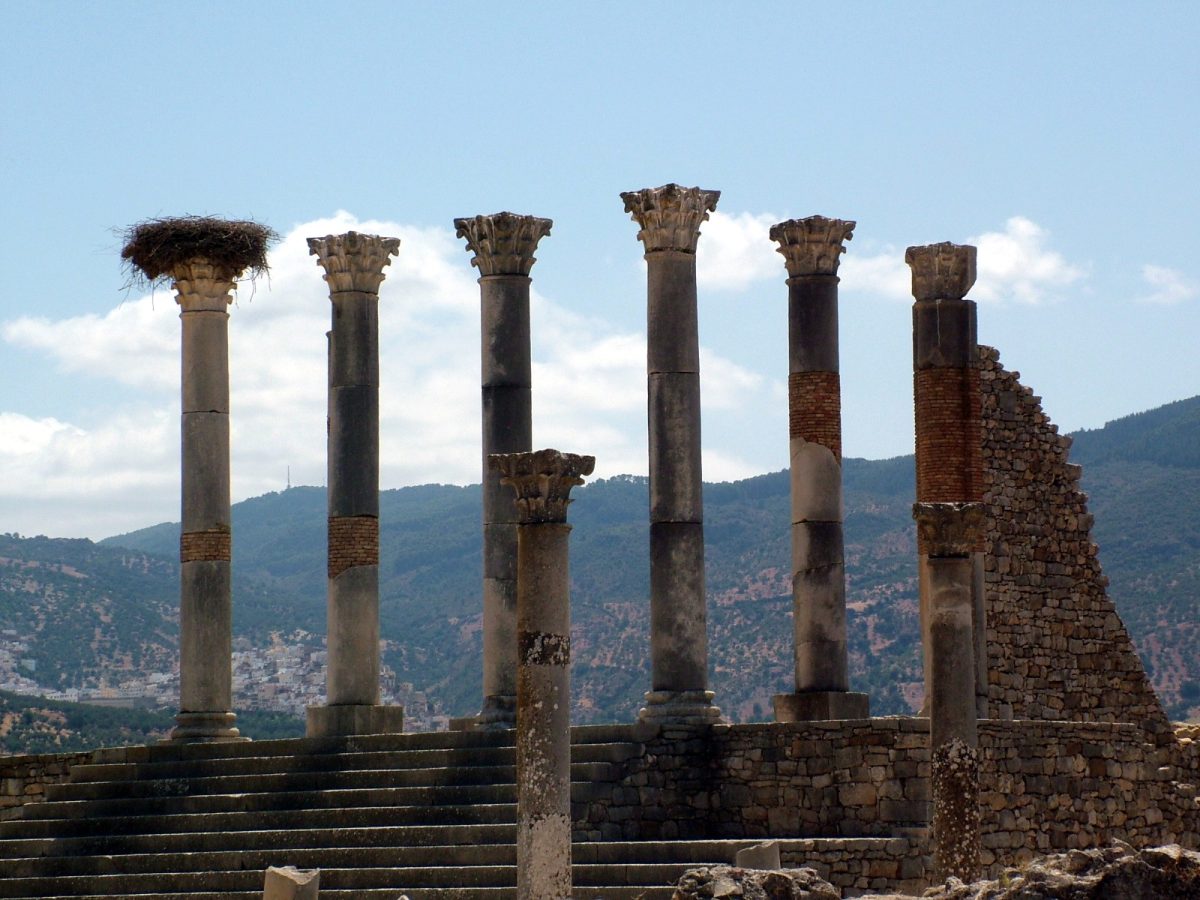
Photo: Marcin Sochacki (Wanted), CC BY-SA 4.0
Volubilis tickets: which one for you
Our pick for each kind of visit, with live dates and prices from GetYourGuide. Free cancellation on most.
Best for: First visit, a day from Fes
Transport and a guide for Volubilis, a look at Moulay Idriss and an afternoon in Meknes, the standard and efficient way to see all three.
- A day trip from Rabat: From rabat volubilis and meknes full day tour Covers the longer drive from the coast with a guide at the ruins and in Meknes, for visitors not travelling on to Fes.
- On the way to Chefchaouen: Fez one way transfer from fes to chefchaouen via volubilis A one-way transfer from Fes that stops at the ruins, so you see Volubilis without spending an extra day on the road.
Tickets and tours: all the options
There is one entry ticket, sold at the gate next to the car park, which covers the whole site and the small museum and garden by the entrance. Official guides wait at the gate and offer tours of about an hour and a half for a fixed fee; agree the price before you start. Signs on the site are few, so a guide or a good guidebook helps a lot.
Most tours sold online are full-day trips from Fes that combine Volubilis with the holy town of Moulay Idriss and the imperial city of Meknes, with transport by minibus or private car. Some come from Rabat, Tangier or Casablanca, and several transfers between Fes and Chefchaouen or Rabat stop at the ruins on the way. A few multi-day tours of the imperial cities include it. Transport is always included, while the entry ticket, a local guide at the site and lunch are often extra, so check the details. Small-group and private versions cost more but let you spend longer at the site.
For most visitors, a day trip from Fes with a guide at the ruins is the simplest plan; if you are staying in Meknes, a grand taxi there and back is easy and cheaper.
What to see at Volubilis
Museum and the oil presses
Start at the small museum by the entrance, which displays inscriptions, sculpture and bronzes from the site. Then cross the stream and climb into the town, passing the remains of stone olive presses, with circular crushing basins and the slots for the press beams. Volubilis had dozens of these mills, which show the source of its wealth.
Forum, basilica and Capitol
At the centre of the town, the forum is overlooked by the tall columns and arches of the basilica, the law court, where white storks nest each spring. Beside it, the Capitoline temple has had several columns re-erected on its high podium. From the temple steps you can see across the plain to Moulay Idriss on its hillside.
29 tickets and tours for Volubilis
Live dates and prices from GetYourGuide. Free cancellation on most tickets.
Arch of Caracalla
A short walk north stands the triumphal arch built in AD 217 in honour of the emperor Caracalla and his mother, partly reconstructed in the 1930s. It marks the start of the Decumanus Maximus, the main street. Look at the medallions and the inscription on the attic, then walk under it for a view of the street running up to the Tangier Gate.
Ephebe and Labours of Hercules houses
Along the main street, the large town houses keep their mosaic floors under the open sky. The House of the Ephebe was named after a bronze statue found there, and the House of the Labours of Hercules shows the hero's twelve tasks in a series of panels. Look also for the House of Dionysus and the Four Seasons, with a bright central scene.
House of Orpheus and the Baths
Head back south-west to the House of Orpheus, the finest house of the lower town, with a round mosaic of Orpheus playing to animals and a dolphin floor. Its kitchen and private bath are well preserved. Nearby, the Baths of Gallienus keep their heating system, and the path then returns past the oil presses to the entrance.
A short history
A Berber settlement with Carthaginian links grew here from the 3rd century BC, and Volubilis may have been a capital of the kingdom of Mauretania under Juba II. After Rome annexed the kingdom in AD 40, the town flourished on olive oil and gained a basilica, a temple and a triumphal arch in the 2nd and early 3rd centuries. Rome withdrew around AD 285, but Christians and then Muslims lived on here; Idris I, founder of the Idrisid dynasty, ruled here in the late 8th century. It was abandoned after power moved to Fes. Sultan Moulay Ismail took stone from it for Meknes; an earthquake in 1755 toppled much of the rest. French archaeologists excavated it from 1915.
Getting there
Volubilis lies about 30 km north of Meknes and 3 km from the town of Moulay Idriss Zerhoun. From Meknes, shared grand taxis leave from near Bab Mansour for Moulay Idriss, about 40 minutes; from there walk 3 km or take a petit taxi to the gate. A taxi hired for the round trip from Meknes, with waiting time, is the easiest independent option. From Fes the drive is about 80 km and takes an hour and a half; trains run from Fes to Meknes in about 40 minutes. Fes airport is the nearest with international flights. By car, there is a car park at the entrance on the road from Moulay Idriss.
Rules and what to bring
Stay off the mosaics and do not walk across them, even where there is no rope, and do not climb on the reconstructed columns or the arch. Drones are restricted in Morocco and need a permit. There is almost no shade, so bring a hat, sun cream and plenty of water, especially from May to September. A café with toilets is at the entrance, and Moulay Idriss has simple restaurants.
When to go
Most day trips from Fes reach Volubilis in late morning, so the site is busiest from about 10.30 am to 1 pm. Arrive at opening, when the light is soft on the arch and the mosaics, or come in the late afternoon, when the sun is low over the plain and the heat eases.
Spring, from March to May, is the best season: the fields around the ruins are green and full of flowers, the storks are nesting on the basilica and temperatures are mild. October and November are pleasant too. In July and August the ridge is very hot by midday, often well over 35 degrees, and there is nowhere to shelter. Winter days are cool and often clear, with occasional rain. During Ramadan tour schedules and opening times can shift, so check locally. Allow one and a half to two hours with a guide, a little longer if you want photographs of each mosaic.
Combine it with
Moulay Idriss Zerhoun, the hillside holy town with the tomb of Idris I, is 3 km away and gives a view back over the ruins. Meknes, 40 minutes south, has the gate of Bab Mansour and the royal granaries of Moulay Ismail. Fes is an hour and a half east.
Compare
At a glance
| Hours | Daily from about 8 am to sunset, roughly 5 pm in winter and 7 pm in summer |
|---|---|
| Closed | Open daily |
| Entry fee | from MAD 70; under-12s MAD 30 |
| Time needed | 1.5 to 2 hours |
| Best time | At opening or late afternoon; March to May, October and November |
| Booking | Pay at the gate; no need to book ahead |
| Access | Uneven paving, gravel and grass on a gentle slope; no shade; difficult for wheelchairs |
| Getting there | About 30 km north of Meknes, 40 minutes by car or grand taxi; 1.5 hours from Fes |
| Founded | 250 BC (3rd century BC (midpoint)) |
| Abandoned | 1050 |
| Excavated | 1915 |
| Civilisation | Roman |
| Area | 42 ha |
| UNESCO | Archaeological Site of Volubilis |
| Website | sitedevolubilis.org |
| Checked | October 2026 |
Frequently asked questions
When is Volubilis open?
Daily from about 8 am to sunset, roughly 5 pm in winter and 7 pm in summer. Open daily.
How much is the entry fee for Volubilis?
Entry fee: from MAD 70; under-12s MAD 30.
How long do you need at Volubilis?
Allow 1.5 to 2 hours for Volubilis.
Do I need to book Volubilis in advance?
Pay at the gate; no need to book ahead.
Can I book a ticket or tour for Volubilis online?
Yes. GetYourGuide lists 29 tickets and tours for Volubilis, with live dates and prices and free cancellation on most of them.
When is the best time to visit Volubilis?
At opening or late afternoon; March to May, October and November.
How do I get to Volubilis?
About 30 km north of Meknes, 40 minutes by car or grand taxi; 1.5 hours from Fes.
Is Volubilis accessible, and what is the terrain like?
Uneven paving, gravel and grass on a gentle slope; no shade; difficult for wheelchairs.
Is Volubilis worth visiting?
Worth it for mosaics left where they were laid and a Roman town in open countryside, an easy stop between Fes and Meknes. Skip or shorten it in the heat of a summer afternoon, or if you have already seen large Roman sites in Europe or Tunisia.
How old is Volubilis?
Volubilis dates from 250 BC (3rd century BC (midpoint)). It was abandoned in 1050. Excavations began in 1915.
Is Volubilis a UNESCO World Heritage Site?
Yes. Volubilis is part of the UNESCO World Heritage Site Archaeological Site of Volubilis.