Ancient Monument · Roman · Tunisia
Zaghouan Aqueduct
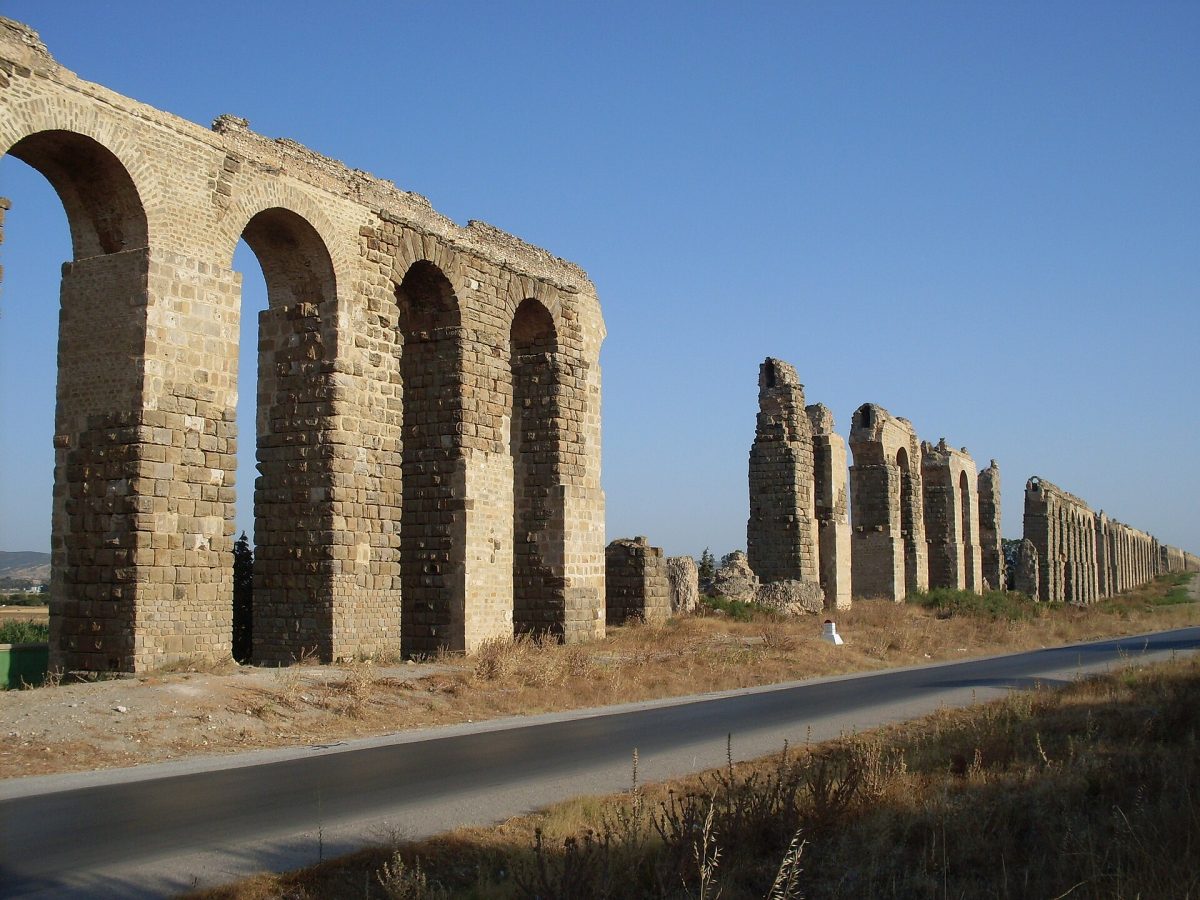
The Zaghouan Aqueduct is the Roman water line that carried spring water from the mountains of Zaghouan to Carthage, 132 km including its branches. Its tall arcades still march across the plain south of Tunis near Mohamedia, and at the source in Zaghouan town a Water Temple of the 2nd century AD marks the sacred spring.
Zaghouan Aqueduct tickets: which one for you
Our pick for each kind of visit, with live dates and prices from GetYourGuide. Free cancellation on most.
Best for: First visit, from Tunis
A guided day with transport and lunch that links the arches, the Water Temple at the spring and the Roman city of Uthina, which are hard to join up by public transport.
- Private, for archaeology fans: Private roman tour oudhna zaghouan thuburbo majus Your own guide and driver for the aqueduct, Uthina and Thuburbo Majus, so you can spend longer at the sites that interest you most.
- From the Hammamet resorts: Full or half day berber experience in zriba ollya takrouna and zaghouan Picks up from Hammamet and pairs Zaghouan with the hill villages of Takrouna and Zriba, a mix of Roman remains and rural Tunisia in one outing.
Tickets and tours: all the options
There is nothing to buy for the aqueduct itself: the arcades stand in open fields beside the roads south of Tunis, and you can stop and walk up to them freely. The Water Temple at Zaghouan is an open site on the hillside above the town; when a guardian is present a small fee or a tip may be asked, but there is no booking system.
Organised tours treat the aqueduct as one stop on a wider day. The common formats are a guided day trip from Tunis with a driver, a guide and lunch, combining the arches, the temple and the Roman city of Uthina near Oudhna; private Roman tours that add Thuburbo Majus; and day trips from Hammamet, Sousse or Mahdia that mix Zaghouan with the Berber villages of Zriba and Takrouna. Some trips are sold to cruise passengers arriving at La Goulette. Entry fees at the other sites are sometimes extra, so check what is included.
With a hired car or a taxi for the day, an independent visit is simple and cheap, and the arches need no explanation. Without one, a guided day from Tunis is the sensible choice, because public transport reaches Zaghouan town but not the best stretches of the arcade or Uthina.
What to see at Zaghouan Aqueduct
Arcades near Mohamedia
The most photographed stretch rises beside the main road south of Tunis near Mohamedia and Fouchana. Here a long line of stone arches, up to about 20 metres tall in places, crosses the plain of the Oued Miliane. Walk along the foot of the arcade to see the cut stone facing, the rubble core and the gaps where sections have fallen.
Water channel and vents
Where the arcade is broken you can look up into the channel on top, about 90 cm wide and 1.3 metres high under a stone vault. Small square openings in the roof let air in, and the inner walls kept their waterproof lining. Falcons and other birds nest in the holes, and the arcade is listed as an important bird area.
9 tickets and tours for Zaghouan Aqueduct
Live dates and prices from GetYourGuide. Free cancellation on most tickets.
Water Temple at Zaghouan
At the source, on the slope above Zaghouan town, the Roman Water Temple stands on an artificial terrace. A crescent-shaped portico with niches for statues curves around a small shrine where the spring emerged, and a basin in front gathered and cleaned the water. It is a 15-minute walk uphill from the town centre or a short drive.
Zaghouan old town
Below the temple, the old town of Zaghouan was settled by Andalusian refugees in the 17th century and keeps whitewashed lanes, a Roman gate and small mosques. It is known for rose water and a local almond pastry. Walking down from the temple through the old streets takes about twenty minutes and ends near the main square and the cafes.
A short history
Carthage, rebuilt as a Roman colony, depended on rain cisterns until the 2nd century AD. Sources link the aqueduct with Hadrian's visit in 128, which ended a five-year drought, and with the opening of the great Antonine Baths in 162. The channel ran by gravity from Zaghouan, dropping only about 264 metres on a journey of some 90 km, and later received a second branch from Djouggar. It was cut by the Vandals in 439, during Justinian's reconquest and at the Arab conquest of 698, and repaired each time. The Hafsid rulers reused it in the 13th century, and in the 1860s it was restored to bring water to Tunis again.
Getting there
The best stretch of arches lies about 25 km south of central Tunis, along the road through Mohamedia and Fouchana towards Zaghouan. Tunis Carthage airport is about 35 km away. There is no convenient bus stop by the arcade, so most independent visitors take a taxi or hire a car; the drive takes about 30 minutes outside rush hour, and you can pull over on the verge near the arches. Zaghouan town is about 60 km south of Tunis, roughly an hour by car. Shared louages leave from the southern louage station in Tunis and drop you in the centre of Zaghouan, from where the Water Temple is a short uphill walk. From Hammamet, Zaghouan is about an hour inland.
Rules and what to bring
Do not climb on the arches, which are loose in places, and stay away from the roadside traffic when taking photographs. Drones need a permit in Tunisia and may be confiscated at customs without one. Bring water, a hat and sunscreen, as there is no shade along the arcade. There are no facilities at the arches; cafes and toilets are in Mohamedia and Zaghouan. Dress modestly in the old town of Zaghouan.
When to go
The arches face the open plain, so the low sun of early morning or late afternoon gives the best light and the most comfortable temperatures. In July and August the plain south of Tunis is very hot and dusty from late morning, so plan the arches early and keep the shaded lanes of Zaghouan for later. There are no crowds at any time of year: day tours stop briefly, and you will often have a stretch of arcade to yourself.
The best months are March to May, when the fields around the arches are green and the hills above Zaghouan are in flower, and October to November, after the summer heat. Winter is mild but can be wet, and dirt tracks to the arches turn muddy after rain. During Ramadan, cafes in Zaghouan close in the daytime. Allow about an hour for the arches near Mohamedia, and a half day to add the Water Temple and the old town.
Combine it with
Uthina, a Roman city with an amphitheatre and mosaics near Oudhna, lies about 15 minutes by car from the arches at Mohamedia. Thuburbo Majus, with its forum and Capitol temple, is about 30 minutes west of Zaghouan. The Bardo Museum in Tunis holds the great mosaics of the region, and Carthage, where the water ended up, is 30 minutes beyond Tunis.
At a glance
| Hours | Arcades visible at any time; Water Temple in daylight hours |
|---|---|
| Closed | Open daily |
| Entry fee | Free; a small fee may be charged at the Water Temple |
| Time needed | About 1 hour, half a day with Zaghouan |
| Best time | Late afternoon for the light; March to May and October to November |
| Booking | No ticket needed; book day tours from Tunis or Hammamet a day ahead |
| Access | Arches seen from roadsides and dirt tracks; temple on a hillside with steps; little shade |
| Getting there | Car or taxi from Tunis to Mohamedia, about 30 minutes; louage to Zaghouan about 1 hour |
| Founded | AD 150 (2nd century AD (midpoint)) |
| Civilisation | Roman |
| Height | 20 m (arcades on the Miliane plain, maximum) |
| Checked | October 2026 |
Frequently asked questions
When is Zaghouan Aqueduct open?
Arcades visible at any time; Water Temple in daylight hours. Open daily.
How much is the entry fee for Zaghouan Aqueduct?
Entry fee: Free; a small fee may be charged at the Water Temple.
How long do you need at Zaghouan Aqueduct?
Allow About 1 hour, half a day with Zaghouan for Zaghouan Aqueduct.
Do I need to book Zaghouan Aqueduct in advance?
No ticket needed; book day tours from Tunis or Hammamet a day ahead.
Can I book a ticket or tour for Zaghouan Aqueduct online?
Yes. GetYourGuide lists 9 tickets and tours for Zaghouan Aqueduct, with live dates and prices and free cancellation on most of them.
When is the best time to visit Zaghouan Aqueduct?
Late afternoon for the light; March to May and October to November.
How do I get to Zaghouan Aqueduct?
Car or taxi from Tunis to Mohamedia, about 30 minutes; louage to Zaghouan about 1 hour.
Is Zaghouan Aqueduct accessible, and what is the terrain like?
Arches seen from roadsides and dirt tracks; temple on a hillside with steps; little shade.
Is Zaghouan Aqueduct worth visiting?
Worth it for the long march of Roman arches across open country and the elegant temple at the spring. Skip or shorten it if you want a ruined city with streets, which nearby Uthina and Thuburbo Majus do better.
How old is Zaghouan Aqueduct?
Zaghouan Aqueduct dates from AD 150 (2nd century AD (midpoint)).