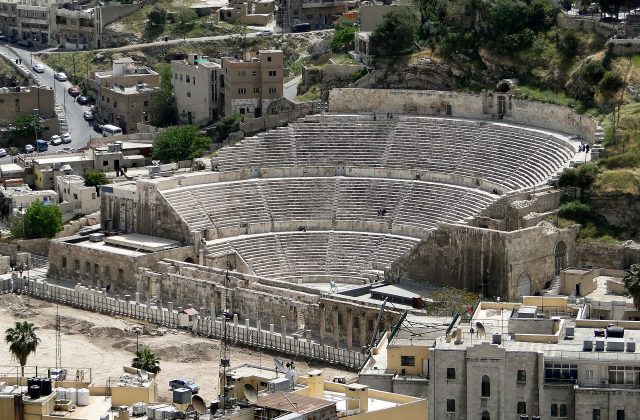
Roman Theatre, Amman
Amman, Jordan
The Roman Theatre of Amman is a steep, 6,000-seat theatre cut into a hillside in the downtown of the Jordanian capital,…
1 ticket or tour
Ancient City · Near Eastern · Jordan
The Amman Citadel crowns Jabal al-Qal'a, the L-shaped hill above downtown Amman that has been lived on since the Bronze Age. Its main sights are the Roman Temple of Hercules, a Byzantine church and the domed Umayyad palace of the 8th century, with a small archaeological museum. The views over the Roman Theatre and the old city are the best in the capital.

Photo: David Bjorgen, CC BY 2.5
Our pick for each kind of visit, with live dates and prices from GetYourGuide. Free cancellation on most.
Best for: First visit to Amman
A local guide leads a walk through the old centre, the markets and up to the Citadel, so the hill makes sense as part of the city rather than a single stop.
Entry is a single ticket bought at the gate at the top of the hill, and it is covered by the Jordan Pass, which most foreign visitors buy before arrival because it also waives the tourist visa fee. The ticket includes the Jordan Archaeological Museum on the site. There is nothing to book in advance and no timed entry.
What is sold online is mostly city walks in which the Citadel is one part. Walking tours of downtown Amman take in the markets, the Roman Theatre and the hill, sometimes with a street art trail. Food walks add tastings of falafel, knafeh and coffee, and a few cultural outings combine the Citadel with a cooking, embroidery or dance class and a meal in a local home. Day trips by car cover the Citadel in the morning and then Jerash and the hilltop castle at Ajloun, or the old town of As-Salt with lunch. Private guides are easy to hire in Amman and are reasonably priced.
Signs on the hill are short, so a guide helps to separate the many periods. For most visitors the Citadel works best on their own with the Jordan Pass, perhaps with a short guide at the gate; join a city walk if you want the downtown streets explained too.
Start at the southern end of the hill with the Great Temple, built in the AD 160s and usually called the Temple of Hercules. Several tall columns of the front portico have been set up again on the podium. Nearby lie the fragments of a giant marble statue, including a hand and an elbow, which suggest a figure about 12 metres high.
From the edge of the temple terrace the city falls away below. Look down on the Roman Theatre cut into the opposite hill, the forum area beside it and the jumble of houses climbing the slopes. This is the place for photographs, especially in the softer light of early morning or late afternoon, when the white stone of the city glows.
Live dates and prices from GetYourGuide. Free cancellation on most tickets.
Walking north along the main path, the remains of a small basilica of the 6th or 7th century AD come next, with rows of column bases and patches of floor. Much of its stone was taken from the unfinished Roman temple. It is a short stop, but it marks the Christian city that existed before the Muslim conquest of AD 661.
At the northern part of the hill stands the Umayyad palace complex of the early 8th century. Its domed audience hall, entered through a cross-shaped vestibule, has been given a modern dome by Spanish restorers and is the best-preserved building on the site. Behind it a colonnaded street leads to courtyards and the foundations of the governor's residence.
Beside the palace a large round cistern, lined with stone steps, collected rainwater for the whole complex. Finish at the Jordan Archaeological Museum near the temple, a small building opened in 1951 with finds from prehistory to the Islamic period, including inscriptions in the Ammonite language. It is compact and takes about twenty minutes.
Citadel Hill has traces of settlement from the Neolithic period, and a tomb shows occupation in the Middle Bronze Age. In the Iron Age it was the capital of the Ammonite kingdom, the Rabbath Ammon of the Bible. It passed to Assyrian, Babylonian, Ptolemaic and Seleucid rulers, and under Rome the city, renamed Philadelphia, spread into the valleys, leaving the hill as its acropolis. The Great Temple dates from AD 161 to 166. After the Muslim conquest the Umayyads built a palace here, but the town declined later and was largely empty until Circassian settlers arrived in 1878. Excavations by Italian, British, French, Spanish and Jordanian teams have continued since the 1920s, and much of the hill is still unexcavated.
The Citadel sits on the hill directly above downtown Amman. From hotels in the city centre a taxi or ride-hailing car takes about 5 minutes to the gate on the hilltop road; from Abdoun or Shmeisani allow 15 to 20 minutes. On foot, steep lanes and stairways climb from the area near the Roman Theatre and King Talal Street; the walk takes about 20 minutes and is hot in summer, so many people take a taxi up and walk down. Queen Alia International Airport is about 35 km south, around 40 minutes by taxi or by the Airport Express bus to the city. Parking at the top is limited but usually possible.
Keep off the walls, the temple podium and the statue fragments, and do not enter fenced excavation areas. Drones are not allowed without official permission in Amman. Dress modestly, with shoulders and knees covered, as you would elsewhere in the city. The hill is exposed, so bring water, a hat and sunscreen; in winter a windproof layer helps. Toilets are near the entrance and a few vendors sell drinks, but there is no proper café on the site.
Arrive at opening at 8 am for cool air and an empty hill, or come in the last hour before closing, when the low sun lights the city and the call to prayer rises from the mosques below. Tour groups usually visit between about 10 am and 1 pm, often combined with the Roman Theatre.
March to May and October to November are the most comfortable months. Summer afternoons are hot on the open hilltop, though Amman is less extreme than the Jordan Valley. Winter brings cold winds and occasional rain, and on rare days snow. Fridays, the weekly holiday, bring local families in the afternoon. During Ramadan the site may close earlier than usual. Allow about an hour and a half for the ruins and museum, and longer if you want to sit at the viewpoints.
The Roman Theatre, built in the 2nd century AD for about six thousand spectators, is a 20-minute walk down the hill, with the Odeon and the downtown markets beside it. The Jordan Museum, 10 minutes by taxi, holds the Ain Ghazal statues. Jerash, the best-preserved Roman city in Jordan, is about an hour north by car.
| Hours | From 8 am; closes about 7 pm Apr–Sep and about 4 pm Oct–Mar; earlier in Ramadan |
|---|---|
| Closed | Open daily |
| Entry fee | from JOD 3; included in the Jordan Pass |
| Time needed | 1.5 to 2 hours |
| Best time | Early morning or the hour before sunset; March to May and October |
| Booking | Pay at the gate or use the Jordan Pass; no booking needed |
| Access | Hilltop site with uneven paving, some steps and little shade; main paths are passable with care |
| Getting there | Taxi from downtown, about 5 minutes; or a steep 20-minute walk up from the Roman Theatre |
| Founded | 1800 BC (fortified c. 1800 BC; Neolithic traces earlier) |
| Civilisation | Near Eastern |
| Checked | October 2026 |
From 8 am; closes about 7 pm Apr–Sep and about 4 pm Oct–Mar; earlier in Ramadan. Open daily.
Entry fee: from JOD 3; included in the Jordan Pass.
Allow 1.5 to 2 hours for Amman Citadel.
Pay at the gate or use the Jordan Pass; no booking needed.
Yes. GetYourGuide lists 7 tickets and tours for Amman Citadel, with live dates and prices and free cancellation on most of them.
Early morning or the hour before sunset; March to May and October.
Taxi from downtown, about 5 minutes; or a steep 20-minute walk up from the Roman Theatre.
Hilltop site with uneven paving, some steps and little shade; main paths are passable with care.
Worth it for a two-hour visit that covers Roman, Byzantine and Umayyad Amman with the city's best viewpoint thrown in. Skip or shorten it if you have only one day in Jordan, when Jerash or Petra will give far more.
Amman Citadel dates from 1800 BC (fortified c. 1800 BC; Neolithic traces earlier).
Amman, Jordan
The Roman Theatre of Amman is a steep, 6,000-seat theatre cut into a hillside in the downtown of the Jordanian capital,…
1 ticket or tour