Ancient City · Greek · Greece
Ancient Olympia
Ancient Olympia is the sanctuary of Zeus in the western Peloponnese where the Olympic Games were held every four years for more than a millennium. The site covers about 106 hectares of pine-shaded ruins: temples, training halls, treasuries and the original stadium. The modern Olympic flame is still lit here at the Temple of Hera.
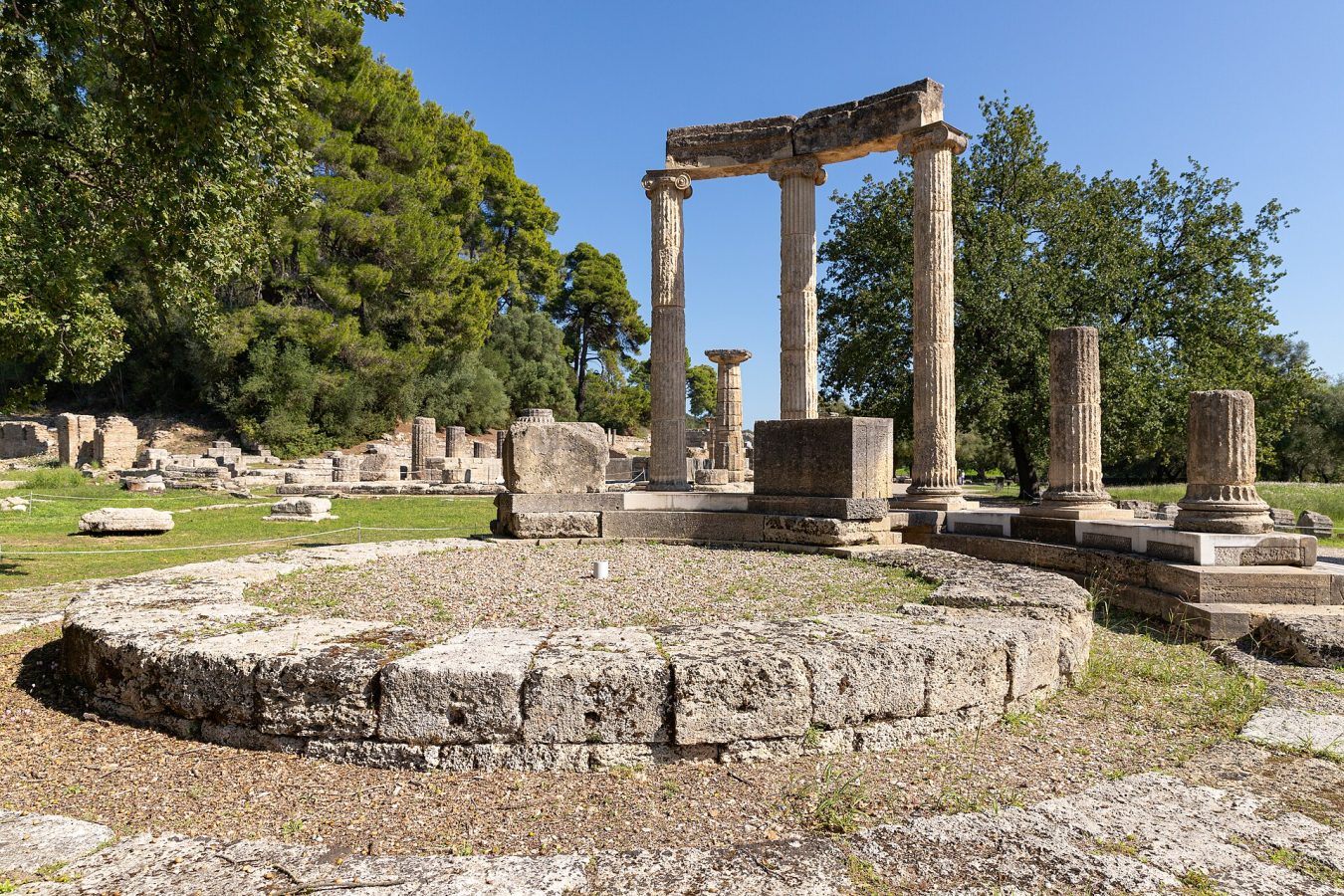
Photo: dronepicr, CC BY 2.0
Ancient Olympia tickets: which one for you
Our pick for each kind of visit, with live dates and prices from GetYourGuide. Free cancellation on most.
Best for: First visit, with an expert
An archaeologist walks you through the Altis and the museum, which turns a field of fallen drums into a readable sanctuary.
- A day trip from Athens: One day tour to ancient olympia Transport there and back in one long day, with a guided visit; the simplest option if you have no car.
- Cruise passengers at Katakolo: Katakolon olympia highlights shore excursion Transfer from the port, a guided loop of the main sights and a return timed to the ship's departure.
Tickets and tours: all the options
One ticket covers the archaeological site, the Archaeological Museum and the smaller museums of the ancient Games and of excavation history. It is sold at the booth by the entrance and on the official Greek e-ticket portal, and there is no timed slot or daily limit, so most independent visitors simply buy it on arrival. Under-18s and EU citizens under 25 enter free, and several state holidays are free for everyone.
Most tours on GetYourGuide fall into three groups. Local guided walks of about two hours start in the village and cover the Altis, the stadium and often the museum; some are led by archaeologists, and private guides can be booked for families. Shore excursions from Katakolo, where cruise ships call, add a coach or minibus transfer of about 40 minutes and a guide, sometimes with a winery, olive farm or beach stop. Day trips from Athens are very long, about three and a half hours on the road each way, and some combine Olympia with the Corinth Canal, Mycenae or Nafplio over two days. Check whether the entry fee is included, as many quotes leave it out. If you have a car, the best plan is to stay in the village, enter at opening on your own ticket and hire a guide only for the first hour.
What to see at Ancient Olympia
Temple of Zeus
From the entrance follow the path past the gymnasium into the Altis, the sacred grove. The Temple of Zeus, finished around 456 BC, lies in tumbled column drums where earthquakes threw them; one column has been raised again. It once held the gold and ivory statue of Zeus by Phidias, counted among the Seven Wonders of the ancient world.
Stadium and vaulted tunnel
East of the temples, walk through the vaulted stone passage the athletes used and come out onto the stadium. The track of about 192 metres between the stone start and finish lines is the length that gave the ancient world its stadion. There were never stone seats: up to 40,000 spectators sat on the grass banks either side.
89 tickets and tours for Ancient Olympia
Live dates and prices from GetYourGuide. Free cancellation on most tickets.
Temple of Hera and Pelopion
Walk back along the terrace of the treasuries, small temple-shaped buildings of the Greek city-states, to the Temple of Hera at the foot of Kronos Hill. It is among the oldest Doric temples in Greece, and the Olympic flame is lit at its altar. The low mound beside it is the Pelopion, the shrine of the hero Pelops.
Philippeion and Zanes
Next to the Temple of Hera stands the Philippeion, a round memorial begun by Philip II of Macedon after 338 BC, with several Ionic columns restored. Below the treasuries runs the row of Zanes bases, which carried bronze statues of Zeus paid for with fines from athletes caught cheating. Their names were carved on the plinths as a warning.
Workshop of Phidias and Palaestra
On the western side of the Altis, the brick building is the workshop where Phidias made the great statue, later turned into an early Christian church. A cup with his name was found nearby. Beside it the palaestra, a square wrestling school with a restored colonnade, is the most photographed corner of the site.
Archaeological Museum
Leave by the main gate and walk five minutes north to the museum. Its central hall reconstructs the two pediments of the Temple of Zeus, with the chariot race and the battle of Lapiths and Centaurs. Look also for the winged Nike of Paeonius, the Hermes attributed to Praxiteles and the bronze helmets dedicated after victories.
A short history
Olympia was a sanctuary rather than a town: people worshipped here from at least the 10th century BC, and tradition dates the first Games to 776 BC. The Games grew into the greatest festival of the Greek world, and most buildings date from the 6th to the 4th century BC, with later Roman baths. After the Roman emperor Theodosius I banned pagan festivals at the end of the 4th century AD, the site declined. Earthquakes in the 6th century and floods of the Alfeios and Kladeos rivers then buried it under several metres of silt. A French expedition dug briefly in 1829, and German excavations began in 1875. Olympia has been on the UNESCO list since 1989.
Getting there
The site lies at the edge of the village of Ancient Olympia, about 20 km east of Pyrgos, the regional town. Buses run from Pyrgos to the village several times a day and take about 40 minutes; Pyrgos has coach links with the Kifissos bus station in Athens, a journey of around four and a half hours. Cruise ships dock at Katakolo, about 35 km away, where taxis and excursion coaches wait at the pier. By car from Athens, allow about three and a half hours via the motorway past Corinth and Patras; there is a free car park beside the entrance. The nearest airports with summer flights are Araxos near Patras and Kalamata, each about two hours' drive.
Rules and what to bring
Do not climb on column drums, walls or the stadium start lines, and keep to the marked paths; guards whistle at anyone sitting on the ruins. Drones and tripods need a permit. Bring water, a hat and sunscreen: the pines shade the Altis, but the stadium is fully exposed. Toilets and a small café are by the entrance, and the village has plenty of tavernas a few minutes away. Large bags may be refused inside the museum.
When to go
Cruise passengers from Katakolo arrive between about 9 am and 11 am, and on days with two or three ships the stadium tunnel and the museum fill with groups until early afternoon. Check the port schedule: on quiet days, or after 3 pm on busy ones, the site is calm. Opening time in summer is the best moment for the stadium, which has no shade at all.
April, May and October are the best months, warm enough for shorts and with green grass among the stones. July and August often pass 35 degrees, as Olympia lies in a sheltered valley; walk the stadium first, then the shaded Altis, and leave the air-conditioned museum for the middle of the day. Winter is quiet but hours are short. The flame-lighting ceremony at the Temple of Hera takes place a few months before each Olympic Games and closes parts of the site. Allow two hours for the ruins and one more for the museum.
Combine it with
The village itself is small; stay overnight to see the site at opening. The Temple of Apollo Epicurius at Bassae, another UNESCO site in the mountains, is about an hour and a half by car. Katakolo has a beach and a museum of ancient Greek technology, and the Kaiafas lagoon lies about 40 minutes south on the way to Kalamata.
At a glance
| Hours | 8 am to 8 pm Apr–Aug, closing earlier in steps to 6 pm by late Oct; 8.30 am to 3.30 pm Nov–Mar |
|---|---|
| Closed | Open daily except 1 Jan, 25 Mar, 1 May, Orthodox Easter Sunday, 25 and 26 Dec |
| Entry fee | from EUR 20 with the museums; EU under-25s free |
| Time needed | 3 to 4 hours with the museum |
| Best time | At opening or the last two hours; April, May and October |
| Booking | Pay at the gate or online; no need to book ahead |
| Access | Level gravel paths with some shade from pines; the stadium tunnel and museum are step-free |
| Getting there | Bus from Pyrgos to Ancient Olympia village, about 40 minutes; the gate is a 5-minute walk |
| Founded | 776 BC (traditional date of the first Games, 776 BC) |
| Excavated | 1875 |
| Civilisation | Greek |
| Area | 1.1 km² |
| Visitors | 484 238 a year (2018) |
| UNESCO | Archaeological Site of Olympia |
| Website | olympia-greece.org |
| Checked | October 2026 |
Frequently asked questions
When is Ancient Olympia open?
8 am to 8 pm Apr–Aug, closing earlier in steps to 6 pm by late Oct; 8.30 am to 3.30 pm Nov–Mar. Open daily except 1 Jan, 25 Mar, 1 May, Orthodox Easter Sunday, 25 and 26 Dec.
How much is the entry fee for Ancient Olympia?
Entry fee: from EUR 20 with the museums; EU under-25s free.
How long do you need at Ancient Olympia?
Allow 3 to 4 hours with the museum for Ancient Olympia.
Do I need to book Ancient Olympia in advance?
Pay at the gate or online; no need to book ahead.
Can I book a ticket or tour for Ancient Olympia online?
Yes. GetYourGuide lists 89 tickets and tours for Ancient Olympia, with live dates and prices and free cancellation on most of them.
When is the best time to visit Ancient Olympia?
At opening or the last two hours; April, May and October.
How do I get to Ancient Olympia?
Bus from Pyrgos to Ancient Olympia village, about 40 minutes; the gate is a 5-minute walk.
Is Ancient Olympia accessible, and what is the terrain like?
Level gravel paths with some shade from pines; the stadium tunnel and museum are step-free.
Is Ancient Olympia worth visiting?
Worth it for walking the original Olympic stadium and seeing the Temple of Zeus sculptures in the museum. Skip or shorten it if you dislike low, fallen ruins, or if a cruise stop leaves you only an hour in the heat.
How old is Ancient Olympia?
Ancient Olympia dates from 776 BC (traditional date of the first Games, 776 BC). Excavations began in 1875.
Is Ancient Olympia a UNESCO World Heritage Site?
Yes. Ancient Olympia is part of the UNESCO World Heritage Site Archaeological Site of Olympia.