Chicanna
Xpujil, Mexico
Chicanna is a small Maya site in southern Campeche, famous for a temple whose doorway is carved as the gaping mouth of…
No online ticket
Ancient City · Maya · Mexico
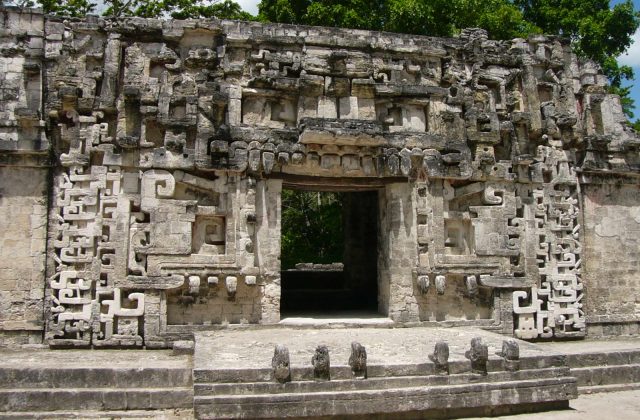
Becan is a Maya city in the forests of southern Campeche, Mexico, surrounded by a dry moat almost 2 km long that is unique among Maya sites. Its plazas, palaces and pyramids in the Rio Bec style, with rounded corners and false towers, are easy to visit from Xpujil and rarely see more than a handful of visitors.

Photo: Infrogmation, CC BY-SA 4.0
Becan is run by INAH, Mexico's national institute of archaeology, and entry is by a small fee paid at the ticket office by the car park. There is no timed entry and no queue. Mexican residents enter free on Sundays, and the ticket covers only Becan; nearby sites such as Chicanna and Xpujil each charge their own modest fee. Guides are sometimes available at the entrance, and the panels give the basic layout in Spanish and English.
Online, the only product that includes Becan is a half-day tour from Bacalar or Chetumal with transport and a guide. It suits visitors based on the Caribbean side who do not have a car and want an easy introduction to the Rio Bec region, though the drive takes about two hours each way.
Most visitors combine Becan with Calakmul, Chicanna and Xpujil over two or three days, staying in Xpujil or in the eco-lodges along the highway. Local guides and drivers in Xpujil organise trips to Calakmul, and many include Becan on the way back.
The sensible plan for most people is to stay at least one night in Xpujil, visit Becan with your own transport or a taxi, and use the local guides only for the longer trip into the Calakmul reserve.
Before entering the core, look at the dry moat that circles the city, about 1.9 km around and up to several metres deep, with an earth bank on the inner side. Seven raised causeways once crossed it. The path from the car park passes over one of them. Experts still debate whether it was built for defence or to mark a sacred boundary.
Inside the moat, the tallest pyramid rises about 30 metres above the main plaza. Its steep stairway leads to a temple at the top, and the view from there stretches over unbroken forest to the south. Climbing may be allowed or restricted depending on its condition, so check the signs before setting off up the steps.
Live dates and prices from GetYourGuide. Free cancellation on most tickets.
Next to the main plaza, Structure VIII is a palace complex with two false towers in the Rio Bec style and dark vaulted passages running through it. Walk through the tunnel-like corridors, which connect plazas and courtyards; bring a torch, as some sections are completely dark. Watch for bats in the inner rooms.
Across the central plaza, Structure X is a temple with a large stucco mask of a deity under a modern roof on its front. Around it, smaller palaces and platforms show the rounded corners and decorated facades typical of the region, with pieces of carved stone and stucco preserved.
Finish at the eastern side of the site, where a small ballcourt and several platforms frame a quieter plaza shaded by tall trees. Fewer people walk this far, and it is a good place to rest in the shade. From here, the path loops back to the entrance across one of the causeways, giving a second view of the moat.
Becan was occupied from the Middle Preclassic period, around 550 BC, and the moat was dug in the Late Preclassic or early Classic, perhaps between AD 100 and 250, when it was one of the largest fortified sites of the Maya lowlands. The city reached its peak between about AD 600 and 1000 as a regional centre of the Rio Bec style, with palaces and false towers covered in stucco. It was abandoned, like many lowland sites, around AD 1200. The ruins were reported in 1934 by Karl Ruppert and John Denison of the Carnegie Institution, who named the site after the moat. Tulane University studied the ditch in 1969 to 1971, and INAH later restored the main buildings.
Becan lies just north of Federal Highway 186, about 7 km west of the town of Xpujil, in the municipality of Calakmul in Campeche. From Xpujil, a taxi takes about 10 minutes; agree a price with waiting time or arrange a pickup. By car, follow the highway west and turn off at the signposted access road to the parking area. Chetumal is about 120 km east, roughly an hour and three-quarters by car, and Bacalar about two hours. Chetumal has the nearest commercial airport. The Tren Maya line between Chetumal and Escarcega has a station at Xpujil, and ADO buses on the same route also stop in town.
Climbing is allowed only on structures where signs permit it; take care on steep, narrow stairs and never climb on facades or stucco decoration. Bring plenty of water, a hat, sun cream and insect repellent, since mosquitoes are common in the forest. A torch helps in the passages of Structure VIII. Toilets are at the entrance, but there are no shops or cafes inside; Xpujil has restaurants. Drones need an INAH permit.
Becan is never crowded, and even in high season you may share the site with only a few other visitors. The main challenge is the climate. From April to June the heat and humidity are intense and the stone gets very hot by midday. The rainy season, roughly June to October, brings afternoon storms and more mosquitoes, though the forest is green. The best months are November to March, when it is cooler and drier.
The ideal times of day are opening at 8 am, when birds and howler monkeys are active and the light is soft, or after 3 pm, when the sun is lower; the last entry is about an hour before closing. Allow about two hours to walk around the moat, explore the passages and climb the main structures. If you are combining it with Chicanna or Xpujil, start at Becan early in the morning and visit the smaller sites later.
Chicanna, with its famous serpent mouth doorway, is 2 km away, and the site of Xpujil with its three towers is at the edge of town. Calakmul, the great Classic city inside the biosphere reserve, is about two hours away by road and needs a full day. Balamku and Hormiguero are also nearby.
| Hours | Daily 8 am to 5 pm; last entry around 4 pm |
|---|---|
| Closed | Open daily |
| Entry fee | Small INAH fee at the gate |
| Time needed | 1.5 to 2 hours |
| Best time | At opening or after 3 pm; November to March, drier months |
| Booking | Pay at the gate; no booking needed |
| Access | Steep stairs and some climbing on structures; forest paths and humidity; no shade in plazas |
| Getting there | About 7 km west of Xpujil on Highway 186, 10 minutes by taxi |
| Civilisation | Maya |
| Checked | October 2026 |
Daily 8 am to 5 pm; last entry around 4 pm. Open daily.
Entry fee: Small INAH fee at the gate.
Allow 1.5 to 2 hours for Becan.
Pay at the gate; no booking needed.
Yes. GetYourGuide lists one ticket or tour for Becan, with live dates and prices and free cancellation on most of them.
At opening or after 3 pm; November to March, drier months.
About 7 km west of Xpujil on Highway 186, 10 minutes by taxi.
Steep stairs and some climbing on structures; forest paths and humidity; no shade in plazas.
Worth it for the moat, the vaulted passages and the Rio Bec architecture, all in quiet jungle with few people. Skip or shorten it if you dislike heat and humidity, or prefer large restored sites such as Palenque or Chichen Itza.
Xpujil, Mexico
Chicanna is a small Maya site in southern Campeche, famous for a temple whose doorway is carved as the gaping mouth of…
No online ticket