Becan
3 km away
Becan is a Maya city in the forests of southern Campeche, Mexico, surrounded by a dry moat almost 2 km long that is…
1 ticket or tour
Ancient City · Maya · Mexico
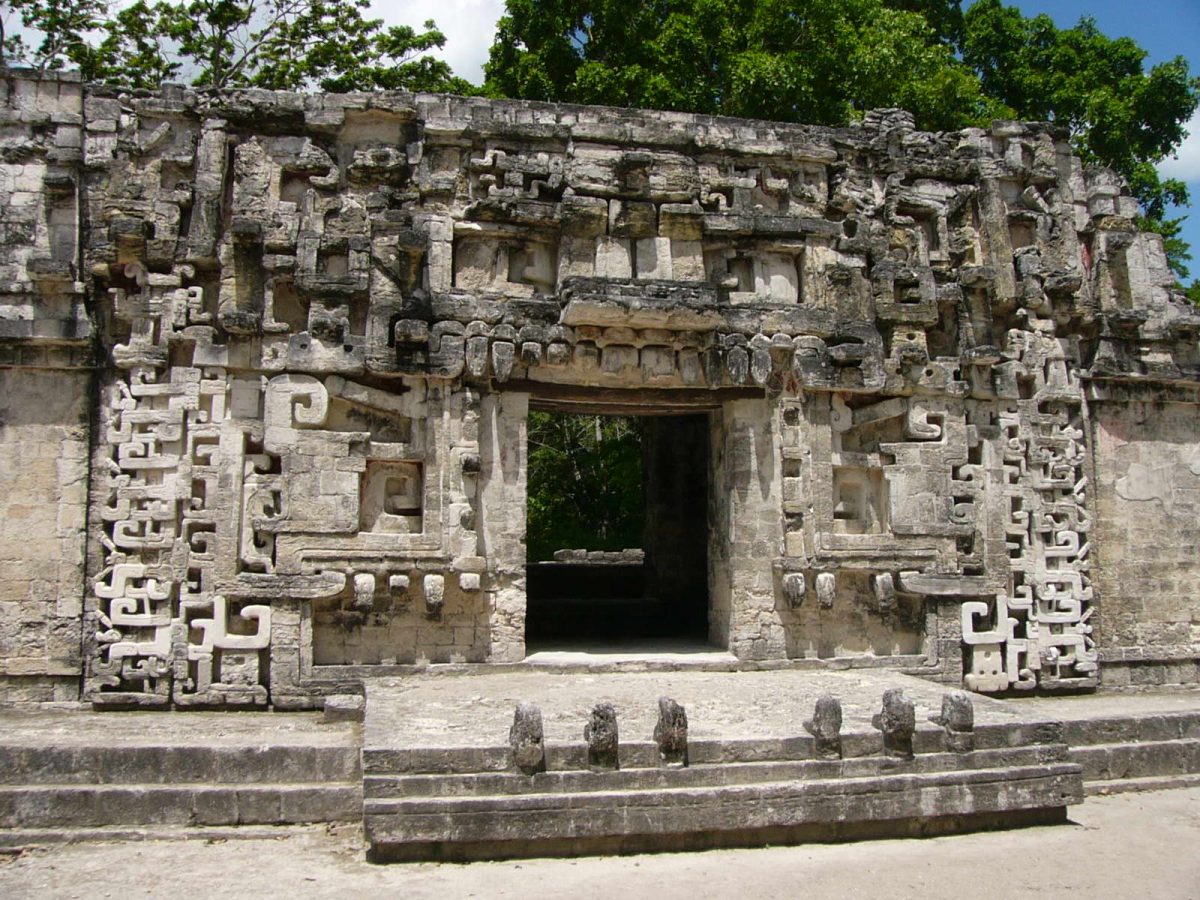
Chicanna is a small Maya site in southern Campeche, famous for a temple whose doorway is carved as the gaping mouth of a serpent-like monster. It flourished between about AD 500 and 800 as an elite district linked to nearby Becan. The buildings are low but richly decorated in the Rio Bec and Chenes styles, and visitors are few.
Nothing for Chicanna alone is sold online. Entry works the usual way for sites run by INAH, the national institute of archaeology: you pay a small fee in pesos at the ticket booth by the car park, and Sundays are free for Mexican citizens and residents. Bring cash, since card machines are unreliable in this remote area. There is no audio guide and only basic signs in Spanish and English.
Most people visit in one of two ways. Independent travellers with a car stop here on Highway 186 between Escarcega and Chetumal, often adding Becan and Xpuhil on the same afternoon, all within a few kilometres. Others base themselves in Xpujil for two nights and use local taxis or a hotel driver.
Small agencies and guides in Xpujil arrange day tours that combine Chicanna with Becan, Hormiguero or Balamku, and sometimes with Calakmul the following morning. These usually include transport and a Spanish- or English-speaking guide, while entry fees and lunch are often extra. Hotels in Xpujil and the eco-lodges on the road to Calakmul can book them.
The sensible choice is to rent a car in Campeche, Bacalar or Chetumal and drive the Rio Bec sites at your own pace, adding a guide only for Calakmul.
From the entrance a short path leads to the main plaza, where Structure II stands on its east side. Its central doorway is framed as an enormous open mouth with fangs above and below, read as the face of the creator god Itzamna. Look for the eyes and curled snout carved in stucco over the lintel and the stepped panels to either side.
Facing it across the plaza, Structure I is a longer range of six rooms with two low towers in the Rio Bec style, imitation pyramids with steps too steep to climb. Its four relief panels survive in part. Archaeologists believe the two temples were aligned with the sun's movements and served the calendar.
Live prices from GetYourGuide for tickets and tours that include this site. Free cancellation on most of them.
A forest path of a few hundred metres leads to Structure XX, a two-storey building whose upper temple also has a monster-mouth doorway, stacked masks at the corners and remains of stucco. It is one of the best examples of the Chenes style this far south, and the climb to the upper terrace is short but steep.
Returning towards the plaza, the outlying groups include Structure VI, a smaller temple with traces of a roof comb and decorated facades. These buildings are less restored, but quiet: look for agoutis, coatis and toucans in the surrounding trees, especially early in the morning when the site has just opened.
Chicanna was occupied from about 300 BC until roughly AD 1100, but most of what stands today dates from its peak between AD 500 and 800, in the Late Classic period. It was a compact settlement of fine residences and temples that seems to have depended on Becan, the walled capital of the Rio Bec region 2 km away, and may have housed its ruling families. Its buildings mix the Rio Bec, Chenes and Puuc styles. The archaeologist Jack Eaton recorded the site in 1966 and named it after the serpent-mouth doorway of Structure II, which was excavated around 1970. INAH has since consolidated the main groups, and the site lies within the wider Calakmul region.
Chicanna is just south of Highway 186, the road across the base of the Yucatan Peninsula, about 11 km west of the small town of Xpujil and 2 km from the entrance road to Becan. Signs mark the turning, and a short access road ends at the car park and ticket booth. ADO buses between Escarcega, Campeche and Chetumal stop in Xpujil; from there a taxi takes about 15 minutes, and drivers will wait or return. Chetumal airport is about 120 km east, roughly two hours by car, and Campeche city is about four hours north-west. There are fuel stations in Xpujil, but few on the long stretches either side, so fill up.
Climbing is restricted on the decorated facades, and drones need an INAH permit. Do not touch the stucco. Bring insect repellent, water and a hat: mosquitoes are fierce in the wet season and there is no shop inside. Toilets are at the entrance. Stay on marked paths, which also helps avoid ticks and snakes in the undergrowth.
Arrive at opening, at 8 am, when the forest is cool, the light falls on the east-facing doorways and birds and monkeys are active. By late morning the humidity builds and the sun is strong in the open plaza. Chicanna is rarely busy at any hour; even in high season you may share it with only a handful of people, because tour groups head for Calakmul instead.
The dry season from November to April is the best time to visit. Rain is common from June to October, when paths turn muddy and mosquitoes multiply, although the forest is greenest then and the site is almost empty. April and May are the hottest months.
Allow about an hour for the main plaza and Structure XX. With Becan, Xpuhil and Chicanna together, plan a full afternoon, and keep Calakmul, two hours away, for a separate early start.
Becan, with its moat, wall and tall pyramids, is about 2 km away and needs two hours. Xpuhil's three-towered temple stands on the edge of Xpujil town, 15 minutes east. Calakmul, the great Maya capital deep in the biosphere reserve, is about 2 hours' drive from Xpujil and deserves a full day.
3 km away
Becan is a Maya city in the forests of southern Campeche, Mexico, surrounded by a dry moat almost 2 km long that is…
1 ticket or tour
56 km away
Calakmul is the great Maya capital of the Snake Kingdom, deep in the rainforest of southern Campeche, 35 km from the…
9 tickets & tours
75 km away
Kohunlich is a Maya city in the rainforest of southern Quintana Roo, about 65 km west of Chetumal, known above all for…
4 tickets & tours
| Hours | Usually 8 am to 5 pm (INAH hours); last entry about an hour before closing |
|---|---|
| Closed | Normally open daily; check with INAH Campeche on holidays |
| Entry fee | Small INAH fee in pesos; Sundays free for Mexican residents |
| Time needed | about an hour |
| Best time | At 8 am for birds and cool air; November to April, the dry season |
| Booking | Pay at the gate; no booking needed |
| Access | Short forest paths, uneven stone and steep steps; humid and shaded; hard for wheelchairs |
| Getting there | About 11 km west of Xpujil on Highway 186; taxi from Xpujil about 15 minutes |
| Founded | 300 BC (c. 300 BC) |
| Abandoned | 1100 |
| Excavated | 1970 |
| Civilisation | Maya |
| Checked | October 2026 |
Usually 8 am to 5 pm (INAH hours); last entry about an hour before closing. Closed: Normally open daily; check with INAH Campeche on holidays.
Entry fee: Small INAH fee in pesos; Sundays free for Mexican residents.
Allow about an hour for Chicanna.
Pay at the gate; no booking needed.
Yes. GetYourGuide sells tickets and guided tours whose route includes Chicanna; live prices are shown on this page.
At 8 am for birds and cool air; November to April, the dry season.
About 11 km west of Xpujil on Highway 186; taxi from Xpujil about 15 minutes.
Short forest paths, uneven stone and steep steps; humid and shaded; hard for wheelchairs.
Worth it for travellers on the Rio Bec route who want the finest monster-mouth facade in the region. Skip or shorten it if you came for tall pyramids: Calakmul and Becan offer those, and Chicanna needs only an hour.
Chicanna dates from 300 BC (c. 300 BC). It was abandoned in 1100. Excavations began in 1970.
Xpujil, Mexico
Becan is a Maya city in the forests of southern Campeche, Mexico, surrounded by a dry moat almost 2 km long that is…
1 ticket or tour