Dadan
AlUla, Saudi Arabia
Dadan, in the oasis of AlUla in north-west Saudi Arabia, was the capital of the ancient kingdoms of Dadan and Lihyan,…
9 tickets & tours
Tomb & Necropolis · Near Eastern · Saudi Arabia
Hegra, 20 km north of AlUla, was the second city of the Nabataean kingdom after Petra and is now Saudi Arabia's first UNESCO World Heritage Site. More than 110 monumental tombs are carved into its sandstone outcrops, many with inscriptions on their facades, and the dry climate has kept them unusually sharp.

Photo: Carole Raddato from FRANKFURT, Germany, CC BY-SA 2.0
Our pick for each kind of visit, with live dates and prices from GetYourGuide. Free cancellation on most.
Best for: First visit, the standard tour
The guided circuit of the main tomb groups and the rock sanctuary, with the entry included and transport around the site.
Hegra cannot be visited on your own. Entry is only by guided tour sold through Experience AlUla, the official tourism platform, with a choice of time slots during the day. The standard version uses buses that drive between the main tomb groups, with a guide at each stop. Premium options use small vintage open vehicles or private hosts and cost more. Tickets often sell out at weekends and in the winter season, so book a few days ahead.
The tours sold on GetYourGuide are packages built around these visits. Some cover Hegra alone, with entry and transport from your hotel; others combine it with AlUla Old Town, Elephant Rock, the ancient city of Dadan and the inscriptions of Jabal Ikmah for a full day. There are also nature and wildlife drives, photography tours, sunset visits, family tours and balloon flights over the valley at sunrise, as well as long day trips from Medina and organised trips from Jeddah.
For a first visit, the standard guided tour is enough to see the main tombs; add Dadan and Jabal Ikmah on the same day if you have only one full day in AlUla.
The most famous tomb stands alone in a single huge boulder, its facade, crowned with stepped motifs, carved from the top down and never finished, so the lower part is still rough. It was made in the 1st century AD for a man named Lihyan son of Kuza. Walk round the rock to see how the carvers worked downward.
This large outcrop holds dozens of tombs on its faces, among them some of the finest at Hegra. Look above the doorways for carved eagles, urns and faces, and for the inscribed panels giving the owner's name, the date and curses on anyone who reused the tomb. The tallest facades reach about 16 metres.
Live dates and prices from GetYourGuide. Free cancellation on most tickets.
A smaller group of tombs on a reddish outcrop to the south has plainer facades crowned with the stepped motifs typical of Nabataean design. Here you can look inside an open tomb and see the burial niches cut into the floor and walls. It is often quieter than the main stops.
To the north-east, a narrow passage between high rocks leads into a hidden sanctuary. Beside it, the Diwan is a rock-cut hall with benches on three sides, probably used for religious banquets. Look for small niches carved for sacred stones along the passage walls, and for inscriptions in Nabataean script.
On the edge of the site lie the restored buildings of a station on the Ottoman railway from Damascus to Medina, opened in the early 20th century. A workshop shed holds an old locomotive and wagons, and the stone buildings show how pilgrims once travelled south. Some tours stop here at the end.
Inscriptions in the Lihyanite script on nearby rocks show settlement by the 3rd or 2nd century BC, when the oasis lay on the incense route. The Nabataeans developed it in the 1st century AD under King Aretas IV, making it the southern centre of their kingdom, with wells, farms and monumental tombs. In AD 106 Rome annexed the kingdom, and Hegra became part of the province of Arabia, with a Roman garrison and inscriptions in Greek and Latin. Later the site was largely abandoned and gained a reputation as a cursed place linked to the people of Thamud in the Quran. In 2008 it became Saudi Arabia's first UNESCO World Heritage Site.
Hegra lies about 20 km north of the town of AlUla in north-west Saudi Arabia. AlUla International Airport has flights from Riyadh and Jeddah and some seasonal international routes; taxis and hire cars are available on arrival. Most tours start from the official visitor centre, where you check in before boarding the tour bus into the site; it is about 30 minutes by car from the town centre. Without a car, use a taxi or the shuttle services run during the winter season, and ask about transfers when booking. From Medina the drive takes about four hours. There is parking at the visitor centre.
Touching or climbing the tomb facades is forbidden, and visitors must stay with the guide and on the marked paths. Drones are not allowed without a permit. Dress modestly, with shoulders and knees covered, and bring a hat, sunglasses, sunscreen and water, especially outside winter. Wear closed shoes for sand and rock. The visitor centre has toilets, a cafe and shade; there are no facilities inside the site between stops.
The best months are October to March, when days are warm and sunny and nights in the desert can be cold. This is also the main season, when AlUla hosts winter festivals and concerts, and the most popular tour times, early morning and late afternoon, sell out first.
From May to September midday temperatures often pass 40 degrees, and tours are fewer and shorter. Early morning gives soft light on the tombs and cooler air. The late afternoon slot ends in golden light on the sandstone, which is the best time for photographs. Weekends, especially Friday and Saturday, are busier with Saudi visitors. During Ramadan tour times may change. Allow about three hours for the tour and transfers, and a full day if you add Dadan and Jabal Ikmah.
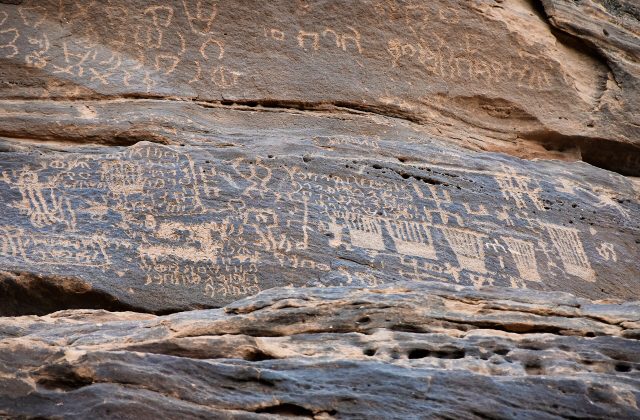
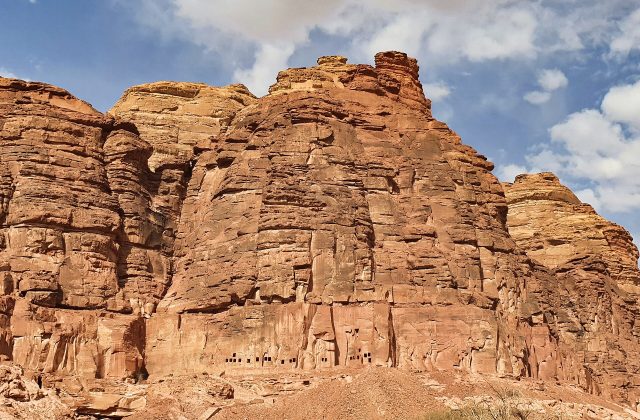
Dadan, the capital of the Lihyanite kingdom with tombs cut into a cliff face, and Jabal Ikmah, a canyon covered with ancient inscriptions, are about 30 to 40 minutes south. AlUla Old Town, a mud-brick village, and Elephant Rock, a huge sandstone arch, are easy to add for sunset.
| Hours | Tours run from morning to sunset; times vary by season |
|---|---|
| Closed | Open daily; tour times vary with the season |
| Entry fee | from SAR 95 for the standard guided tour; premium tours cost more |
| Time needed | About 3 hours |
| Best time | Early morning or the late afternoon tour; Oct–Mar |
| Booking | Book a tour through the official AlUla platform; weekends and winter sell out |
| Access | Tour buses between stops; short walks on sand and rock; some stops reachable in a wheelchair |
| Getting there | From AlUla town, about 30 minutes by road to the visitor centre; tour buses run from there |
| Founded | AD 50 (1st century AD (midpoint)) |
| Civilisation | Near Eastern |
| Area | 16.2 km² |
| UNESCO | Hegra Archaeological Site (al-Hijr / Mada'in Salih) |
| Checked | October 2026 |
Tours run from morning to sunset; times vary by season. Open daily; tour times vary with the season.
Entry fee: from SAR 95 for the standard guided tour; premium tours cost more.
Allow About 3 hours for Hegra (Mada’in Salih).
Book a tour through the official AlUla platform; weekends and winter sell out.
Yes. GetYourGuide lists 21 tickets and tours for Hegra (Mada’in Salih), with live dates and prices and free cancellation on most of them.
Early morning or the late afternoon tour; Oct–Mar.
From AlUla town, about 30 minutes by road to the visitor centre; tour buses run from there.
Tour buses between stops; short walks on sand and rock; some stops reachable in a wheelchair.
Worth it for the carved tomb facades of Qasr al-Farid and Qasr al-Bint in a desert landscape with few visitors. Skip or shorten it if you dislike set itineraries: visits follow a guided tour with fixed stops, and summer heat is severe.
Hegra (Mada’in Salih) dates from AD 50 (1st century AD (midpoint)).
Yes. Hegra (Mada’in Salih) is part of the UNESCO World Heritage Site Hegra Archaeological Site (al-Hijr / Mada'in Salih).
AlUla, Saudi Arabia
Dadan, in the oasis of AlUla in north-west Saudi Arabia, was the capital of the ancient kingdoms of Dadan and Lihyan,…
9 tickets & tours
AlUla, Saudi Arabia
Jabal Ikmah is a sandstone canyon in the AlUla oasis of north-western Saudi Arabia whose walls carry hundreds of…
8 tickets & tours