Dahshur Pyramids
45 km away
Dahshur is the royal cemetery south of Cairo where King Sneferu built the Bent Pyramid and the Red Pyramid around 2600…
10 tickets & tours
Ancient City · Egyptian · Egypt
Karanis is the mud-brick ruin of a Ptolemaic and Roman farming town on the north-eastern edge of the Faiyum Oasis, about 75 km south-west of Cairo. It covered roughly 60 hectares and kept two limestone temples to crocodile gods, streets of collapsed houses and a small museum, and it sees very few foreign visitors.
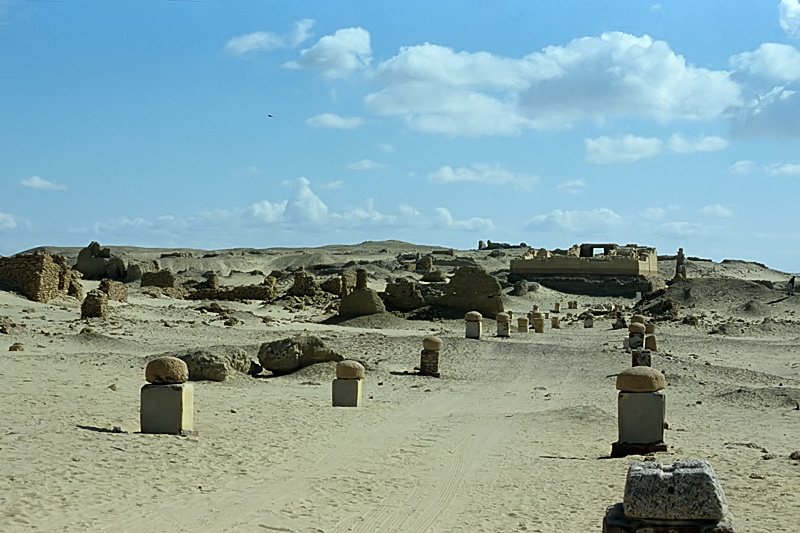
Photo: Roland Unger, CC BY-SA 3.0
Nothing is sold online for Karanis on its own, and no regular tour of the site appears on the big booking platforms. Entry works the simple Egyptian way: you buy a ticket from the guard post at the gate and walk in. The small Kom Aushim Museum beside the ruins may be covered by the same ticket or charged separately, so ask at the window.
Most foreign visitors come on a private day trip to the Faiyum from Cairo with a driver, and sometimes with an Egyptologist guide booked through a hotel or a local agency. Such trips usually pair Karanis with Wadi el Rayan and its waterfalls, the fossil valley of Wadi el Hitan, Lake Qarun or the pottery village of Tunis, so the ruin takes an hour or so of a long day. Check what the price covers: transport and driver are normal, while entry tickets and lunch are often extra.
There is little signage on the site, so a guide who can explain the temples and the street plan is worth more here than at a better-presented monument. The sensible plan is a car with a driver for the day, Karanis first while the morning is cool, then the lake and the desert sites.
The best-preserved building and the first stop from the gate is the limestone South Temple, built in Egyptian style and dedicated under Nero to two crocodile gods, Pnepheros and Petesouchos. Walk through the gateway into the inner rooms, look for the raised altar in the sanctuary and the small rooms on both sides where priests lived and stored temple goods.
A short walk north across the mounds, the North Temple is plainer but keeps engaged columns of Greek and Roman type at its outer corners and in the doorways. An altar sized for a crocodile mummy suggests that it also served a crocodile god. From its walls you get the clearest view over the street pattern of the town.
Live prices from GetYourGuide for tickets and tours that include this site. Free cancellation on most of them.
Between and around the temples stretch the ruined houses of farming families, built of mud brick with vaulted cellars, wall niches and the stumps of staircases. Look for the large storage buildings with rows of bins, where grain was kept before it was taxed and shipped. Walk carefully: the walls are fragile and the ground hides holes.
Towards the edge of the excavated area lies a small public bath, recognisable by fired brick, plaster-lined basins and the remains of heating channels under the floors. It is modest beside the baths of big Roman cities, but it shows that even a village of farmers and veterans in the Faiyum kept up Greek and Roman habits.
Finish at the museum by the entrance, opened in 1974, which displays pottery, tools, glass, coins and other finds from Karanis and from older sites in the oasis. It is small and old-fashioned, but it gives context that the bare mounds outside cannot, and it is a shaded place to rest before the drive on.
Karanis was one of the settlements founded in the Faiyum under Ptolemy II Philadelphus in the 3rd century BC to farm newly drained land. It stagnated in the late Ptolemaic period and grew again after Augustus took Egypt and had the canals and dykes repaired. Retired soldiers, mostly Greek speakers, farmed here, and the town prospered into the 2nd century AD before slow decline. Radiocarbon dates show that people still lived here in the 6th century. Farmers dug the mound for fertiliser for decades; Grenfell and Hunt tested it in 1895, and the University of Michigan excavated from 1924, recovering thousands of papyri now in its collection.
Karanis lies at Kom Aushim on the main desert road from Cairo to the city of Faiyum, at the point where the road drops into the oasis. From central Cairo or Giza the drive takes about an hour and a half; from Cairo International Airport allow two hours or more in traffic. The usual way is a private car with a driver or a taxi hired for the day, since public minibuses run to Faiyum city but do not make a practical return trip for visitors. The entrance and a small parking area are next to the road, and the temples are a five-minute walk from the gate. Foreign visitors heading into the Faiyum may be accompanied by tourist police.
Do not climb on the mud-brick walls or the temple stones, and do not pick up sherds or other finds lying on the ground: everything belongs to the site. Drones need a permit in Egypt and are likely to be confiscated without one. Bring water, a hat, sunscreen and closed shoes for the loose ground, and carry cash in small notes for the ticket. Facilities are basic, so plan food and toilets in Faiyum or on the road.
Go in the morning. The site sits on the edge of the desert with no shade at all, and from May to September the heat at midday is hard to bear on the open mounds. The most comfortable months are October to April, when mornings are mild and the light is good for photographs. Winter days are short, so start early if you also want Wadi el Rayan or Wadi el Hitan.
Crowds are not a problem: you may share the site with a handful of other visitors or none at all, although Egyptian school groups sometimes visit the museum. Friday is the main day out for families from Cairo, so the roads to Lake Qarun and the oasis are busier then. Allow one to two hours for the ruins and the museum, and plan Karanis as part of a full day in the Faiyum.
Karanis is the first stop on most Faiyum day trips from Cairo. Lake Qarun is about 30 minutes away, the pottery village of Tunis about an hour, and the waterfalls of Wadi el Rayan and the whale fossils of Wadi el Hitan, a UNESCO site, a further hour or two into the desert. The pyramids at Hawara and Meidum can be added with an early start.
45 km away
Dahshur is the royal cemetery south of Cairo where King Sneferu built the Bent Pyramid and the Red Pyramid around 2600…
10 tickets & tours
49 km away
Saqqara is the vast burial ground of ancient Memphis, 30 km south of Cairo, where the Step Pyramid of Djoser stands as…
23 tickets & tours
49 km away
Memphis, at the village of Mit Rahina about 20 km south of Cairo, was the capital of Egypt from around 3100 BC and the…
13 tickets & tours
| Hours | Daytime only, roughly 8 am to 4 pm; confirm locally before driving out |
|---|---|
| Closed | Usually open daily; check locally on public holidays |
| Entry fee | A modest fee at the gate; ask about student rates |
| Time needed | 1 to 2 hours with the museum |
| Best time | Early morning; October to April, when the desert edge is cooler |
| Booking | No booking; pay at the gate |
| Access | Sand, loose rubble and uneven mounds with no shade; not suitable for wheelchairs or pushchairs |
| Getting there | Car or taxi from Cairo on the desert road to Faiyum, about 1.5 hours; the site is by the road |
| Founded | 250 BC (3rd century BC (midpoint), under Ptolemy II) |
| Abandoned | AD 650 |
| Excavated | 1924 |
| Civilisation | Egyptian |
| Area | 60 ha |
| Checked | October 2026 |
Daytime only, roughly 8 am to 4 pm; confirm locally before driving out. Closed: Usually open daily; check locally on public holidays.
Entry fee: A modest fee at the gate; ask about student rates.
Allow 1 to 2 hours with the museum for Karanis (Kom Aushim).
No booking; pay at the gate.
Yes. GetYourGuide sells tickets and guided tours whose route includes Karanis (Kom Aushim); live prices are shown on this page.
Early morning; October to April, when the desert edge is cooler.
Car or taxi from Cairo on the desert road to Faiyum, about 1.5 hours; the site is by the road.
Sand, loose rubble and uneven mounds with no shade; not suitable for wheelchairs or pushchairs.
Worth it for travellers curious about ordinary life in Roman Egypt, combined with a Faiyum day out. Skip it if you want painted tombs or grand columns, because most of the town is low, eroded mud-brick walls.
Karanis (Kom Aushim) dates from 250 BC (3rd century BC (midpoint), under Ptolemy II). It was abandoned in AD 650. Excavations began in 1924.
Faiyum, Egypt
The pyramid of Senusret II at El Lahun, at the entrance to the Faiyum, was built for a pharaoh of the 12th Dynasty in…
No online ticket
Faiyum, Egypt
The Pyramid of Hawara, near Faiyum, is the mudbrick pyramid of Amenemhat III, a pharaoh of the 12th Dynasty who ruled…
No online ticket