
Baths of Caracalla
1 km away
The Baths of Caracalla are the ruins of the huge public baths opened in Rome in AD 216, covering about 15 hectares…
16 tickets & tours
The Pyramid of Cestius is a Roman tomb in the shape of a steep pyramid, built in about 18 to 12 BC for the magistrate Gaius Cestius beside the Porta San Paolo in Rome. Faced in white marble and about 36 metres high, it survived because it was built into the Aurelian Walls, and its painted burial chamber can be visited on guided tours.
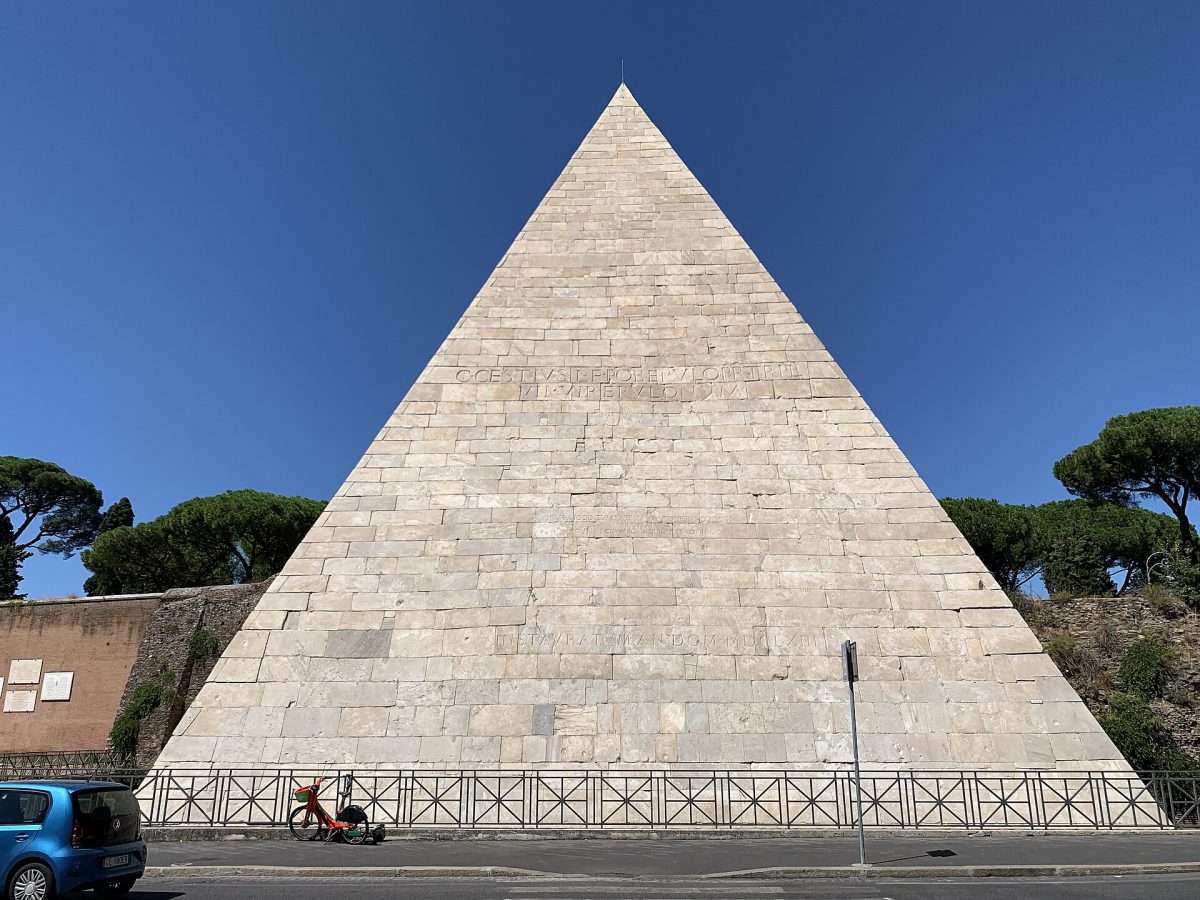
Photo: Chabe01, CC BY-SA 4.0
The exterior of the pyramid is free and visible at any hour from Piazzale Ostiense and Via Marmorata, and from inside the Protestant Cemetery. The interior is a different matter. After restoration finished in 2015 the burial chamber opened to the public, but only on certain days each month and only on guided visits booked in advance, in small groups, through the state archaeological authorities of Rome. A small fee is charged, and places go quickly, so book as soon as you know your dates.
No other tickets or tours for the pyramid alone are sold online. Some private guides and themed walks of the Ostiense and Testaccio districts include it from the outside, along with the Protestant Cemetery and Porta San Paolo, and a few general tours of ancient Rome pass by on the way to or from Ostia. Trains to Ostia Antica leave from the station beside the pyramid, so it is a natural stop before or after a day trip there.
For most visitors the sensible plan is to see the pyramid from outside on the way to the Protestant Cemetery and the Testaccio market, and to book the interior tour only if one of the scheduled days fits your trip.
Start at Piazzale Ostiense, by the metro exit, for the full view of the pyramid rising beside the walls. Its brick-faced concrete core is covered with white marble slabs on a travertine base. Look for the dedication to Gaius Cestius carved on the faces, and for the extra inscription added in 1663 under Pope Alexander VII to record the restoration of the tomb.
On the guided visit you enter through a narrow passage cut later into the solid structure, since the tomb was sealed with no door. The barrel-vaulted chamber is about six metres long, four wide and nearly five high. Faint traces of the Roman frescoes recorded when it was opened in 1660 survive on the plaster walls, and the guide explains what the early drawings showed.
Live prices from GetYourGuide for tickets and tours that include this site. Free cancellation on most of them.
Walk round to the left to Porta San Paolo, the fortified gate of the Aurelian Walls built in the 270s AD, when the pyramid was absorbed into the defences as a triangular bastion. Inside the gate towers is a small museum of the Via Ostiense, with models of ancient Ostia and its harbours. The stretch of wall here is among the best preserved in Rome.
Behind the pyramid, entered from Via Caio Cestio, the Non-Catholic Cemetery spreads under cypress trees against the walls. Its old part, closest to the pyramid, holds the grave of John Keats, and Shelley's ashes lie further up. The view of the pyramid from among the tombs is the classic one. A small donation is requested at the gate.
Gaius Cestius was a praetor, tribune of the plebs and member of the Epulones, one of the priestly colleges of Rome. His tomb was built in about 18 to 12 BC and, according to its inscription, completed in 330 days, on open ground where the road to Ostia forked. Its steep shape recalls the pyramids of Nubia rather than those of Giza, at a time when Egyptian fashions were popular in Rome. Between AD 271 and 275 it was built into the Aurelian Walls, which saved it. The chamber was opened and recorded in 1660, and in 2015 a restoration funded by the Japanese businessman Yuzo Yagi was completed. It is part of the UNESCO-listed historic centre of Rome.
The pyramid stands at Piazzale Ostiense, in the south of central Rome. Metro line B stops at Piramide, whose exit faces the pyramid; from Termini the ride takes about ten minutes. The adjacent Porta San Paolo station serves the train to Ostia Antica and Ostia Lido, and Roma Ostiense station, on the regional lines and the train from Fiumicino airport, is a five-minute walk away. Trams and several buses also stop on the square. On foot, it is about 20 minutes from the Circus Maximus along Viale Aventino. Driving is not advisable, as parking is scarce. For the interior tour, meet at the point given in your booking.
The interior tour has strict group sizes, and latecomers may not be admitted, so arrive early with your booking confirmation. Do not touch the painted plaster in the chamber. Large bags are not practical in the narrow passage. In the Protestant Cemetery, behave as in any place of burial, keep voices low and do not step on graves. Bars and cafes are plentiful around the square, and toilets are in the cafes.
The pyramid can be seen at any hour, but the white marble looks best in the soft light of early morning and late afternoon. Piazzale Ostiense is a busy traffic junction, so weekend mornings are the calmest time to stand and look. In the evening the monument is floodlit, which makes a good stop on the way to dinner in Testaccio.
For the interior, the timing is set by the guided visit calendar, which offers only a few days each month; check it before fixing your plans and book early, especially for spring and autumn. October to May is the best season for walking in this part of Rome, while July and August are hot and the area is dusty. Allow fifteen minutes for the exterior, an hour for the interior tour, and an extra hour for the Protestant Cemetery.
The Protestant Cemetery and the Porta San Paolo museum are next door. Testaccio, with its covered market and the ancient pottery mound of Monte Testaccio, is a 10-minute walk away. The Centrale Montemartini, with Roman sculpture in an old power station, is 15 minutes south, and trains to Ostia Antica take about half an hour.
1 km away
The Baths of Caracalla are the ruins of the huge public baths opened in Rome in AD 216, covering about 15 hectares…
16 tickets & tours
1 km away
The Circus Maximus is the valley between the Palatine and Aventine hills in Rome where chariot races were held for more…
9 tickets & tours
2 km away
The Roman Forum is the valley between the Palatine and Capitoline hills where ancient Rome held its elections, trials,…
162 tickets & tours
| Hours | Exterior visible at all times; interior only on scheduled guided visits |
|---|---|
| Closed | Interior open on set days each month; check the schedule |
| Entry fee | Exterior free; small fee for the guided interior visit |
| Time needed | 15 minutes; an hour with the interior |
| Best time | Morning or late afternoon light; October to May |
| Booking | Book the interior visit well ahead; places are few |
| Access | Exterior seen from flat pavements; interior reached by a passage and steps; limited wheelchair access |
| Getting there | Metro line B to Piramide station, directly opposite the pyramid |
| Founded | 12 BC (c. 18-12 BC) |
| Civilisation | Roman |
| Height | 37 m (Pyramid of Cestius) |
| UNESCO | Historic Centre of Rome |
| Checked | October 2026 |
Exterior visible at all times; interior only on scheduled guided visits. Closed: Interior open on set days each month; check the schedule.
Entry fee: Exterior free; small fee for the guided interior visit.
Allow 15 minutes; an hour with the interior for Pyramid of Cestius.
Book the interior visit well ahead; places are few.
Yes. GetYourGuide sells tickets and guided tours whose route includes Pyramid of Cestius; live prices are shown on this page.
Morning or late afternoon light; October to May.
Metro line B to Piramide station, directly opposite the pyramid.
Exterior seen from flat pavements; interior reached by a passage and steps; limited wheelchair access.
Worth it for a striking Roman pyramid in the city, free to see outside and best paired with the Protestant Cemetery next door. Skip or shorten it if you cannot book the interior tour: from the street the visit takes only ten minutes.
Pyramid of Cestius dates from 12 BC (c. 18-12 BC).
Yes. Pyramid of Cestius is part of the UNESCO World Heritage Site Historic Centre of Rome.
Rome, Italy
The Colosseum is the largest amphitheatre the Romans ever built, an oval of travertine about 189 metres long that held…
349 tickets & tours
Rome, Italy
The Roman Forum is the valley between the Palatine and Capitoline hills where ancient Rome held its elections, trials,…
162 tickets & tours
Rome, Italy
The Appian Way is the Roman road begun in 312 BC from Rome towards southern Italy, and its first 16 km out of the city…
36 tickets & tours
Rome, Italy
Ostia Antica is the ancient port of Rome at the old mouth of the Tiber, 25 km from the centre of Rome, preserved by…
19 tickets & tours
Rome, Italy
The Baths of Caracalla are the ruins of the huge public baths opened in Rome in AD 216, covering about 15 hectares…
16 tickets & tours
Rome, Italy
The Circus Maximus is the valley between the Palatine and Aventine hills in Rome where chariot races were held for more…
9 tickets & tours


