
Colosseum
Rome, Italy
The Colosseum is the largest amphitheatre the Romans ever built, an oval of travertine about 189 metres long that held…
349 tickets & tours
Ancient City · Roman · Italy
The Roman Forum is the valley between the Palatine and Capitoline hills where ancient Rome held its elections, trials, triumphs and markets for over a thousand years. Its temples, basilicas, arches and Senate House lie in a sunken field of ruins, and the same ticket covers the Palatine above, with the remains of the imperial palaces.
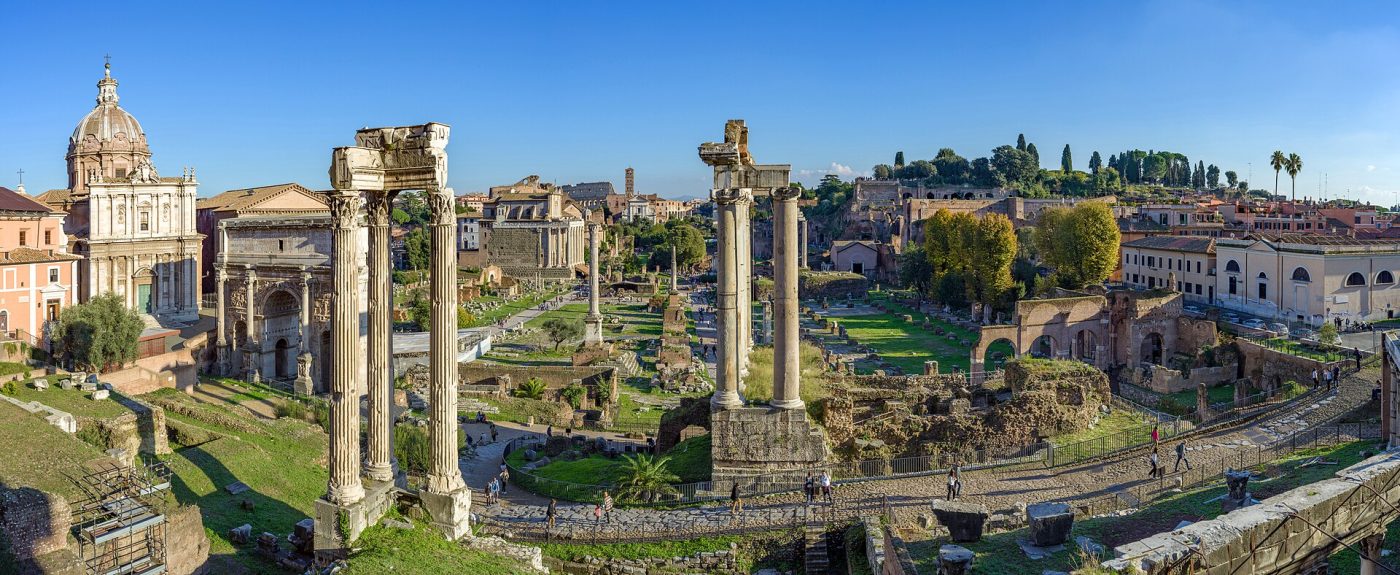
Photo: This Photo was taken by Wolfgang Moroder. Feel free to us, CC BY-SA 3.0
Our pick for each kind of visit, with live dates and prices from GetYourGuide. Free cancellation on most.
Best for: First visit, a guided walk
A guide who brings the scattered ruins of the Forum and Palatine to life, which matters more here than at the Colosseum, with tickets arranged.
The Forum and the Palatine form one archaeological park with the Colosseum and share its tickets. The standard ticket gives one entry to the Colosseum and one to the Forum and Palatine within 24 hours, timed for the Colosseum; a special ticket adds sites on the Palatine and in the Forum that open only on certain days, such as the painted rooms of the House of Augustus and the church of Santa Maria Antiqua. Tickets carry the visitor's name and are checked against an identity document.
On GetYourGuide the Forum is usually sold as part of a longer visit. The commonest format is a guided walk of about three hours in a small group that starts at the Colosseum and continues through the Forum and up the Palatine; some versions add the arena floor or the underground of the Colosseum. Shorter guided walks of the Forum and Palatine alone, private guides, family tours and audio-guide tickets are also sold, and some evening walks only skirt the outside. A guide matters more here than at the Colosseum, because the ruins are scattered and poorly labelled.
For a first visit, the sensible choice is a guided walk covering the Forum and the Palatine together, or the standard ticket with a good audio guide.
Enter from the Colosseum side and walk down the Sacred Way, the processional road of the triumphs. At the top stands the Arch of Titus, built after AD 81, whose inner reliefs show the treasures of the Temple of Jerusalem carried through Rome. Below it rise the three huge coffered vaults of the Basilica of Maxentius and Constantine.
Continue down to the round Temple of Vesta, where the sacred flame burned, and the courtyard of the House of the Vestal Virgins behind it, lined with statues of the chief priestesses. Across the paving, a low altar marks the Temple of Caesar, built where his body was cremated in 44 BC; visitors still leave flowers there.
Live dates and prices from GetYourGuide. Free cancellation on most tickets.
At the western end, the tall brick Curia, rebuilt by Diocletian, still stands to its full height, with a patterned marble floor inside. In front stand the Rostra, the speakers' platform, the Arch of Septimius Severus of AD 203, and the eight granite columns of the Temple of Saturn, which held the state treasury. The Column of Phocas is the last monument added.
Walking back along the south side, the three fluted columns of the Temple of Castor and Pollux mark one of the oldest sanctuaries of the Forum. Behind them, the church of Santa Maria Antiqua, built into an imperial building, keeps layers of painted saints from the 6th to the 8th centuries; it opens on certain days.
Climb the path to the Palatine, where the emperors built their palaces on the hill of Rome's legendary founding. Walk through the ruins of the Domus Flavia and the sunken garden called the Stadium of Domitian, look down over the Circus Maximus, and end in the 16th-century Farnese Gardens, whose terrace gives the classic view over the Forum.
The Forum began as a marshy valley used for burials, drained in the 7th century BC by the great sewer later called the Cloaca Maxima. It became the political, religious and commercial heart of the city under the kings and the Republic, and emperors filled it with temples, basilicas and triumphal arches; the Palatine above became the site of their palaces, giving the word palace its name. After the fall of the western empire, churches occupied some buildings, earthquakes and stone robbers took the rest, and the buried valley became a cow pasture. Excavation began in earnest in the early 19th century and continues. The area is part of the Historic Centre of Rome, on the UNESCO list since 1980.
The archaeological park lies between the Colosseum and Piazza Venezia in central Rome. Metro line B to Colosseo is the easiest approach; from the station it is a 5-minute walk to the gate on Via Sacra, below the Arch of Titus. A second entrance is on Via dei Fori Imperiali at Largo della Salara Vecchia, a 10-minute walk from Piazza Venezia, and a third on Via di San Gregorio leads straight up to the Palatine. Buses 75, 85, 87 and the tram 8 stop nearby. From Fiumicino, take the Leonardo Express to Termini, about 32 minutes, and the metro two stops. Do not drive into the centre.
Do not climb on the ruins, sit on the marble fragments or pick up stones, and keep out of fenced excavations. Drones are banned, and large bags and glass bottles are refused at security. Bring the identity document named on your ticket. There is almost no shade in the Forum, so carry a hat and water; the public fountains inside give cold drinking water. Toilets are near the main entrances and on the Palatine, but there is no cafe.
The Forum is busiest from late morning to mid-afternoon, when groups move on from their Colosseum slots. Opening at 9 am and the two hours before closing are calmer, and late afternoon light on the Palatine gives the best views over the ruins. Entering via the Via dei Fori Imperiali or San Gregorio gates often avoids the longest security lines.
March to May and October to November are the best months, though Easter week is very crowded. In July and August the sunken valley traps heat and temperatures often pass 35 degrees, so start at opening and climb to the shadier Palatine gardens. The first Sunday of the month is free and very busy. Some special sites on the Palatine open only on certain days, so check before you go. Allow two to three hours for both areas, or half a day with the Colosseum.
The Colosseum shares the ticket and is a few minutes away, so most visitors do all three in one long morning. The Imperial Forums along Via dei Fori Imperiali can be seen from the pavement, and the Capitoline Museums, with a terrace above the Forum, are a 10-minute walk. The Mamertine Prison and the Circus Maximus are close by.
| Hours | 9 am to an hour before sunset: to 7.15 pm in summer, 4.30 pm in winter |
|---|---|
| Closed | Open daily except 1 Jan and 25 Dec |
| Entry fee | from EUR 18 with the Colosseum; under-18s free |
| Time needed | 2 to 3 hours with the Palatine |
| Best time | At 9 am or the last two hours; Mar–May and Oct–Nov |
| Booking | Timed named tickets, shared with the Colosseum; book ahead in season |
| Access | Uneven paving, slopes and steps; little shade; a lift and step-free routes cover parts of the Palatine |
| Getting there | Metro line B to Colosseo, then a 5-minute walk to the Via Sacra gate |
| Founded | 750 BC (8th century BC (midpoint)) |
| Civilisation | Roman |
| UNESCO | Historic Centre of Rome |
| Website | parcocolosseo.it/area/foro-romano |
| Checked | October 2026 |
9 am to an hour before sunset: to 7.15 pm in summer, 4.30 pm in winter. Open daily except 1 Jan and 25 Dec.
Entry fee: from EUR 18 with the Colosseum; under-18s free.
Allow 2 to 3 hours with the Palatine for Roman Forum and Palatine.
Timed named tickets, shared with the Colosseum; book ahead in season.
Yes. GetYourGuide lists 162 tickets and tours for Roman Forum and Palatine, with live dates and prices and free cancellation on most of them.
At 9 am or the last two hours; Mar–May and Oct–Nov.
Metro line B to Colosseo, then a 5-minute walk to the Via Sacra gate.
Uneven paving, slopes and steps; little shade; a lift and step-free routes cover parts of the Palatine.
Worth it for walking the Sacred Way past the Senate House, the House of the Vestals and two triumphal arches. Skip or shorten it if you will not read up or take a guide, because unlabelled fragments mean little, or if you are visiting in the midday heat of July.
Roman Forum and Palatine dates from 750 BC (8th century BC (midpoint)).
Yes. Roman Forum and Palatine is part of the UNESCO World Heritage Site Historic Centre of Rome.
Rome, Italy
The Colosseum is the largest amphitheatre the Romans ever built, an oval of travertine about 189 metres long that held…
349 tickets & tours
Rome, Italy
The Appian Way is the Roman road begun in 312 BC from Rome towards southern Italy, and its first 16 km out of the city…
36 tickets & tours
Rome, Italy
Ostia Antica is the ancient port of Rome at the old mouth of the Tiber, 25 km from the centre of Rome, preserved by…
19 tickets & tours
Rome, Italy
The Baths of Caracalla are the ruins of the huge public baths opened in Rome in AD 216, covering about 15 hectares…
16 tickets & tours
Rome, Italy
The Circus Maximus is the valley between the Palatine and Aventine hills in Rome where chariot races were held for more…
9 tickets & tours
Rome, Italy
The Domus Aurea is the Golden House that Nero built on the Oppian Hill after the fire of AD 64, now a maze of vaulted…
6 tickets & tours


