
Colosseum
Rome, Italy
The Colosseum is the largest amphitheatre the Romans ever built, an oval of travertine about 189 metres long that held…
349 tickets & tours
Tomb & Necropolis · Roman · Italy
The Appian Way is the Roman road begun in 312 BC from Rome towards southern Italy, and its first 16 km out of the city still run past tombs, catacombs and villas. Long stretches keep their original basalt paving. Now a protected archaeological park on the UNESCO list since 2024, it is the best place near Rome to walk or cycle through ancient countryside.
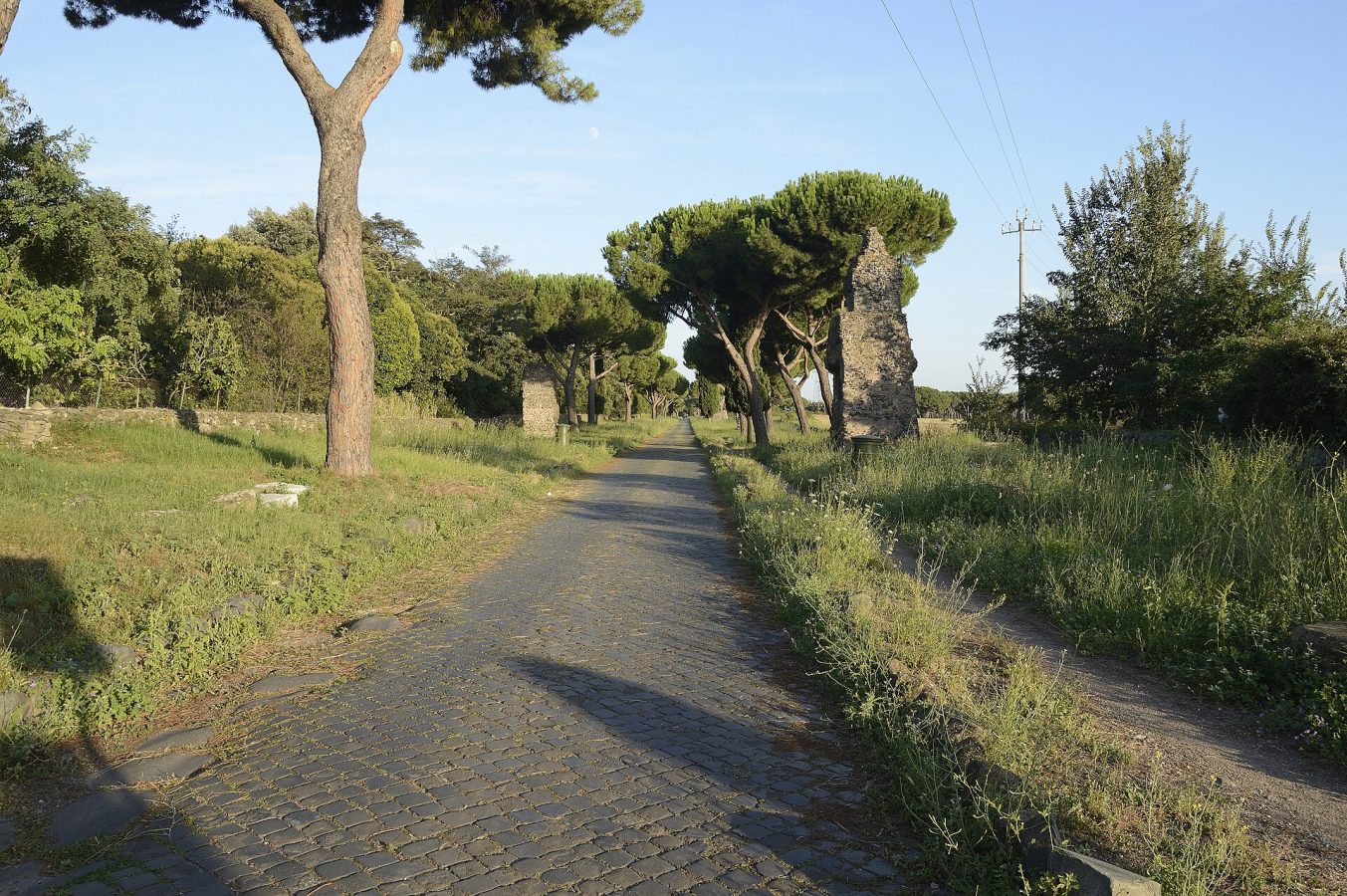
Photo: Livioandronico2013, CC BY-SA 4.0
Our pick for each kind of visit, with live dates and prices from GetYourGuide. Free cancellation on most.
Best for: First visit, by e-bike
Covers the road, a catacomb and the aqueducts in one guided ride, with a motor that takes the work out of the cobbles and the distance.
The road itself is a public street with no ticket. What you pay for are the sites along it: the Christian catacombs, run by the Church and visited only with their own guides on a short tour every half hour or so, and the monuments of the Appia Antica archaeological park, such as the Tomb of Caecilia Metella and the Villa of the Quintili, which have small tickets of their own or a combined park ticket and close on Mondays. The Circus of Maxentius and the Museum of the Walls at Porta San Sebastiano are run by the city. Most visitors pick one catacomb, since the experience is similar in each.
Tours sold online are mostly by bike, e-bike or golf cart, because the interesting stretch is long. Guided e-bike tours typically last three to four hours, combine the road with a catacomb and the Park of the Aqueducts, and include bike, helmet and guide; catacomb entry is often included but check. Golf cart tours suit families and visitors who cannot cycle. Walking tours with transport from the centre focus on the first few kilometres, and there are food and wine versions, sunrise rides and simple bike rentals.
If you are comfortable on a bike, a guided e-bike tour is the best way to see the road; otherwise take the bus out, visit one catacomb and walk south as far as you like.
Start at the best-preserved gate in the Aurelian Walls, where the Appian Way leaves the city. The towers hold the small Museum of the Walls, and you can walk a stretch of the rampart walkway with views over the road. Just outside the gate the Via Appia Antica begins, at first a narrow street with traffic and little room for walkers.
About 1.5 km further, past the small church of Domine Quo Vadis, the entrance to San Callisto opens on the right. A guide leads you down into galleries on several levels, past the crypt of the popes where nine bishops of Rome were buried in the 3rd century. The visit lasts about 40 minutes and keeps to a fixed route.
Live dates and prices from GetYourGuide. Free cancellation on most tickets.
A few minutes south, the Basilica of San Sebastiano stands above another catacomb with well-preserved painted Roman tombs underground. Across the road the Circus of Maxentius, an early 4th-century chariot racing track, keeps its long outline and the remains of its starting gates, with the imperial villa and the mausoleum of the emperor's son beside it.
Just beyond, the road climbs to the round tomb of Caecilia Metella, a noblewoman of the 1st century BC. The massive drum was turned into a castle tower in the Middle Ages, and the small museum inside shows how it was built. From here the traffic thins and the original paving, kerbstones and lines of tombs begin.
South of Caecilia Metella the road runs straight between pines and cypresses, lined with broken tombs, statues and inscriptions, with the Alban Hills ahead. This is the most beautiful stretch to walk or cycle. About 3 km on, the Villa of the Quintili spreads across the fields on the left, a huge country estate with baths, a nymphaeum and marble floors.
Appius Claudius Caecus, censor in 312 BC, built the first section of the road as a military route to Capua during the wars against the Samnites. It was later extended across the Apennines to Brindisi, making it the main highway to southern Italy and the Greek East. Romans buried their dead outside the city walls, so wealthy families lined the road with tombs, and early Christians dug catacombs beneath the fields beside it. After the rebellion led by Spartacus in 71 BC, thousands of captured slaves were crucified along it. In the Middle Ages its tombs were quarried or fortified. The Appia Antica regional park was created in 1988, and the road joined the UNESCO list in 2024.
Bus 118 runs from near the Colosseum and Circo Massimo through Porta San Sebastiano and along the road past the catacombs; it takes about 20 minutes but is not very frequent. Bus 218 from San Giovanni runs to the area of Domine Quo Vadis and San Callisto by a parallel road, and bus 660 from Colli Albani metro station on line A reaches the Tomb of Caecilia Metella. A taxi from the centre takes 15 to 20 minutes. Bikes can be hired near Domine Quo Vadis or brought on a tour. Driving is not a good idea: parking is scarce and the old paving is narrow. From Ciampino airport, the Villa of the Quintili area is the closest point.
The first stretch beyond the city gate carries traffic and has almost no pavement, so walk with care or start further out. Do not climb on the tombs or take stones from the paving. Photographs are not allowed inside the catacombs, and visitors must stay with the guide. Bring water, sun protection and shoes with thick soles; the paving is hard on thin shoes and bike tyres. Cafés and drinking fountains are few beyond Caecilia Metella.
The road is at its best on Sundays and public holidays, when the main stretch is closed to private traffic and fills with walkers and cyclists, especially in the morning. On weekdays it is quieter but cars and buses use the first section. Some catacombs close for a lunch break, each one closes on a different day of the week and the park sites close on Mondays, so plan around them: San Callisto and San Sebastiano rarely close on the same day.
Spring, from March to May, and autumn, from September to November, are the most pleasant seasons, with green fields and mild air. In summer the road has very little shade south of Caecilia Metella, so ride early or in the late afternoon and carry plenty of water. Winter is quiet and often clear, but days are short. Allow half a day for one catacomb and the first stretch, and a full day to reach the Villa of the Quintili.
The Park of the Aqueducts, with long arches of Roman aqueducts, is a short ride east and appears on most bike tours. The Baths of Caracalla lie just inside the walls, a 10-minute walk from Porta San Sebastiano. The Colosseum and the Roman Forum are 15 minutes by bus.
| Hours | Road open at all times; catacombs about 9 or 10 am to 5 pm, some closing at lunch; park sites 9 am to dusk |
|---|---|
| Closed | Road open daily; park sites close Mondays; each catacomb one day a week |
| Entry fee | Road free; park sites EUR 8 each; catacombs extra |
| Time needed | Half a day; a full day by bike |
| Best time | Sunday morning, when it is closed to traffic; spring and autumn |
| Booking | No booking for the road; book bike tours ahead at weekends |
| Access | Ancient basalt paving, gravel and grass verges; hard for wheelchairs and pushchairs; little shade |
| Getting there | Bus 118 from the Colosseum or Circo Massimo to the catacombs, about 20 minutes |
| Founded | 312 BC |
| Civilisation | Roman |
| UNESCO | Via Appia. Regina Viarum |
| Website | camminodellappia.it |
| Checked | October 2026 |
Road open at all times; catacombs about 9 or 10 am to 5 pm, some closing at lunch; park sites 9 am to dusk. Closed: Road open daily; park sites close Mondays; each catacomb one day a week.
Entry fee: Road free; park sites EUR 8 each; catacombs extra.
Allow Half a day; a full day by bike for Appian Way.
No booking for the road; book bike tours ahead at weekends.
Yes. GetYourGuide lists 36 tickets and tours for Appian Way, with live dates and prices and free cancellation on most of them.
Sunday morning, when it is closed to traffic; spring and autumn.
Bus 118 from the Colosseum or Circo Massimo to the catacombs, about 20 minutes.
Ancient basalt paving, gravel and grass verges; hard for wheelchairs and pushchairs; little shade.
Worth it for a half day of walking or cycling an ancient road lined with tombs, with an underground catacomb visit on the way. Skip or shorten it if you dislike uneven cobbles, or if you have only one or two days in Rome.
Appian Way dates from 312 BC.
Yes. Appian Way is part of the UNESCO World Heritage Site Via Appia. Regina Viarum.
Rome, Italy
The Colosseum is the largest amphitheatre the Romans ever built, an oval of travertine about 189 metres long that held…
349 tickets & tours
Rome, Italy
The Roman Forum is the valley between the Palatine and Capitoline hills where ancient Rome held its elections, trials,…
162 tickets & tours
Rome, Italy
Ostia Antica is the ancient port of Rome at the old mouth of the Tiber, 25 km from the centre of Rome, preserved by…
19 tickets & tours
Rome, Italy
The Baths of Caracalla are the ruins of the huge public baths opened in Rome in AD 216, covering about 15 hectares…
16 tickets & tours
Rome, Italy
The Circus Maximus is the valley between the Palatine and Aventine hills in Rome where chariot races were held for more…
9 tickets & tours
Rome, Italy
The Domus Aurea is the Golden House that Nero built on the Oppian Hill after the fire of AD 64, now a maze of vaulted…
6 tickets & tours


