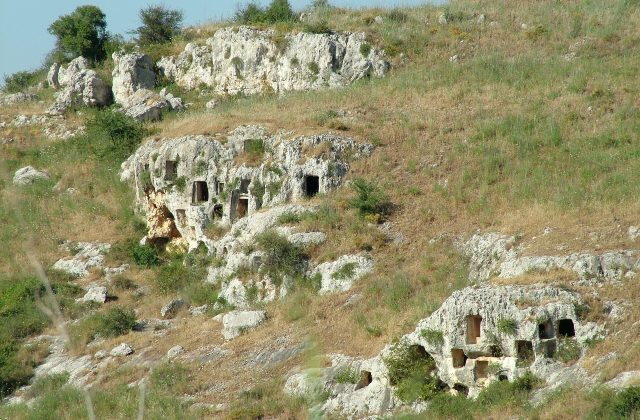
Necropolis of Pantalica
43 km away
Pantalica is a limestone promontory above the Anapo and Calcinara gorges in south-east Sicily, honeycombed with about…
1 ticket or tour
Theatre & Amphitheatre · Roman · Italy
The Roman Amphitheatre of Catania is a sunken slice of one of the largest arenas in the Roman world, exposed below street level in Piazza Stesicoro. Only about a tenth of the building can be seen, built of black Etna basalt and red brick, but it once seated around 15,000 people. It sits on the main street, so it costs nothing to look.
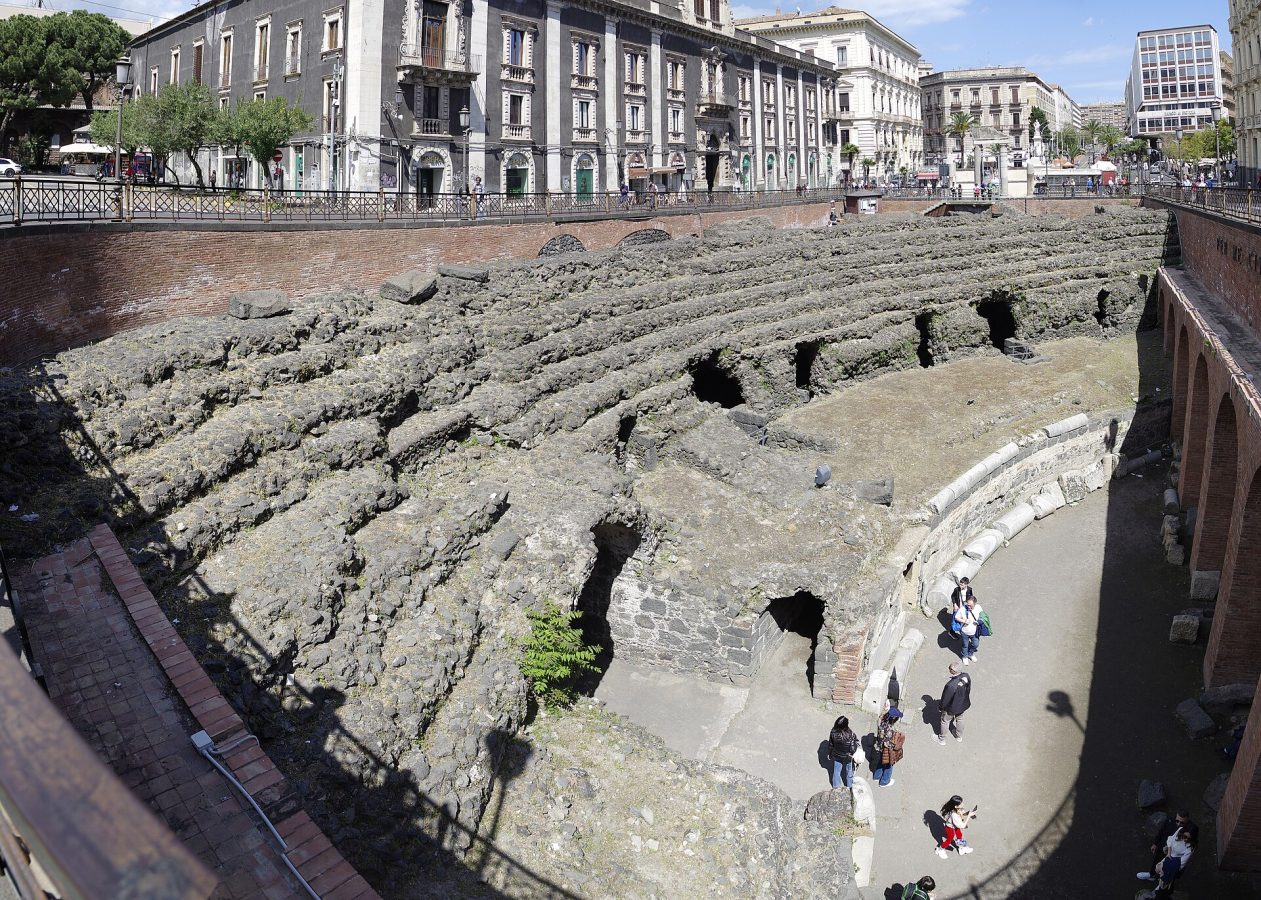
Photo: Berthold Werner, CC BY-SA 4.0
There is nothing to buy online for this monument alone, and no tour sold for it specifically. The amphitheatre is part of the Greek and Roman archaeological park of Catania, run by the Sicilian region, and two levels of visit exist. The first needs no ticket at all: the excavated sector lies in a pit in the middle of Piazza Stesicoro, and you look down on it from the railings around the edge.
The second is a walk into the vaulted corridors behind the gate on the square, which open on a schedule that has changed many times over the years because of repairs, flooding and safety work. When they are open, entry is either free or a small charge paid on the spot, and staff or volunteers sometimes show people round. Ask at the Roman Theatre on Via Vittorio Emanuele, which belongs to the same park, or check the regional park listings shortly before you go.
Most people see the amphitheatre as one stop on a guided walk of the historic centre or a food tour along Via Etnea, which pass the square anyway. A general walking tour of Catania with a local guide is the sensible way to get the background, then come back on your own if the galleries are open.
Start at the railings on the north side of the square, facing the church of San Biagio. Below you lies a curved section of the outer ring: tall arches of red brick set in walls of dark lava stone. Look for the contrast between the black basalt and the brick, which must have been far more striking when marble still covered the seating.
On the square, an iron gate leads down into the ruins. It was framed in 1906 with fragments of ancient columns from the upper gallery and an architrave carved with the words Amphitheatrum Insigne. Side panels carry verses by the poet Mario Rapisardi honouring the lawgiver Charondas and the poet Stesichorus, said by tradition to be buried nearby.
Live prices from GetYourGuide for tickets and tours that include this site. Free cancellation on most of them.
When the gate is open, steps lead into the corridor that ran around the outside of the seating. Walking along it you pass radial walls and concrete vaults that once carried fourteen rows of seats. The passages are dim and cool even in August, and they continue under the houses and streets that were built on top of the arena.
Walk round to the narrow Vico Anfiteatro behind the square, where the structure can be seen rising to the height of its third storey between later buildings. The neoclassical front of San Biagio, known locally as Sant'Agata alla Fornace, stands on top of the old galleries, a good example of how the city simply built over its arena.
The amphitheatre was probably built in the 2nd century AD, under Hadrian or Antoninus Pius, on the northern edge of Roman Catina next to its cemetery, and was greatly enlarged in the 3rd century. Its arena measured about 70 by 50 metres, among the biggest in the empire. By the 5th century it was disused, and Theodoric allowed the townspeople to take its stone. Builders later robbed it for the cathedral; after the earthquake of 1693 it was buried and used as a parade ground. Digs began in the late 18th century; the present view dates from work on Piazza Stesicoro in the early 1900s, and during the bombing of 1943 the galleries served as a shelter.
Catania Fontanarossa airport is about 5 km south of the centre; the Alibus shuttle runs to the city centre in roughly half an hour, and taxis take about 20 minutes. From the central railway station, the metro runs to Stesicoro in a few minutes, and the exit comes up on the square beside the ruins. On foot, the amphitheatre is about 15 minutes north of the cathedral along Via Etnea, the main shopping street, which climbs gently all the way. Driving into the centre is slow and parking is scarce; use a car park outside the old town or near the station and continue by metro. City buses along Via Etnea stop next to the square.
Do not climb over the railings or drop litter into the pit, which has suffered from neglect in the past. In the galleries, follow the staff and stay on the lit route, since parts of the structure are unstable and side passages are closed for safety. Wear shoes with grip, as floors can be wet. Piazza Stesicoro is busy with traffic and a street market nearby, so keep bags closed. Cafes and toilets are found in the surrounding streets.
Because the view from the square is free and always available, the amphitheatre fits into any walk through Catania. Morning light falls well on the arches, and the market streets around Piazza Stesicoro are at their liveliest before lunch. In the evening the ruins are lit, and Via Etnea fills with people taking the passeggiata.
Summer in Catania is hot, often above 35 degrees in July and August, so plan the galleries for the middle of the day, when their cool air is welcome. Spring and autumn are the most comfortable months for walking the centre. In early February the city celebrates the feast of Saint Agatha, when processions pass close by and the whole area is crowded and partly closed to traffic. Allow fifteen minutes for the railings, and up to an hour if the corridors are open.
The Roman Theatre and Odeon, part of the same park, are a 15-minute walk south on Via Vittorio Emanuele. Continue to the cathedral and the fish market, then to Castello Ursino and its civic museum, about ten minutes further. A day trip up Mount Etna, an hour by car, or to Taormina, about an hour by train or bus, fills a second day.
43 km away
Pantalica is a limestone promontory above the Anapo and Calcinara gorges in south-east Sicily, honeycombed with about…
1 ticket or tour
51 km away
The Neapolis Archaeological Park in Syracuse, Sicily, holds the great Greek theatre of the 5th century BC, the stone…
7 tickets & tours
54 km away
Morgantina is a Greek and Sicel city spread along the Serra Orlando ridge near Aidone, in the hills of central Sicily.
1 ticket or tour
| Hours | Viewable from the square at any time; the gallery gate opens in the daytime on a changing schedule |
|---|---|
| Closed | Galleries close on some days; check with the regional park |
| Entry fee | Free from the street; small fee or free for the galleries |
| Time needed | 15 minutes to an hour |
| Best time | Morning or late afternoon; any season, as it is a city-centre stop |
| Booking | No booking; walk up to the railings or the gate |
| Access | Railings at street level are step-free; the galleries below need stairs and have uneven, damp floors |
| Getting there | Catania metro to Stesicoro station, which opens onto the square |
| Founded | AD 150 (2nd century AD (midpoint)) |
| Civilisation | Roman |
| Checked | October 2026 |
Viewable from the square at any time; the gallery gate opens in the daytime on a changing schedule. Closed: Galleries close on some days; check with the regional park.
Entry fee: Free from the street; small fee or free for the galleries.
Allow 15 minutes to an hour for Roman Amphitheatre of Catania.
No booking; walk up to the railings or the gate.
Yes. GetYourGuide sells tickets and guided tours whose route includes Roman Amphitheatre of Catania; live prices are shown on this page.
Morning or late afternoon; any season, as it is a city-centre stop.
Catania metro to Stesicoro station, which opens onto the square.
Railings at street level are step-free; the galleries below need stairs and have uneven, damp floors.
Worth it for a quick look at black lava arches in the heart of Catania on any city walk. Skip a special trip if you expect a complete arena; Siracusa or Taormina have far more to see.
Roman Amphitheatre of Catania dates from AD 150 (2nd century AD (midpoint)).
Catania, Italy
The Roman Theatre of Catania is a 2nd-century theatre for about 7,000 spectators, built of black lava stone and hemmed…
No online ticket


