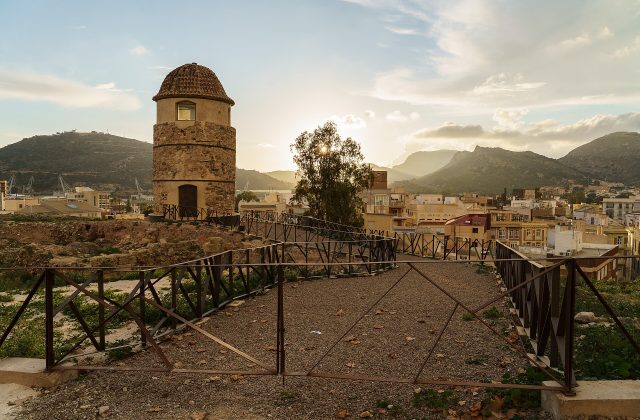
Cerro del Molinete
Cartagena, Spain
Cerro del Molinete is a hill in the centre of Cartagena where the Carthaginian general Hasdrubal is thought to have…
No online ticket
Theatre & Amphitheatre · Roman · Spain
The Roman Theatre of Cartagena was built between 5 and 1 BC for about 6,000 spectators on the slope of a hill above the port of Carthago Nova. Buried under later houses until 1988, it is now reached through a museum designed by Rafael Moneo and a passage beneath the ruined old cathedral.

Photo: Diego Delso, CC BY-SA 4.0
The standard ticket covers the Museo del Teatro Romano and the theatre itself, which can only be reached through the museum. Tickets are sold at the museum entrance on Plaza del Ayuntamiento, and audio guides are available in several languages. Skip-the-line products are not needed except perhaps on days when several cruise ships are in port and groups arrive together.
The one product on GetYourGuide is a combined ticket that covers the theatre together with other sites and museums of ancient Cartagena, such as the Punic wall and the Roman forum. It suits visitors who want to see the city's layers of history in one day, and it saves buying separate tickets at each site. Check how long the ticket is valid, which sites it includes and their opening days, since some smaller museums keep shorter hours.
Guided walking tours of the old town, offered by local agencies and the tourist office, usually include the theatre and explain the Punic and Roman city on the way. Cruise excursions often stop here for an hour. For most visitors the sensible plan is the combined ticket for a full day in Cartagena, or the standard museum ticket for a short stop.
The visit starts in the Palacio de Riquelme on Plaza del Ayuntamiento and continues through Moneo's modern galleries, linked by escalators that climb the hillside. The rooms show the architecture of the stage front, with capitals and pieces of cornice, and explain how the theatre was found under a poor neighbourhood. Allow half an hour here before going outside.
The highlight of the museum is the hall of sculpture from the theatre: altars carved with reliefs, marble statues and portrait heads, and inscriptions naming Gaius and Lucius Caesar, the grandsons of Augustus to whom the building was dedicated. Their names fix the theatre's date. Look for traces of the original paint on some marble.
Live dates and prices from GetYourGuide. Free cancellation on most tickets.
From the galleries, a corridor runs beneath the ruined church of Santa Maria la Vieja, the old cathedral of Cartagena built over part of the seating. Here you see the Roman, Byzantine and medieval layers on top of each other, including remains of the market that reused the theatre's stones in the 5th century. The passage brings you out at the top of the theatre.
Step out onto the upper levels of the seating, which is partly original and partly restored, and look down over the paved orchestra. The cavea was cut into the slope of the Concepcion hill, facing north to shelter the audience from the easterly winds. Walk down the stairs to the front rows to see the details.
Behind the stage stands the reconstructed lower part of the stage front, with columns of reddish stone and white marble capitals set back into their original positions. Seen from the seating, it gives an idea of the two-storey facade that once rose behind the actors. The panoramic lift up to the castle is a few minutes away from the exit.
Cartagena, founded by the Carthaginians as Qart Hadasht, became the Roman colony of Carthago Nova, and under Augustus a theatre was built between 5 and 1 BC on the slope of the Concepcion hill above the port. Dedicated to Augustus' grandsons Gaius and Lucius, it held about six thousand people and was used for two centuries. After a fire, its stones were reused in the 5th century AD for a market, and a Byzantine quarter grew over the ruins, followed by the church of Santa Maria la Vieja. The theatre was rediscovered in 1988 during building work, fully excavated by 2003, and opened with its museum by Rafael Moneo in 2008.
Cartagena is about 35 minutes by car from Region de Murcia International Airport at Corvera and about an hour and a quarter from Alicante airport. Trains from Madrid reach Cartagena station via Murcia, and buses from Murcia take about 50 minutes. From the railway or bus station, the walk to Plaza del Ayuntamiento in the old town takes about 15 minutes along Calle Real or Calle Mayor. Cruise passengers land at the terminal next to the old town and reach the museum in about ten minutes on foot. Drivers can use the underground car parks near the port or on the edge of the old town, as the centre is largely pedestrianised.
Photography without flash is allowed in most of the museum and the theatre, but tripods and drones need permission. Do not sit on the original seating where it is roped off, or touch sculpture and inscriptions. Large bags may have to be left at the entrance. In summer, bring water and a hat for the open theatre, which has no shade. There is no cafe inside, but the old town around Plaza del Ayuntamiento has many bars and restaurants.
Cartagena is busy with cruise passengers on many days of the year, and their groups reach the theatre between about 9.30 am and early afternoon. On those days, visit at the very start, or wait until after 3 pm, when most ships are preparing to leave. Days without ships are much calmer, and the museum galleries are quiet.
From June to September the open theatre is very hot in the middle of the day, so do the indoor museum first and the seating at the end of the afternoon light. The spring and autumn months are ideal. In September the Carthaginians and Romans festival fills the old town with parades and camps, which is lively but crowded. Holy Week is also busy. Allow an hour for the museum and the theatre, and a full day if you add the other sites on a combined ticket.
The Punic wall interpretation centre, the Roman forum district and the House of the Fortune, a Roman house with wall paintings, are all within a 10-minute walk. A panoramic lift beside the theatre rises to the Concepcion castle. The National Museum of Underwater Archaeology is on the waterfront, about 15 minutes on foot.
| Hours | Typically 10 am to early evening Tue–Sat, mornings only on Sundays; longer in summer |
|---|---|
| Closed | Usually Mondays; check holiday openings |
| Entry fee | Moderate fee; reduced for students and seniors |
| Time needed | 1 to 1.5 hours |
| Best time | Weekday mornings at opening; October to May for milder heat |
| Booking | Pay at the museum; book ahead on cruise days in high season |
| Access | Museum has lifts and escalators; the theatre itself has steps and uneven stone, with some step-free viewpoints |
| Getting there | A 10-minute walk from the cruise terminal or the port to Plaza del Ayuntamiento |
| Founded | 5 BC (built 5-1 BC) |
| Excavated | 1988 |
| Civilisation | Roman |
| Checked | October 2026 |
Typically 10 am to early evening Tue–Sat, mornings only on Sundays; longer in summer. Closed: Usually Mondays; check holiday openings.
Entry fee: Moderate fee; reduced for students and seniors.
Allow 1 to 1.5 hours for Roman Theatre of Cartagena.
Pay at the museum; book ahead on cruise days in high season.
Yes. GetYourGuide lists one ticket or tour for Roman Theatre of Cartagena, with live dates and prices and free cancellation on most of them.
Weekday mornings at opening; October to May for milder heat.
A 10-minute walk from the cruise terminal or the port to Plaza del Ayuntamiento.
Museum has lifts and escalators; the theatre itself has steps and uneven stone, with some step-free viewpoints.
Worth it for a well-presented Augustan theatre and a museum route that tells its story from start to finish. Shorten it if you only have a cruise stop, since an hour covers the highlights, and skip the slower rooms.
Roman Theatre of Cartagena dates from 5 BC (built 5-1 BC). Excavations began in 1988.
Cartagena, Spain
Cerro del Molinete is a hill in the centre of Cartagena where the Carthaginian general Hasdrubal is thought to have…
No online ticket