
Roman Theatre of Cartagena
334 km away
The Roman Theatre of Cartagena was built between 5 and 1 BC for about 6,000 spectators on the slope of a hill above the…
1 ticket or tour
Tomb & Necropolis · Other · Algeria
The Royal Mausoleum of Mauretania is a huge round stone tomb on a hilltop near Tipasa, west of Algiers, linked to King Juba II and Queen Cleopatra Selene. About 60 metres across and still around 30 metres high, it is ringed by 60 Ionic columns. It forms part of the UNESCO site of Tipasa.
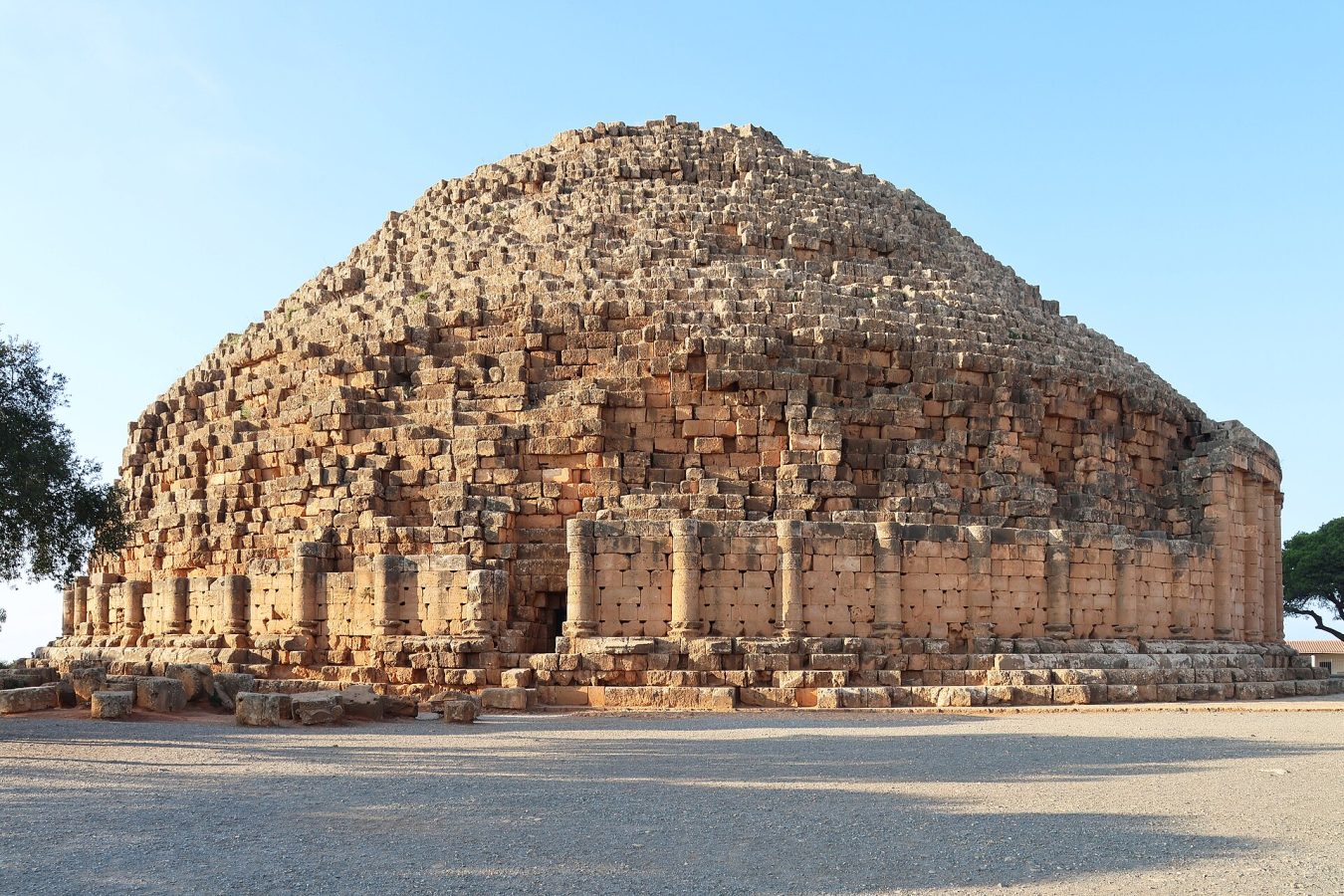
Photo: Bernard Gagnon, CC BY 4.0
Nothing for the mausoleum alone is sold online. Entry is through a gate at the foot of the monument, where a small fee in Algerian dinars is paid in cash; there are no timed tickets and no online booking. Information on site is limited to a few panels, so it helps to know the story of Juba II and Cleopatra Selene before you arrive.
Most foreign visitors come with a car and driver from Algiers or with a local agency, which is the easiest way to handle the roads and, at times, the formalities of travel in Algeria. These day trips usually combine the mausoleum with the Roman ruins of Tipasa and sometimes with the museum and port at Cherchell further west; they include transport and often a guide and lunch, while entry fees may be extra. Independent travellers can reach Tipasa by bus from Algiers and take a taxi out to the hilltop, agreeing a price for the return.
The sensible plan for most visitors is a private day trip from Algiers: the mausoleum in the morning, Tipasa and lunch by the sea afterwards.
Walk around the base of the monument first. The great cylindrical drum stands on a square platform about 60 metres a side and is wrapped in 60 engaged Ionic columns, whose capitals have mostly been lost. Above them the stone rises in a stepped cone. The scale is best felt standing close to the wall.
Four false doors, set at the points of the compass, interrupt the columns. Their panels are divided by mouldings into a cross-like pattern, which led later visitors to call the building the tomb of the Christian woman. Look closely at the eastern side, where the real entrance to the interior lies beneath one of these doors.
Live prices from GetYourGuide for tickets and tours that include this site. Free cancellation on most of them.
Inside, a long vaulted gallery spirals through the mass of the monument to two burial chambers at its centre, once closed by stone slabs that could be raised and lowered. The interior is often closed to visitors; if it is open, bring a torch. Even from outside, the low entrance shows how thick the walls are.
Walk round slowly and you can read the monument's later history in its scars. A large breach in one side dates from attempts to break in or demolish it under the Ottomans, and gun damage from the colonial period is still visible. Lost facing stones show the core of rubble behind the dressed blocks.
The tomb stands on a hill about 250 metres above the sea, and the platform gives views north over the Mediterranean and south over the farmland of the Mitidja plain. On a clear day you can follow the coast west towards Tipasa and Mount Chenoua. It explains why the kings chose this landmark for their monument.
The mausoleum is usually attributed to Juba II, a Berber prince raised in Rome whom Augustus made king of Mauretania, and to his wife Cleopatra Selene, daughter of Cleopatra VII and Mark Antony. It is traditionally dated to about 3 BC and resembles the Mausoleum of Augustus in Rome. A Roman geographer of the 1st century described a shared royal tomb here, so it may have served the whole dynasty. No remains have been found inside, perhaps because of early robbery. In 1555 an Ottoman governor tried to demolish it, and later it was shelled. It was listed by UNESCO with Tipasa in 1982 and was on the danger list from 2002 to 2006.
The mausoleum stands on a hilltop above the coast road between Algiers and Tipasa, near Sidi Rached, about 10 km east of Tipasa and roughly 65 km west of central Algiers. There is no public transport to the gate. Buses and shared taxis run from Algiers to Tipasa in about an hour and a half, depending on traffic; from Tipasa take a local taxi up the hill and arrange the ride back. From Houari Boumediene airport the drive takes about an hour and a quarter. By car, follow the signs from the coastal road to the access road that climbs to the site; there is space to park near the entrance.
Climbing on the monument is forbidden and dangerous: the stones are loose in places. Drones are not allowed without permission, and photography of nearby military or official buildings should be avoided. Bring water, a hat and sun protection, as the hilltop is fully exposed, and a torch in case the interior is open. There are no cafes at the site; eat in Tipasa. Carry cash in dinars for the entry fee and dress modestly.
The site is rarely busy. Algerian families and school groups come at weekends, which in Algeria fall on Friday and Saturday, and on public holidays; weekday mornings are very quiet. Mornings are best for the light on the eastern side, where the entrance is, and the late afternoon gives a warm colour to the stone and clear views along the coast.
Spring, from March to May, and October and November are the most comfortable months: mild, often clear, and green in spring. July and August are hot and humid on the coast, and the bare hilltop offers no shade, so go early. Winter brings rain and wind, but also the clearest air on bright days. Opening hours can be shortened during Ramadan, and sites may close on religious holidays, so ask your driver or hotel the day before. Allow about an hour here, and a full day with Tipasa and the return to Algiers.
The Roman and early Christian ruins of Tipasa, by the sea, are about 15 minutes west by car and make the natural pair. Cherchell, ancient Caesarea and Juba II's capital, lies about 45 minutes further west, where the museum holds fine Roman statues. Algiers and its Casbah are about an hour east.
334 km away
The Roman Theatre of Cartagena was built between 5 and 1 BC for about 6,000 spectators on the slope of a hill above the…
1 ticket or tour
372 km away
The Arch of Trajan is the 12-metre triple gateway of Timgad, a Roman colony founded in AD 100 in the high plains of…
5 tickets & tours
| Hours | Daylight hours, roughly morning to late afternoon |
|---|---|
| Closed | Usually open daily; hours can change without notice |
| Entry fee | Small fee in DZD at the gate |
| Time needed | about an hour |
| Best time | Morning or late afternoon; March to May and October |
| Booking | Pay at the gate; no booking |
| Access | Short walk on uneven ground around the tomb; exposed hilltop with no shade |
| Getting there | About 10 km east of Tipasa, signposted from the coast road near Sidi Rached; car or taxi only |
| Founded | 3 BC (c. 3 BC) |
| Civilisation | Other |
| Area | 7.8 ha |
| Height | 32 m (Mausoleum, present height) |
| Elevation | 250 m above sea level |
| UNESCO | Tipasa |
| Checked | October 2026 |
Daylight hours, roughly morning to late afternoon. Closed: Usually open daily; hours can change without notice.
Entry fee: Small fee in DZD at the gate.
Allow about an hour for Royal Mausoleum of Mauretania.
Pay at the gate; no booking.
Yes. GetYourGuide sells tickets and guided tours whose route includes Royal Mausoleum of Mauretania; live prices are shown on this page.
Morning or late afternoon; March to May and October.
About 10 km east of Tipasa, signposted from the coast road near Sidi Rached; car or taxi only.
Short walk on uneven ground around the tomb; exposed hilltop with no shade.
Worth it for one of the largest ancient tombs in North Africa, with wide views to the sea, combined with Tipasa. Skip or shorten it if you want painted chambers or a large ruined town; it is one monument, seen mostly from outside.
Royal Mausoleum of Mauretania dates from 3 BC (c. 3 BC).
Yes. Royal Mausoleum of Mauretania is part of the UNESCO World Heritage Site Tipasa.
