Selge
73 km away
Selge is a ruined Pisidian city high in the Taurus Mountains above the Koprulu Canyon, about 60 km inland from Manavgat…
9 tickets & tours
Ancient City · Greek · Turkey
Sagalassos is a Greek and Roman city spread over mountain terraces between 1,400 and 1,700 metres in the Taurus range, about 100 km north of Antalya. Hadrian named it the first city of Pisidia, and Belgian excavations since 1990 have re-erected fountains, gates and a hero shrine. Few ancient sites in Turkey have such a dramatic setting.

Photo: Justinianus, CC BY-SA 4.0
Nothing for Sagalassos alone is sold online through the big tour platforms. The site is run by the Turkish Ministry of Culture, and you simply pay at the ticket office by the car park; the Museum Pass Turkey is accepted, which makes sense if you are touring several sites in the south-west. Signs in Turkish and English explain the main buildings, and a site plan at the entrance helps you choose a route.
Because public transport stops in the valley, most visitors come by hire car, often as a detour on the drive between Antalya and Pamukkale or the Lakes Region. Some private drivers and small agencies in Antalya offer full-day trips that pair Sagalassos with Burdur museum or Lake Salda; they include transport and sometimes a guide and lunch, while entry is often extra. Private guides can be arranged in Antalya or Isparta for those who want the history explained in detail.
For most travellers the best plan is to drive up early in the day, walk down from the upper city to the lower agora at your own pace, and allow time for Burdur museum, where many of the finest statues are displayed.
Start at the upper agora, the civic square of the Roman city. Along one side stands the Antonine Nymphaeum, a monumental fountain of the 2nd century AD, rebuilt by the excavators with its columns and statues, and water flows through it again. Columns of honour and the council house surround the paved square, with mountain peaks above.
At the edge of the upper agora rises the heroon, a tall shrine of the time of Augustus that probably honoured a legendary founder or Alexander the Great. It has been re-erected from its fallen blocks. Look at the frieze of dancing girls around the base; the originals are in Burdur museum and copies have been placed on the monument.
Live prices from GetYourGuide for tickets and tours that include this site. Free cancellation on most of them.
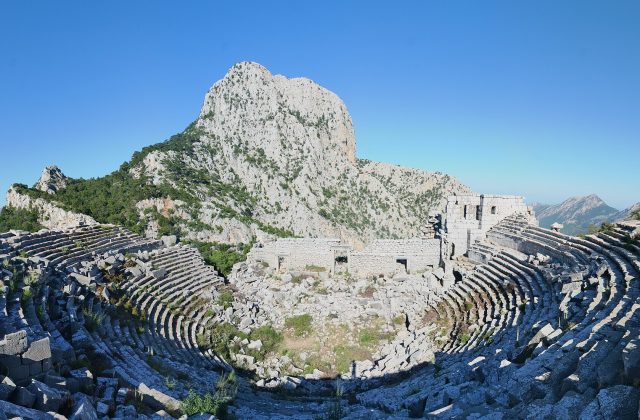
A climb up the slope to the north-east leads to the theatre, one of the highest in the ancient world and once able to seat several thousand people. Earthquakes shifted and toppled its rows of seats, leaving them in wave-like disorder. Entry inside may be restricted for safety, but the view from the edge across the city and valley is striking.
Walk down the colonnaded street to the lower agora, framed by a monumental gate and the Hadrianic nymphaeum. Beside it lie the vast Roman baths, where in 2007 archaeologists found the pieces of a colossal statue of Hadrian. The great vaulted halls are partly roofed for protection, and the excavators continue to work here in summer.
On the way back towards the entrance, look for the small library founded by a citizen named Flavius Severianus Neon, with a mosaic floor that is sometimes covered for protection. Further on, the Doric fountain house still collects spring water from the hill. These quieter corners show how carefully the city managed its water and its learning.
The mountain was settled long before the city, and a Hittite text of the 14th century BC may already name it. Sagalassos was a wealthy Pisidian town when Alexander the Great took it in 333 BC, and it adopted Greek culture quickly. Under Rome it flourished, and Hadrian made it the first city of Pisidia and a centre of the imperial cult. An earthquake in 518 and a plague in the 540s weakened it, and after another earthquake in the 7th century the townspeople moved to the valley. The ruins were little looted. Large excavations led by Marc Waelkens of the University of Leuven began in 1990, and the site is on the UNESCO tentative list.
Sagalassos lies on Mount Akdag, about 7 km above the small town of Aglasun in Burdur province. From Antalya the drive north takes about an hour and a half via the main road towards Burdur and Isparta, then a turn-off to Aglasun; from Burdur or Isparta it is about 40 minutes. The final road climbs in bends to a car park at the entrance, which is at the upper part of the site. Without a car, take a minibus from Burdur or Isparta to Aglasun and a taxi up the hill, agreeing a waiting time for the return. The nearest airports are Antalya and the small Isparta airport.
Do not climb on restored monuments or walk into the areas taped off for excavation, and leave stones and fragments where they lie. Drones need a permit. The site is steep and high, so wear walking shoes, take water and sun protection, and bring a warm layer: even in summer the wind can be cool. Toilets and a small shop are near the ticket office, but food is better in Aglasun or Burdur. Go slowly if you are not used to altitude.
At 1,500 metres, Sagalassos has a mountain climate. Summer days are warm but much cooler than Antalya on the coast, which makes the site a good escape in July and August. Mornings are clearest, before haze and afternoon cloud build over the peaks, and the low light at the end of the day is lovely on the stone.
May and June bring wild flowers and green slopes, and September and October are crisp and stable. Between December and March snow is common and the road may be closed, so check before driving up. Crowds are rarely a problem: tour groups from the coast seldom come so far inland, and you may share the site with only a few other visitors and the archaeologists working there in summer. Allow two to three hours for the main route and more if you want to explore the outer quarters.
Burdur Archaeological Museum, 40 minutes away, holds the colossal statues and many other finds from Sagalassos. Lake Salda, with its white shores, is about an hour and a quarter west of Burdur. The Insuyu cave and Lake Burdur are easy stops on the same road.
73 km away
Selge is a ruined Pisidian city high in the Taurus Mountains above the Koprulu Canyon, about 60 km inland from Manavgat…
9 tickets & tours
77 km away
Termessos is a Pisidian mountain city at about 1,000 metres on the slopes of Gulluk Dagi, north-west of Antalya, so…
3 tickets & tours
85 km away
Perge is an ancient Greek and Roman city on the plain 15 km east of Antalya, once one of the great cities of Pamphylia.
12 tickets & tours
| Hours | Daylight hours, longer from Apr–Oct and shorter in winter; check the Ministry of Culture site |
|---|---|
| Closed | Open daily; snow may close the road in winter |
| Entry fee | Modest fee at the gate; Museum Pass Turkey accepted |
| Time needed | 2 to 3 hours |
| Best time | Morning for clear mountain air; May, June, September and October |
| Booking | Pay at the gate; no booking needed |
| Access | Steep stony paths between terraces at about 1,500 metres; not suitable for wheelchairs or pushchairs |
| Getting there | About 7 km uphill from the town of Aglasun, which is 30 km from Burdur; car or taxi from there |
| Abandoned | AD 650 |
| Excavated | 1990 |
| Civilisation | Greek |
| Elevation | 1 500 m above sea level |
| Checked | October 2026 |
Daylight hours, longer from Apr–Oct and shorter in winter; check the Ministry of Culture site. Open daily; snow may close the road in winter.
Entry fee: Modest fee at the gate; Museum Pass Turkey accepted.
Allow 2 to 3 hours for Sagalassos.
Pay at the gate; no booking needed.
Yes. GetYourGuide sells tickets and guided tours whose route includes Sagalassos; live prices are shown on this page.
Morning for clear mountain air; May, June, September and October.
About 7 km uphill from the town of Aglasun, which is 30 km from Burdur; car or taxi from there.
Steep stony paths between terraces at about 1,500 metres; not suitable for wheelchairs or pushchairs.
Worth it for a restored Roman city high in the mountains, with running fountains, few crowds and wide views over the valley. Skip or shorten it if steep climbs at altitude are hard for you, or in deep winter, when snow can close the road.