Kabah
8 km away
Kabah is the second-largest Maya city of the Puuc hills in Yucatan, Mexico, about 140 km south of Merida and joined to…
5 tickets & tours
Ancient City · Maya · Mexico
Sayil is a Maya city of the Puuc hills in Yucatan, south of Uxmal, best known for its Great Palace, a three-level building with an 85-metre facade. It flourished briefly around AD 800 to 950 and may have had 10,000 inhabitants. It belongs to the Uxmal World Heritage site and is far quieter.
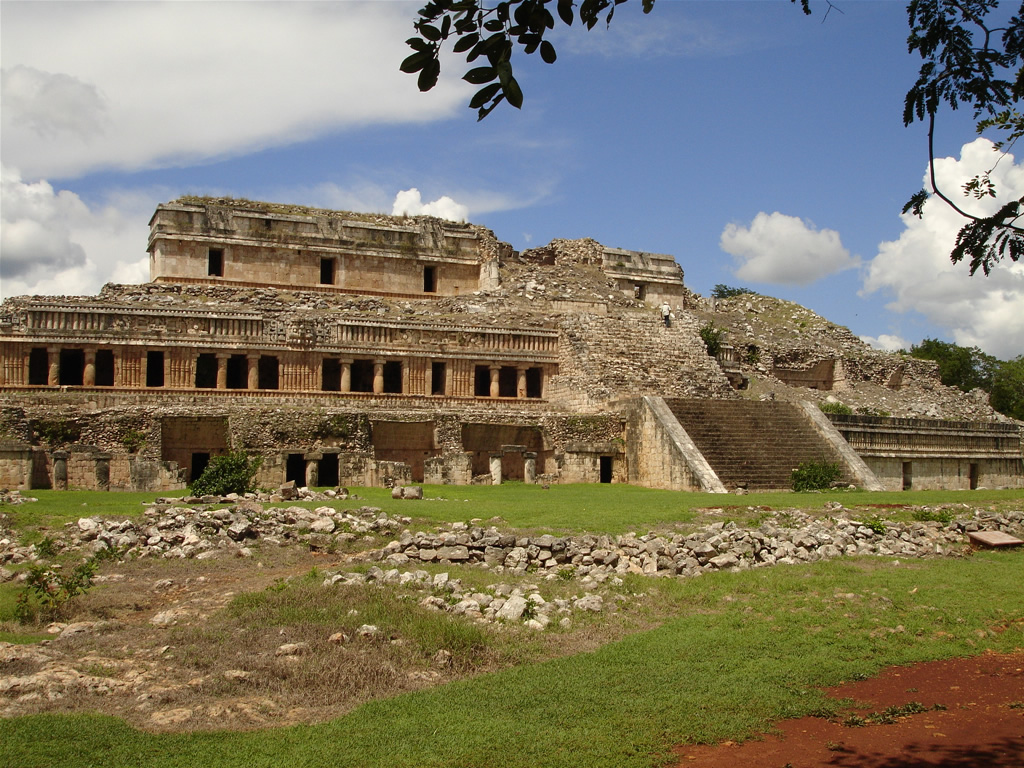
Photo: Juan José Acevedo Góngora, CC BY-SA 2.5
Nothing for Sayil alone is sold online. The site is run by INAH, the Mexican institute of archaeology, and entry is a small fee in pesos paid at the ticket hut. Mexican citizens and residents get free entry on Sundays. Signs in Spanish, English and Maya describe the main buildings, and guides can sometimes be hired at the entrance.
Most visitors see Sayil on the Ruta Puuc, the road that links Kabah, Sayil, Xlapak and Labna, either by hire car or on a day tour from Merida that adds the Loltun caves or Uxmal. Those tours include transport and a guide and often lunch; entry fees may be extra, and time at each site can be short. Some guesthouses in Santa Elena and near Uxmal arrange drivers for the route, and cyclists sometimes ride it from there, though the distances and heat make that a long day.
The sensible plan is to stay a night near Uxmal or in Santa Elena, see Uxmal one day, and drive the Puuc route the next morning in your own time, with about an hour at Sayil between Kabah and Labna.
A short walk from the entrance brings you to the Great Palace, the reason to come. Its three stepped levels rise from a long platform, and the second level has a facade of doorways divided by thick columns and rows of small colonnettes. Look for the masks of the rain god Chaac on the upper frieze and a descending figure above a doorway.
At the foot of the palace a round opening leads into a chultun, an underground cistern that stored rainwater for the dry season. In the Puuc hills there are no rivers or cenotes near the surface, so such cisterns were essential. The plastered catchment area around it shows how the city collected every drop of rain.
Live prices from GetYourGuide for tickets and tours that include this site. Free cancellation on most of them.
From the palace a raised white causeway runs south through the dry forest, the backbone of the city plan. Walk along it in the shade of the trees, listening for birds and watching for iguanas on the stones. Small mounds on either side are the remains of houses and lesser buildings that have not been restored.
A side path climbs to El Mirador, a temple on a low hill crowned by a tall roof comb, the pierced crest that once carried painted stucco figures. The building is less restored than the palace but shows the vertical style of Puuc temples. From its terrace look back across the canopy towards the Great Palace.
Continue to the end of the causeway, where a weathered stone carved with a male figure stands under a small shelter, and further on the South Palace group. These outer buildings are partly cleared and quiet. Allow time for the walk back, which is about a kilometre along the same causeway.
Sayil grew in a shallow valley of the Puuc hills from about AD 800, possibly from an older settlement nearby. It reached its peak around 900, when perhaps 10,000 people lived in the city and several thousand more in the surrounding farmland, relying on cisterns for water. The Great Palace was built and enlarged in this period. The city declined after about 950 and was largely abandoned by around 1000. John Lloyd Stephens and Frederick Catherwood described it in the 1840s, INAH restored the palace in the 20th century, and American archaeologists mapped the city in the 1980s. It was added to the Uxmal UNESCO listing in 1996.
Sayil lies on the Ruta Puuc, a minor road that leaves Highway 261 south of Kabah and runs east towards Labna and Oxkutzcab. From Merida the drive takes about two hours via Muna and Uxmal, and from Santa Elena or the hotels at Uxmal about 30 minutes. There is a small car park at the entrance. No regular bus serves the site; some agencies in Merida run a Puuc route bus or tour, but schedules change, so a hire car or a driver is the reliable choice. Merida airport is the nearest. Fill up with fuel in Muna or Ticul, as stations on the route are few.
Climbing is not allowed on the Great Palace or El Mirador; follow the ropes and signs. Drones need an INAH permit, and tripods may be charged for. Bring plenty of water, a hat, insect repellent and comfortable shoes: the paths are rough and the forest hums with mosquitoes after rain. There are basic toilets at the entrance and sometimes a vendor selling drinks, but no restaurant; eat in Santa Elena or Oxkutzcab.
Yucatan is hot for most of the year, so arrive at opening or come after about 3 pm, when the light turns warm on the palace facade. Midday is hot and bright, though the causeway is shaded by trees. Sayil is one of the quieter sites in the region; tour vans on the Puuc route usually arrive in the late morning and stay only half an hour.
From November to March the weather is drier and more comfortable, and this is the best time for driving the whole Puuc route in a day. April and May are the hottest months, often above 35 degrees. The rainy season from June to October brings afternoon storms, lush forest and more mosquitoes, but also fewer visitors. On Sundays Mexican families take advantage of free entry, which is still rarely crowded here. Allow about an hour, or an hour and a half if you walk to the far end of the causeway.
Kabah, with its wall of Chaac masks, is about 15 minutes away, and the small palace of Xlapak and the arch of Labna follow on the same road within 20 minutes. The Loltun caves lie at the end of the route, and Uxmal is about 40 minutes back towards Merida.
8 km away
Kabah is the second-largest Maya city of the Puuc hills in Yucatan, Mexico, about 140 km south of Merida and joined to…
5 tickets & tours
54 km away
Mayapan was the last great capital of the Maya in Yucatan, ruling much of the north of the peninsula from the 1220s…
2 tickets & tours
88 km away
Edzna is a Maya city in the valley south-east of Campeche, about an hour's drive from the walled port.
3 tickets & tours
| Hours | About 8 am to 5 pm |
|---|---|
| Closed | Open daily |
| Entry fee | Low INAH fee in MXN; free for Mexican residents on Sundays |
| Time needed | about 1 to 1.5 hours |
| Best time | At opening or after 3 pm; November to March for cooler weather |
| Booking | Pay at the gate; no booking |
| Access | Flat forest paths with roots and stones; steep steps on the palace; limited shade between groups |
| Getting there | On the Ruta Puuc road east of Highway 261, a short drive south-east of Kabah; car needed |
| Founded | AD 800 (c. AD 800) |
| Abandoned | 1000 |
| Civilisation | Maya |
| UNESCO | Pre-Hispanic Town of Uxmal |
| Checked | October 2026 |
About 8 am to 5 pm. Open daily.
Entry fee: Low INAH fee in MXN; free for Mexican residents on Sundays.
Allow about 1 to 1.5 hours for Sayil.
Pay at the gate; no booking.
Yes. GetYourGuide sells tickets and guided tours whose route includes Sayil; live prices are shown on this page.
At opening or after 3 pm; November to March for cooler weather.
On the Ruta Puuc road east of Highway 261, a short drive south-east of Kabah; car needed.
Flat forest paths with roots and stones; steep steps on the palace; limited shade between groups.
Worth it for the finest palace facade of the Puuc route and forest paths with almost no one else on them. Skip or shorten it if you have only one day in the region; see Uxmal first and add Sayil only with time to spare.
Sayil dates from AD 800 (c. AD 800). It was abandoned in 1000.
Yes. Sayil is part of the UNESCO World Heritage Site Pre-Hispanic Town of Uxmal.