Becan
51 km away
Becan is a Maya city in the forests of southern Campeche, Mexico, surrounded by a dry moat almost 2 km long that is…
1 ticket or tour
Ancient City · Maya · Mexico
Balamku is a small Maya site in the forest of southern Campeche, about 50 km north of Calakmul, discovered only in 1990. It is famous for one of the largest surviving stucco friezes in the Maya world, nearly 17 metres long, which shows rulers, toads and crocodiles and is preserved under a protective roof.

Photo: HJPD, CC BY 3.0
No tour or ticket for Balamku alone is sold online. Entry is a standard INAH ticket bought at the small booth by the car park, and the fee is low. A guard usually opens the building that protects the stucco frieze and may accompany you inside, since it is kept locked to protect the plaster.
Most visitors reach Balamku on a self-drive trip through the Calakmul region, using Xpujil or the eco-lodges near Conhuas as a base, and stop here on the drive to or from the big sites. Local tour operators in Xpujil sell day trips to Calakmul, which include transport, a guide and sometimes a meal; some will add Balamku on request, but entry fees, including the separate biosphere reserve fees at Calakmul, are often charged on top.
There is no public transport to the site, and few taxis cover the distance, so a rental car or a private driver is needed. Guides can be hired in Xpujil for the whole region, which is useful since the site has limited signs.
The sensible plan is to drive yourself, combine Balamku with Calakmul, and pay the small fee at the gate.
Start at the Central Group with the building that shelters the great frieze, which measures about 16.8 metres long and 1.75 metres high. It shows seated rulers linked to the open mouths of toads and other creatures, with crocodiles below, and traces of red paint survive. Take time inside, as the details become clearer when your eyes adjust to the light.
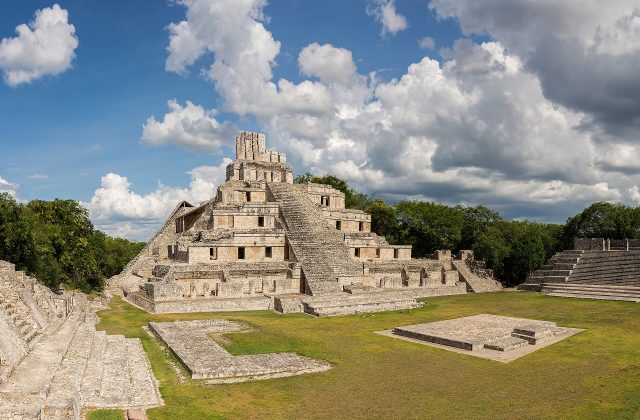
Around the frieze building lie the three plazas of the Central Group, framed by structures whose earliest phases go back to the Late Preclassic. Walk across the plazas to see the layout and the rising mounds. Test pits found remains of the oldest buildings on the site, from the period after 300 BC.
Live prices from GetYourGuide for tickets and tours that include this site. Free cancellation on most of them.
At the southern end of the Central Group, Plaza A holds a small Mesoamerican ball court, where two sloping walls flank the playing alley. Several mounds around it have not yet been excavated. It is a good place to picture public life in a small Maya town of the Classic period.
Follow the forest path to the South Group, investigated by French archaeologists, with four plazas surrounded by restored and partly cleared buildings. Two burials were found in one structure, including an elite individual. Some of the oldest buildings at the site stand here, built over earlier platforms of the Late Preclassic.
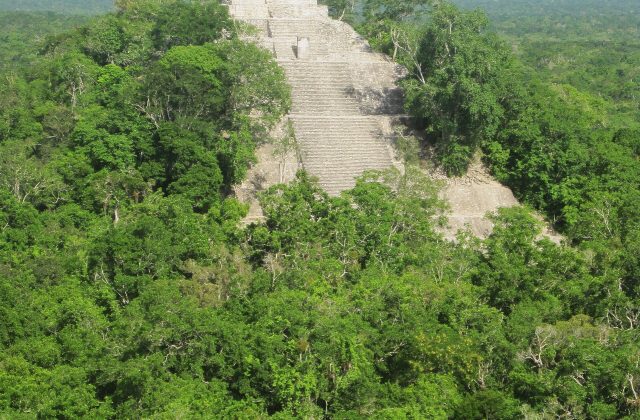
Between the groups, the paths run through dense tropical forest that belongs to the wider Calakmul region. Look and listen for howler monkeys, toucans and wild turkeys, which are common in the early morning. Keep to the paths, as the unexcavated North Group lies further off in the forest and is not open.
Balamku, whose name means jaguar temple in Maya, was occupied from around 300 BC, in the Late Preclassic, until the Terminal Classic between AD 800 and 1000. Its most important buildings date from AD 300 to 600, and its architecture follows the Peten tradition with some Rio Bec influence. The site was discovered in 1990 by archaeologist Florentino Garcia Cruz and INAH custodians, who were investigating a report of looting and found a trench that had exposed the painted stucco frieze. Rescue work followed, and in 1994 and 1995 Ramon Carrasco excavated the Central Group while French archaeologists studied the South Group.
Balamku lies just north of Highway 186, the road that crosses southern Campeche between Escarcega and Chetumal. From Xpujil, the main town of the region, it is about an hour's drive west, and from Escarcega about an hour and a half east. The turn-off is signposted, and a short side road leads to the car park. The Tren Maya has stations at Xpujil and Escarcega, but there is no public transport from either to the site, so rent a car or hire a driver. The nearest airports are Chetumal, about two and a half hours east, and Campeche. Fill the fuel tank before leaving Xpujil or Escarcega.
Do not touch the stucco frieze or use flash photography inside its shelter. Do not climb on unrestored structures or leave the paths. Bring insect repellent, water, a hat and long trousers against mosquitoes and ticks, plus a light raincoat in the wet season. There are no shops at the site and only basic toilets at the entrance. Drones are not allowed at INAH sites without permission.
Balamku receives very few visitors, so crowds are never a problem. The main issue is the climate: the forest is hot and very humid, with temperatures above 30 degrees for much of the year. Go in the early morning, when the air is cooler and wildlife is most active, or late in the afternoon before the site closes.
November to April is the drier season and the best time to visit the region, with fewer mosquitoes and firmer paths. From May to October heavy afternoon rains are common, the paths become muddy and insects are numerous, although the forest is at its greenest. If you plan Calakmul on the same day, visit Calakmul first in the morning and stop at Balamku on the way back east or west. Allow about an hour at the site.
Calakmul, one of the largest Maya cities, lies about 50 km south of the highway, reached by about 60 km of forest road from the turn-off at Conhuas, not far from Balamku. Becan, Chicanna and Xpujil, with Rio Bec style towers, are about an hour east near Xpujil town. Nadzca'an, a little-visited site about 12 km to the north-west, is hard to reach.
51 km away
Becan is a Maya city in the forests of southern Campeche, Mexico, surrounded by a dry moat almost 2 km long that is…
1 ticket or tour
53 km away
Calakmul is the great Maya capital of the Snake Kingdom, deep in the rainforest of southern Campeche, 35 km from the…
9 tickets & tours
119 km away
Edzna is a Maya city in the valley south-east of Campeche, about an hour's drive from the walled port.
3 tickets & tours
| Hours | Daytime opening, roughly from morning to late afternoon; check locally |
|---|---|
| Closed | Usually open daily; check locally |
| Entry fee | A small INAH fee at the gate |
| Time needed | About an hour |
| Best time | Early morning; November to April, the drier season |
| Booking | Pay at the gate; no booking needed |
| Access | Forest paths, mud after rain, some steps; humid and hot; not wheelchair accessible |
| Getting there | A short side road off Highway 186, about an hour west of Xpujil by car |
| Founded | 300 BC (c. 300 BC) |
| Excavated | 1994 |
| Civilisation | Maya |
| Area | 25 ha |
| Checked | October 2026 |
Daytime opening, roughly from morning to late afternoon; check locally. Closed: Usually open daily; check locally.
Entry fee: A small INAH fee at the gate.
Allow About an hour for Balamku.
Pay at the gate; no booking needed.
Yes. GetYourGuide sells tickets and guided tours whose route includes Balamku; live prices are shown on this page.
Early morning; November to April, the drier season.
A short side road off Highway 186, about an hour west of Xpujil by car.
Forest paths, mud after rain, some steps; humid and hot; not wheelchair accessible.
Worth it for a short stop to see a remarkable painted stucco frieze on the way to or from Calakmul. Skip or shorten it if you are short of time, since the site is small and most of its buildings are low, overgrown mounds.
Balamku dates from 300 BC (c. 300 BC). Excavations began in 1994.
Calakmul, Mexico
Calakmul is the great Maya capital of the Snake Kingdom, deep in the rainforest of southern Campeche, 35 km from the…
9 tickets & tours