Avebury Stone Circle
123 km away
Avebury in Wiltshire is the largest stone circle in Britain, a Neolithic henge so big that a whole village grew up…
12 tickets & tours
Palace, Villa & Baths · Roman · United Kingdom
Billingsgate Roman House and Baths are the remains of a riverside house in Roman London, built in the late 2nd century, with a private bath suite added in the 3rd. They lie in the basement of an office block on Lower Thames Street and can be seen only on guided tours. The underfloor heating pillars are among the best preserved in London.
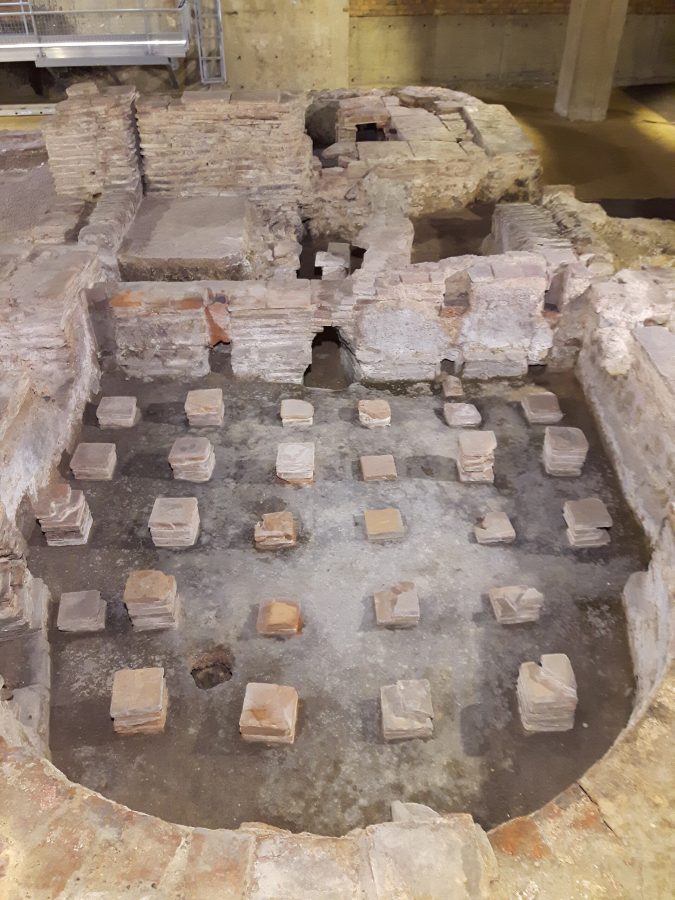
Photo: Carla Brain, CC BY-SA 2.0
Nothing for this site is sold on GetYourGuide, and there is no walk-in entry. The remains sit in the basement of an office building, and the City of London opens them only for guided tours on scheduled dates, run by volunteer City guides. Tickets are released online in advance, groups are small and popular dates sell out, so book as soon as you know your travel dates. The ticket price is modest and covers the guided visit, which lasts under an hour.
There is no audio guide or self-guided option, and the guide is useful in any case: the remains are partly fragmentary, and the guide explains which walls belong to the late 2nd-century house and which to the later bath suite. Groups can sometimes request a private visit through the same organisers.
Most people who come here are already exploring Roman London, so the visit works well as one stop in a walk that also takes in the Roman wall at Tower Hill, the Roman pavement in the crypt of All Hallows by the Tower and the Temple of Mithras in the City. Several London walking-tour companies cover Roman Londinium on foot, but they pass the outside of this building rather than going in. The sensible plan is to book an official tour date and build a Roman City walk around it.
After the stairs down from street level, the tour begins on a walkway above the remains, which fill most of the basement under the modern building. From here the guide outlines the plan: a house with wings around a courtyard, built when this spot lay right on the Roman waterfront of the Thames, long before the river was pushed back by later land reclamation.
The centre of the site is the small bath suite built into the courtyard in the 3rd century. Rows of stacked tile pillars, the hypocaust, once held up the floor while hot air from a furnace circulated underneath. Many pillars still stand to their full height, so you can see exactly how Roman underfloor heating worked.
Live prices from GetYourGuide for tickets and tours that include this site. Free cancellation on most of them.
Next to the hypocaust the guide points out the sequence of rooms a bather passed through: the cold room, the warm room and the hot room. The warm room was the first part found in 1848. Look for the change in floor levels and the remains of the furnace area that heated the hot room nearest to it.
Beyond the baths lie the walls of the east wing of the original late 2nd-century house. Its rooms also had underfloor heating, a sign that the owner was wealthy. A north wing ran at right angles, and there was probably a west wing too, though nothing of it survives. The guide shows how the courtyard sat between them.
The tour ends with the story of the end of the house. Several hundred late 4th-century coins found here show it was still in use around AD 400, which is rare evidence for the last years of Roman London. A Saxon brooch lay in the rubble of the fallen roof, showing the building had collapsed by about AD 500.
The house was built in the late 2nd century on the Thames waterfront of Londinium, with a north and an east wing around a courtyard; the east wing had heated floors. In the 3rd century a bath suite with cold, warm and hot rooms was added in the courtyard. The house stayed in use until the early 5th century, unusually late for Roman London, and was probably a ruin by AD 500. The warm room was found in 1848 during building work for the Coal Exchange and kept in its cellar, the first Roman remains preserved in place in the City. It was excavated again in 1967 to 1970 and kept under the new building. It is a scheduled monument.
The remains lie under an office building at 101 Lower Thames Street, between London Bridge and the Tower of London, close to the old Billingsgate fish market building. The nearest Underground station is Monument, on the District and Circle lines, about five minutes on foot; Bank station on the Northern and Central lines connects to Monument through underground passages. Tower Hill station is about ten minutes east, and London Bridge station, with national rail and Northern and Jubilee line trains, is ten minutes across the river. Buses along Lower Thames Street stop nearby. Do not drive: the City has the congestion charge and very little parking. From Heathrow, take the Elizabeth line to Liverpool Street and walk or change.
Visits are by guided tour only, so arrive a few minutes early at the meeting point given on your ticket; latecomers may not be able to join once the group has gone down. Stay on the walkway, do not touch or lean on the Roman walls and do not drop anything onto the remains. Large bags are better left at your hotel. The basement is cool all year, so bring a layer. There are no toilets or cafes on site.
Because the site is seen only on fixed tour dates, timing is mostly a question of getting a ticket. Tours are usually scheduled on certain weekend days in the warmer half of the year, and the annual open-house weekend in September and archaeology festivals can add extra dates that are free and very popular. Check the programme a month or two ahead and book early.
The weather does not matter underground, so a tour is a good wet-day plan, and weekends are quiet in the City because the offices are closed. Weekday mornings around Monument are busy with commuters, while weekend lunchtimes bring visitors walking between London Bridge and the Tower. Allow an hour for the tour and arrival, and half a day if you add the other Roman sites nearby. In winter, when tours are rarer, the other Roman remains of the City make a good substitute.
The Tower of London and the tall surviving section of the Roman city wall at Tower Hill are ten minutes east on foot. All Hallows by the Tower has a Roman pavement in its crypt. The Temple of Mithras, displayed under an office building in the City, and the remains of the Roman amphitheatre under Guildhall Art Gallery are 15 to 20 minutes' walk away.
123 km away
Avebury in Wiltshire is the largest stone circle in Britain, a Neolithic henge so big that a whole village grew up…
12 tickets & tours
127 km away
Stonehenge is a prehistoric stone circle on Salisbury Plain in Wiltshire, begun about 3000 BC, whose great sarsen…
175 tickets & tours
128 km away
Old Sarum is the great earthwork hill 3 km north of Salisbury where an Iron Age fort of about 400 BC later held a…
1 ticket or tour
| Hours | Guided tours only, on scheduled dates, mostly in the warmer months |
|---|---|
| Closed | Closed except on scheduled tour dates |
| Entry fee | Modest ticket for the guided tour |
| Time needed | about an hour |
| Best time | Any scheduled tour date; pair it with a morning in the City |
| Booking | Book the guided tour in advance; places are limited |
| Access | Basement reached by stairs; viewing walkway over the remains; ask the organisers about step-free access |
| Getting there | Monument Underground station, about 5 minutes on foot along Lower Thames Street |
| Founded | AD 150 (2nd century AD (midpoint), late in the century) |
| Excavated | 1848 |
| Civilisation | Roman |
| Checked | October 2026 |
Guided tours only, on scheduled dates, mostly in the warmer months. Closed: Closed except on scheduled tour dates.
Entry fee: Modest ticket for the guided tour.
Allow about an hour for Billingsgate Roman House and Baths.
Book the guided tour in advance; places are limited.
Yes. GetYourGuide sells tickets and guided tours whose route includes Billingsgate Roman House and Baths; live prices are shown on this page.
Any scheduled tour date; pair it with a morning in the City.
Monument Underground station, about 5 minutes on foot along Lower Thames Street.
Basement reached by stairs; viewing walkway over the remains; ask the organisers about step-free access.
Worth it for a rare look at a Roman house and bath suite under modern London streets. Skip it if you want open-air ruins: the site is a small basement and is shown only on occasional guided tours.
Billingsgate Roman House and Baths dates from AD 150 (2nd century AD (midpoint), late in the century). Excavations began in 1848.

