Acropolis of Athens
Athens, Greece
The Acropolis of Athens is the limestone hill above the city crowned by the Parthenon, the marble temple of Athena…
114 tickets & tours
Ancient Monument · Roman · Greece
Hadrian's Library is the great colonnaded building the emperor Hadrian gave Athens in AD 132, on the north side of the Acropolis beside Monastiraki Square. Behind a facade of tall marble columns lay a courtyard with a long pool and halls where papyrus rolls were kept. Later the site held three churches in turn, whose remains are also on view.
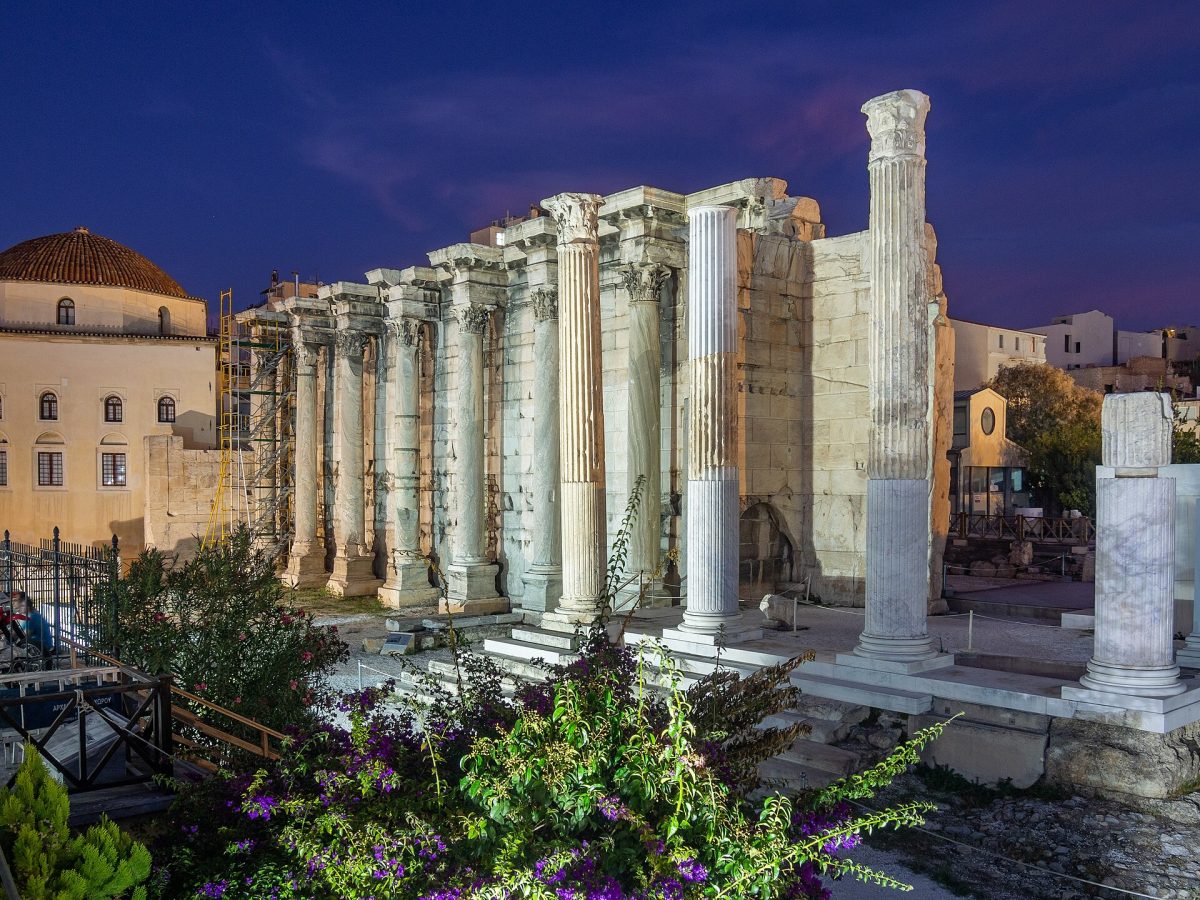
Photo: C messier, CC BY-SA 4.0
Hadrian's Library has its own standard ticket, sold at the entrance on Areos Street and through the official Greek e-ticket system. There is no timed entry and queues are rare. Athens has long offered a combined ticket for its main ancient sites, which covers the Acropolis, the Ancient Agora, the Roman Agora, Kerameikos, the Temple of Olympian Zeus and Hadrian's Library; if you plan to see several of them over a few days, it is usually better value than separate tickets. Under-18s and EU citizens under 25 enter free, and Greek state sites are free on certain days, including the first Sunday of each month from November to March.
Only one product online is aimed at this site: an entry ticket with an audio guide for your phone. It suits visitors who like to wander on their own but want the building explained room by room, since the signs are brief. Check that the price covers entry and is not just the audio app.
Guided walks around Monastiraki and Plaka, and tours of the Roman Agora, often pause outside the library facade without entering. For most visitors the sensible choice is the combined ticket, with a self-guided half hour here between the Agora and the Roman Agora.
Start outside on Areos Street, just off Monastiraki Square, where the west wall still stands with seven Corinthian columns of greenish veined marble from Karystos in Euboea. The central gateway, once crowned by a pediment, was the only way in. Even from the street, the scale shows what an expensive gift Hadrian made to the city he loved.
Through the gate, the large courtyard was once surrounded by a colonnade of about one hundred columns, with gardens and a long ornamental pool in the middle. Today you see the outline of the courtyard and the foundations of the pool. Imagine readers walking under the colonnade, out of the sun, between the halls on the east side.
Live dates and prices from GetYourGuide. Free cancellation on most tickets.
At the far eastern end of the courtyard stood the library itself, a hall with niches in the walls for wooden cupboards that held the papyrus rolls. The rooms on either side served as reading rooms, and the corner halls as lecture rooms. Look for the rows of niches and the remains of the marble wall facing.
In the centre of the courtyard lie the foundations of a 5th-century church with four apses, one of the earliest in Athens. It was replaced in the 7th century by a basilica with three aisles, and then in the 12th century by a simpler church known as the Great Panagia, the city's first cathedral. Their outlines overlap in the ground.
Near the entrance, look for the large statue of the goddess of victory, found in the library during excavations in 1988. Then step back outside to Monastiraki Square to see the 18th-century Tzistarakis Mosque, which stands beside the library, and the line of the walls of late Roman Athens that later incorporated the building.
The emperor Hadrian, a great admirer of Greek culture, built the library in AD 132 as part of a programme of buildings in Athens. It was laid out like a Roman forum, with one monumental entrance, a high wall, a colonnaded courtyard with a pool, and book halls on the east side. The Herulian invasion of 267 badly damaged it, and the prefect Herculius repaired it between 407 and 412; it was then built into the late Roman city wall. Three churches rose in the courtyard between the 5th and 12th centuries. In Ottoman times the old bazaar of Athens occupied the area, and excavations began after a fire destroyed it in 1884.
Hadrian's Library is in the centre of Athens, a two-minute walk from Monastiraki metro station on Line 1 and Line 3. From Athens airport, Line 3 runs direct to Monastiraki in about 40 minutes. From Syntagma Square, walk west along Ermou Street, about 10 minutes, or take Line 3 one stop. From the Acropolis, follow the paths down through Plaka or the Ancient Agora, a walk of 10 to 15 minutes. The entrance is on Areos Street at the north-east corner of Monastiraki Square. The area is pedestrianised and busy, so avoid driving; taxis can drop you at the square.
Do not climb on walls or column bases, and stay on the paths. Large bags and backpacks may be refused, and food is not allowed among the ruins. Drones are forbidden without a permit, as at all Greek archaeological sites, and professional photography needs permission. Bring water and a hat in summer, as shade is limited. There are toilets at the entrance, and cafés and tavernas on every side of Monastiraki Square.
Hadrian's Library is one of the quieter ancient sites in central Athens, even in summer, because many visitors simply photograph the facade from the street. Small groups from cruise ships and city walks pass through in the late morning, so opening time and the last two hours before closing are the calmest. Winter closing times are much earlier than in summer, so check them if you plan to visit in the afternoon from November to March.
The best months are April to June and September to October, when Athens is warm but not exhausting. July and August often bring temperatures above 35 degrees, and the courtyard holds the heat, so go early. The free Sundays in winter and national free days draw local families, but the site rarely feels crowded. Allow about 45 minutes to an hour, and combine it with the Roman Agora next door.
The Roman Agora and the Tower of the Winds are a two-minute walk east, and the Ancient Agora with the Stoa of Attalos is five minutes south-west. The Acropolis is a 15-minute walk uphill through Plaka. The flea market streets and the Tzistarakis Mosque are on Monastiraki Square itself.
| Hours | About 8 am to 8 pm in summer, to around 3 or 5 pm in winter; check current hours |
|---|---|
| Closed | Open daily except 1 Jan, 25 Mar, 1 May, Easter Sunday and 25–26 Dec |
| Entry fee | A few euros; under-18s and EU under-25s free |
| Time needed | 45 minutes to an hour |
| Best time | At opening or late afternoon; April to June and September to October |
| Booking | Pay at the gate or online; no timed slot needed |
| Access | Mostly level gravel and paved paths; some steps and uneven stone; partly accessible |
| Getting there | Monastiraki metro station, Lines 1 and 3, a 2-minute walk |
| Founded | AD 132 |
| Civilisation | Roman |
| Checked | October 2026 |
About 8 am to 8 pm in summer, to around 3 or 5 pm in winter; check current hours. Open daily except 1 Jan, 25 Mar, 1 May, Easter Sunday and 25–26 Dec.
Entry fee: A few euros; under-18s and EU under-25s free.
Allow 45 minutes to an hour for Hadrian’s Library.
Pay at the gate or online; no timed slot needed.
Yes. GetYourGuide lists one ticket or tour for Hadrian’s Library, with live dates and prices and free cancellation on most of them.
At opening or late afternoon; April to June and September to October.
Monastiraki metro station, Lines 1 and 3, a 2-minute walk.
Mostly level gravel and paved paths; some steps and uneven stone; partly accessible.
Worth it for a compact Roman monument in central Athens, with layers from Hadrian to Byzantine Christianity, seen in under an hour. Skip or shorten it if time is short: the facade can be seen free from the street, and the Agora covers more.
Hadrian’s Library dates from AD 132.
Athens, Greece
The Acropolis of Athens is the limestone hill above the city crowned by the Parthenon, the marble temple of Athena…
114 tickets & tours
Athens, Greece
The Ancient Agora of Athens was the civic heart of the classical city, the square below the Acropolis where citizens…
5 tickets & tours
Athens, Greece
The Roman Agora of Athens is the marketplace built with money from Julius Caesar and Augustus in the last decades BC, a…
No online ticket