Acropolis of Athens
Athens, Greece
The Acropolis of Athens is the limestone hill above the city crowned by the Parthenon, the marble temple of Athena…
114 tickets & tours
Ancient City · Greek · Greece
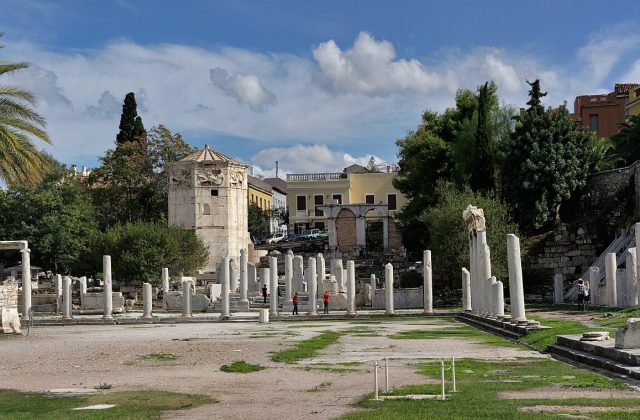
The Ancient Agora of Athens was the civic heart of the classical city, the square below the Acropolis where citizens voted, traded and argued, and where Socrates taught. It holds the best-preserved Doric temple in Greece, the Temple of Hephaestus, and a museum in the fully rebuilt Stoa of Attalos.

Photo: https://www.flickr.com/people/jonezes/, CC BY-SA 2.0
Our pick for each kind of visit, with live dates and prices from GetYourGuide. Free cancellation on most.
Best for: First visit, about two hours
A licensed guide turns the foundations into a story of trials, votes and markets, with entry included so you walk straight in at the gate.
The Agora has its own entry ticket, sold online and at the gates, which also covers the museum in the Stoa of Attalos. It is also part of the combined ticket for the main archaeological sites of Athens, valid for several days, which covers the Acropolis, the Roman Agora, Hadrian's Library and other sites; it pays off if you plan to see at least three. Queues here are far shorter than at the Acropolis, so booking ahead is optional.
GetYourGuide sells e-tickets with an audio commentary on your phone, one version covering the Roman Agora too, which is useful as signs on the site are brief. Guided tours with entry run in small groups for about two hours, and private guided tours suit families or those with specific interests. There are also walking tours that combine the Acropolis, the Roman Agora and the Ancient Agora in one morning, which gives an overview but only a short time in each.
The site makes most sense with some explanation, because many buildings survive only as foundations. For most visitors a guided tour or an audio guide is worth it; a sensible plan is the combined ticket, the Acropolis early in the morning and the Agora with an audio guide afterwards, when its trees offer some shade.
On the low hill on the west side, this Doric temple of the mid-5th century BC still has its columns, pediments and roof beams of marble, which makes it the best-preserved temple of its kind in Greece. It survived because it became a church. Walk right round it to see the carved scenes of Theseus and Heracles above the porches.
On the opposite, east side, the long two-storey colonnade built by King Attalos II of Pergamon was rebuilt in the 1950s exactly as it stood, giving a rare sense of the scale of a Greek stoa. The museum inside shows everyday finds from the Agora, including voting ballots, a clay machine for choosing jurors and pieces of ostraka.
Live dates and prices from GetYourGuide. Free cancellation on most tickets.
The main processional road crosses the Agora diagonally from the entrance by the Stoa of Attalos towards the Acropolis. Along it the great procession of the Panathenaic festival carried a new robe for Athena every four years. Walk part of it uphill: from here the Parthenon appears above the trees, and the road continues to the Acropolis entrance.
In the middle of the square stand the remains of a roofed concert hall built by the Roman general Agrippa around 15 BC. Its later facade survives in three huge statues of giants and tritons, part of a gymnasium built on the site in the 5th century. They mark the moment when the open square was filled with Roman buildings.
Below the Temple of Hephaestus on the west side lie the foundations of the round Tholos, where the city's executive committee ate and slept, and the council chambers. In front stood the Monument of the Eponymous Heroes, a notice board for new laws. These modest stones are where Athenian democracy was run day to day.
Near the southern exit, a small Byzantine church of about AD 1000 stands among the ruins, the only building on the site still roofed and in use. It has a four-leaf plan, and inside are later wall paintings. It shows how life went on in the Agora long after the ancient city had faded, before the area became a residential district.
The area below the Acropolis was a cemetery and settlement before it became a public square in the 6th century BC. Over the following centuries the Athenians built council houses, law courts, temples and colonnades here, and it was the stage for the democracy of the 5th and 4th centuries BC and for the trial of Socrates in 399 BC. Hellenistic kings and Roman emperors added grand buildings until the Herulian raid of AD 267 ruined the area. A residential quarter later covered the site. From 1931 the American School of Classical Studies cleared the houses and excavated, and in the 1950s it rebuilt the Stoa of Attalos as the museum.
The Agora lies in the old centre, between Monastiraki and the north-west slope of the Acropolis. Metro lines 1 and 3 stop at Monastiraki, and line 1 at Thissio; from either it is a walk of about five minutes to the main gate on Adrianou Street. A second gate on the south side, near the Church of the Holy Apostles, opens onto the path up to the Acropolis.
From Athens airport, metro line 3 runs to Monastiraki in about 40 minutes, and the airport bus to Syntagma is an alternative. Driving in the centre is not practical: parking is scarce and streets are restricted. Taxis can drop you on Adrianou Street, a pedestrian zone at its eastern end.
Do not climb on the ruins, sit on marble or enter the Temple of Hephaestus beyond the barriers. Drones are forbidden, and tripods and professional photography need a permit. Large bags may be checked at the entrance. Bring water, a hat and sunscreen in summer: there is shade under the trees, but the paths are dusty and hot. Toilets are near the museum, and there is a drinking fountain, but no cafe on site.
Come at 8 am, when the gates open and before the heat builds, or after 5 pm in summer, when the light on the Temple of Hephaestus turns gold and many visitors have left. Midday from June to August is hot, though the trees give more shade than on the Acropolis. Groups often arrive mid-morning straight from the Acropolis.
March to May and October are the best months: mild days, green grass between the stones and fewer people. The first Sunday from November to March and a few national days are free and much busier. Winter is quiet but closing times are early. The Agora works well in the afternoon after an early Acropolis visit. Allow two hours for the main buildings and the museum, three if you want to wander or take a guided tour.
The Acropolis entrance is a 15-minute walk uphill from the south gate, and the Areopagus rock lies on the way. The Roman Agora and Hadrian's Library are five minutes east, both on the combined ticket. The Kerameikos cemetery is ten minutes north-west, and Monastiraki and Plaka are next door for lunch.
| Hours | 8 am to about 8 pm in summer, to about 5 pm in winter |
|---|---|
| Closed | Open daily except 1 Jan, 25 Mar, 1 May, Orthodox Easter Sunday, 25 and 26 Dec |
| Entry fee | Separate ticket or combined pass; EU under-25s free |
| Time needed | 2 to 3 hours |
| Best time | At 8 am or after 5 pm in summer; March to May and October |
| Booking | E-tickets save the queue; booking ahead is optional outside high summer |
| Access | Gravel and dirt paths, gentle slopes and some shade; step-free route to the Stoa of Attalos |
| Getting there | Metro to Monastiraki or Thissio, then a 5-minute walk to the Adrianou Street gate |
| Founded | 550 BC (6th century BC (midpoint)) |
| Excavated | 1931 |
| Civilisation | Greek |
| Checked | October 2026 |
8 am to about 8 pm in summer, to about 5 pm in winter. Open daily except 1 Jan, 25 Mar, 1 May, Orthodox Easter Sunday, 25 and 26 Dec.
Entry fee: Separate ticket or combined pass; EU under-25s free.
Allow 2 to 3 hours for Ancient Agora of Athens.
E-tickets save the queue; booking ahead is optional outside high summer.
Yes. GetYourGuide lists 5 tickets and tours for Ancient Agora of Athens, with live dates and prices and free cancellation on most of them.
At 8 am or after 5 pm in summer; March to May and October.
Metro to Monastiraki or Thissio, then a 5-minute walk to the Adrianou Street gate.
Gravel and dirt paths, gentle slopes and some shade; step-free route to the Stoa of Attalos.
Worth it for the Temple of Hephaestus and a quieter, shaded walk through the birthplace of democracy. Skip or shorten it if you have only one morning in Athens and the Acropolis comes first, or if scattered foundations without a guide feel meaningless.
Ancient Agora of Athens dates from 550 BC (6th century BC (midpoint)). Excavations began in 1931.
Athens, Greece
The Acropolis of Athens is the limestone hill above the city crowned by the Parthenon, the marble temple of Athena…
114 tickets & tours
Athens, Greece
Hadrian's Library is the great colonnaded building the emperor Hadrian gave Athens in AD 132, on the north side of…
1 ticket or tour
Athens, Greece
The Roman Agora of Athens is the marketplace built with money from Julius Caesar and Augustus in the last decades BC, a…
No online ticket