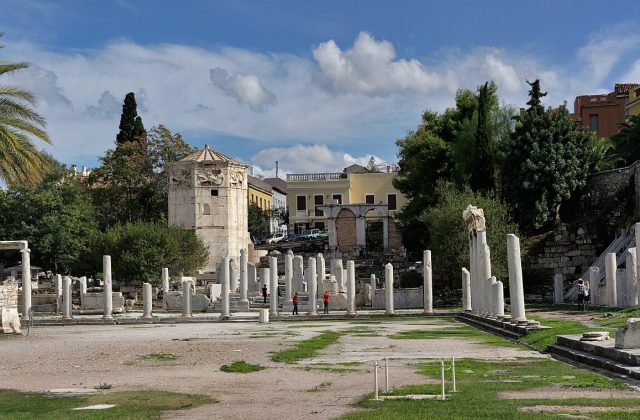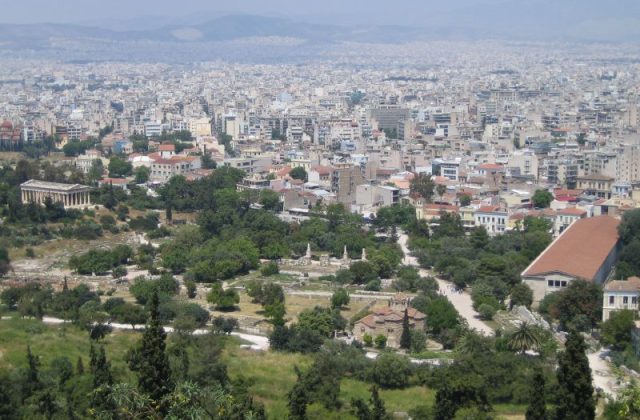
Ancient Agora of Athens
Athens, Greece
The Ancient Agora of Athens was the civic heart of the classical city, the square below the Acropolis where citizens…
5 tickets & tours
Ancient City · Greek · Greece
The Acropolis of Athens is the limestone hill above the city crowned by the Parthenon, the marble temple of Athena built between 447 and 432 BC. The Propylaea gateway, the small Temple of Athena Nike and the Erechtheion with its porch of maidens share the summit, while theatres and sanctuaries line the slopes below.

Photo: A.Savin, CC BY-SA 3.0
Our pick for each kind of visit, with live dates and prices from GetYourGuide. Free cancellation on most.
Best for: First visit, at opening time
A guide meets you before the first slot, so you climb with fewer people and less heat, and continues to the Ancient Agora below the hill.
Entry is by timed ticket, sold online and at the gates, with a fixed hourly slot; numbers per hour are limited, so the cooler early and late slots sell out first in summer. The ticket covers the summit and the north and south slopes, including the Theatre of Dionysus. The old combined ticket for the Ancient Agora, Hadrian's Library, the Kerameikos and other Athens sites has been withdrawn, so each now needs its own ticket. The Acropolis Museum below the hill is separate. There are free days on a few national dates and on the first and third Sundays from November to March.
On GetYourGuide the commonest products are guided walks of about two hours in small groups, often meeting at the metro station before the first slot of the day or in the late afternoon; some add the Acropolis Museum or the Ancient Agora. There are private guides, family tours, smartphone audio tours, city tours by bus or e-scooter that only view the hill, and combined days with Cape Sounion. Check whether the entry ticket is included, since guided prices often exclude it.
For a first visit, a small-group guided tour at opening is the sensible choice: a guide explains the temples while you avoid the worst of the heat and the crowds.
From the main west entrance, a ramp and steps climb to the Propylaea, the monumental marble gateway of 437 BC designed by Mnesicles, its columns framing the way in. On a bastion to the right stands the small Ionic Temple of Athena Nike, rebuilt more than once in modern times, with a copy of its carved frieze of battles.
Through the gateway the Parthenon rises ahead, built under Pericles by Ictinus and Callicrates with sculpture directed by Phidias. Walk round it to see the subtle curves that make its lines look straight, the gaps where the sculptures stood, and the restoration cranes; visitors cannot enter the temple. The best photographs are from the north-west corner.
Live dates and prices from GetYourGuide. Free cancellation on most tickets.
On the north side of the summit, the Erechtheion is an irregular temple on several levels built over the spots linked to Athena's contest with Poseidon. Its south porch is held up by six maidens, the Caryatids; these are casts, as five originals are in the Acropolis Museum and one in the British Museum. Athena's sacred olive tree grows beside it.
At the eastern tip of the rock, by the Greek flag, a platform looks out over the Plaka, the Temple of Olympian Zeus, Lycabettus hill and, on a clear day, the sea at Piraeus. It is the coolest corner when the wind blows. From the north wall you look straight down on the Ancient Agora and the Temple of Hephaestus.
Leaving the summit, take the south slope path. The Odeon, a Roman theatre built in AD 161 by a rich Athenian in memory of his wife, has its tall arched stage wall and restored marble seats; it is seen from above, and used for concerts in summer. Further east along the slope, the Stoa of Eumenes once gave shelter to theatre-goers.
At the eastern end of the south slope lies the Theatre of Dionysus, where the plays of Aeschylus, Sophocles and Euripides were first staged. The carved marble seats of the priests in the front row survive. From here the south-east exit leads to Dionysiou Areopagitou street and the Acropolis Museum opposite.
The hill was a Mycenaean citadel in the Bronze Age and later the main sanctuary of Athena. The Persians destroyed its temples in 480 BC, and from 447 BC Pericles directed the rebuilding that produced the Parthenon, the Propylaea, the Temple of Athena Nike and the Erechtheion. The Parthenon later served as a church and then a mosque; in 1687 a Venetian shell ignited Ottoman gunpowder stored inside and blew out its centre. Between 1801 and 1812 agents of Lord Elgin removed much of its sculpture to London. Restoration began in the 19th century and a long programme has continued since 1975. UNESCO listed the Acropolis in 1987.
The Acropolis rises in the centre of Athens, close to the Plaka. Metro line 2 to Akropoli station brings you to Dionysiou Areopagitou, the pedestrian street round the south of the hill; from there it is a 5-minute walk to the south-east gate or about 10 minutes uphill to the main west entrance. Monastiraki and Thiseio stations on line 1 are about 15 minutes' walk from the west gate. From Athens airport, metro line 3 reaches Syntagma in about 40 minutes, where you change to line 2; the X95 bus also runs to Syntagma. Taxis can drop you on Dionysiou Areopagitou. There is no parking near the hill.
Do not touch the marble or take stones, and keep to the paths and roped areas. Drones are banned, large bags must be left at the cloakroom, and food is not allowed on the summit. Wear shoes with good grip: the marble steps and rock are polished smooth and slippery. Carry water, a hat and sun cream, as there is no shade. Toilets and drinking fountains are near the entrances, but the nearest cafes are outside the site.
The busiest slots run from about 9 am to 1 pm, when cruise passengers and coach groups arrive. The first slot at 8 am is the best for cooler air and softer light, and the last two hours before closing are calmer still in summer, with golden light on the Parthenon. Use the south-east gate, which usually has shorter queues.
April, May, late September and October are the most comfortable months. In July and August temperatures often pass 35 degrees and the site can close for safety in the middle of the day during heatwaves, so book the earliest slot. Winter is quieter, with clear days between rain, and the first and third Sundays from November to March are free and busy. Strong wind can close the summit briefly. Allow up to two and a half hours including the slopes.
The Acropolis Museum, opposite the south-east gate, displays the originals of the sculptures and Caryatids and is best seen right after the visit. The Ancient Agora and the Temple of Hephaestus are a 10-minute walk downhill, and Areopagus hill and Filopappou hill give classic views of the Parthenon at sunset.
| Hours | 8 am to 8 pm Apr–Aug, closing earlier in steps to 6 pm by late Oct; 8 am to 5 pm Nov–Mar |
|---|---|
| Closed | 1 Jan, 25 Mar, 1 May, Orthodox Easter Sunday, 25 and 26 Dec |
| Entry fee | from EUR 30; under-18s and EU citizens under 25 free |
| Time needed | 1.5 to 2.5 hours |
| Best time | At 8 am or the last two hours; April, May, late September and October |
| Booking | Timed tickets with hourly slots; book online days ahead in season |
| Access | Steep marble steps and slippery rock, no shade; a lift on the north face serves wheelchair users |
| Getting there | Metro line 2 to Akropoli, then a 10-minute walk to the south-east or main gate |
| Founded | 450 BC (5th century BC (midpoint), Periclean buildings) |
| Excavated | 1885 |
| Civilisation | Greek |
| Area | 3 ha |
| Elevation | 150 m above sea level |
| Visitors | 4.6 million a year (2024) |
| UNESCO | Acropolis, Athens |
| Checked | October 2026 |
8 am to 8 pm Apr–Aug, closing earlier in steps to 6 pm by late Oct; 8 am to 5 pm Nov–Mar. Closed: 1 Jan, 25 Mar, 1 May, Orthodox Easter Sunday, 25 and 26 Dec.
Entry fee: from EUR 30; under-18s and EU citizens under 25 free.
Allow 1.5 to 2.5 hours for Acropolis of Athens.
Timed tickets with hourly slots; book online days ahead in season.
Yes. GetYourGuide lists 114 tickets and tours for Acropolis of Athens, with live dates and prices and free cancellation on most of them.
At 8 am or the last two hours; April, May, late September and October.
Metro line 2 to Akropoli, then a 10-minute walk to the south-east or main gate.
Steep marble steps and slippery rock, no shade; a lift on the north face serves wheelchair users.
Worth it for standing beside the Parthenon and looking out over Athens to the sea from the summit. Skip or shorten it at midday in summer, when timed groups fill the narrow gateway and the bare rock is very hot; go at opening or towards closing instead.
Acropolis of Athens dates from 450 BC (5th century BC (midpoint), Periclean buildings). Excavations began in 1885.
Yes. Acropolis of Athens is part of the UNESCO World Heritage Site Acropolis, Athens.
Athens, Greece
The Ancient Agora of Athens was the civic heart of the classical city, the square below the Acropolis where citizens…
5 tickets & tours
Athens, Greece
Hadrian's Library is the great colonnaded building the emperor Hadrian gave Athens in AD 132, on the north side of…
1 ticket or tour
Athens, Greece
The Roman Agora of Athens is the marketplace built with money from Julius Caesar and Augustus in the last decades BC, a…
No online ticket