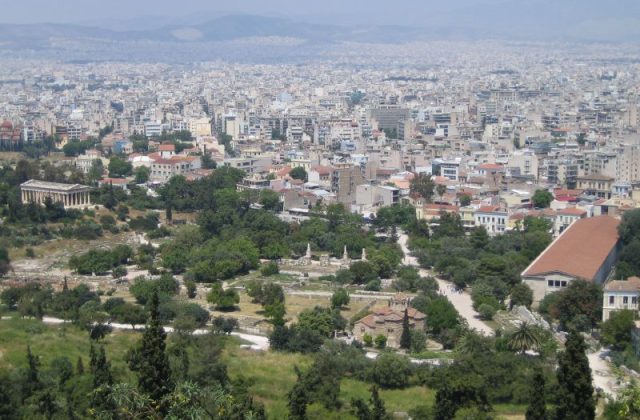
Hadrian’s Library
0 km away
Hadrian's Library is the great colonnaded building the emperor Hadrian gave Athens in AD 132, on the north side of…
1 ticket or tour
Ancient City · Roman · Greece
The Roman Agora of Athens is the marketplace built with money from Julius Caesar and Augustus in the last decades BC, a short walk east of the older Greek Agora. Its star is the Tower of the Winds, an octagonal marble clock tower that survives almost complete. The site is small, central and quick to see.

Photo: Andreas Trepte, CC BY-SA 2.5
Nothing is sold on GetYourGuide for the Roman Agora alone, but the site is easy to visit on your own. There are two ways in. The first is a single ticket bought at the gate or from the official e-ticket service of the Greek culture ministry. The second is the combined ticket for the archaeological sites of central Athens, which includes the Acropolis, the Ancient Agora, the Roman Agora, Hadrian's Library, the Kerameikos and the Temple of Olympian Zeus, and is valid for several days. If you are going to the Acropolis anyway, the combined ticket usually works out cheaper than separate entries, though it does not give a timed Acropolis slot on its own, so check the current rules.
Many guided walks of the old town, Plaka and Monastiraki stop at the railings beside the Tower of the Winds without going in, and some Acropolis and Ancient Agora tours finish nearby. Private guides can include the Roman Agora in a half-day route through the lower city.
The sensible choice for most visitors is the combined ticket, used on a separate morning for the lower sites: Hadrian's Library, the Roman Agora and the Ancient Agora sit within ten minutes of each other.
At the eastern end of the site stands the octagonal marble tower built by the astronomer Andronikos of Kyrrhos, about 12 metres high. Each face carries a relief of one of the eight winds, and sundial lines are cut below them. Inside, channels show where a water clock once worked. Go in: the interior is open and well lit.
Walk west across the square to the main entrance gate, four Doric columns holding up a pediment, still standing to full height. An inscription on the architrave names Augustus's funding of the market. On one of the pillars, look for the decree of Hadrian on the taxing of olive oil sales, a reminder that this was a working market.
Live prices from GetYourGuide for tickets and tours that include this site. Free cancellation on most of them.
The centre of the site is the large open courtyard, once surrounded by Ionic colonnades with shops behind them. Stretches of paving and column bases remain, especially on the eastern side. Panels show how the square looked, and the view up to the north slope of the Acropolis is excellent from here.
On the northern side stands the Fethiye Mosque, built by the Ottomans after their capture of Athens in the 15th century and among the oldest Ottoman buildings in the city. It has served as a school, a barracks and a store, and is sometimes open for exhibitions. Its dome makes a good contrast with the Roman stones around it.
Close to the Tower of the Winds are the remains of a Roman public latrine, with rows of stone seats along the walls, a favourite with children. Beside it is the Ionic East Propylon, the second gate into the market. Just outside the fence on Aiolou Street, the gateway of an Ottoman college is also worth a look.
Julius Caesar promised funds for a new market in Athens in 51 BC, and the work was completed with money from Augustus, probably between 27 and 17 BC, under the direction of Eucles of Marathon. It was a paved courtyard with colonnades and shops, an office for market officials and a fountain to the south. The Tower of the Winds is a little older, from the 1st century BC. After the Herulian raid of AD 267 the administrative centre of the city moved here. In later centuries houses, churches and the Fethiye Mosque covered the area. Greek archaeologists began clearing it in the 19th century; part of the market still lies under the surrounding streets.
From Athens airport, metro line 3 runs to Monastiraki in about 40 minutes, and the airport express bus reaches Syntagma in about an hour. From Monastiraki station, walk up Areos Street past Hadrian's Library and turn left along Polygnotou Street to the entrance, about 5 minutes. From Syntagma it is a 15-minute walk through Plaka. From the Acropolis, follow the paths down the north slope through Anafiotika in about 10 minutes. Driving in the old centre is not practical: the streets are narrow and pedestrianised. Taxis can drop you on Ermou Street or at Monastiraki Square.
Climbing on the ruins, sitting on column bases and using tripods or drones without a permit are not allowed. Food is not allowed inside, but you can bring water, and there is very little shade apart from the tower and a few trees. Wear shoes with grip, as polished marble is slippery. Toilets are at the entrance. Staff begin clearing the site shortly before closing, so be at the gate in good time.
The Roman Agora is much quieter than the Acropolis and the Ancient Agora, and even in high season it rarely feels crowded. Still, the best times are the first hour after opening and the last couple of hours before closing, when the light is warm on the Tower of the Winds and the heat is lower. Midday from June to August is hot, with temperatures often above 35 degrees, and the site offers very little shelter.
April, May, June, September and October are the most comfortable months. In winter, opening hours are shorter, so plan the visit for the morning. Admission is free on certain days, including 6 March, 18 April, 18 May, 28 October and the first Sunday of each month from November to March, and those days are busier. Opening hours can change for strikes or heat, so check the official ministry page. Allow about an hour, or 30 minutes if you only want the tower.
Hadrian's Library is two minutes away towards Monastiraki and is included in the combined ticket. The Ancient Agora, with the Temple of Hephaestus and the Stoa of Attalos museum, is ten minutes west. Climb to the Acropolis in about 15 minutes, or finish in Plaka for lunch.
0 km away
Hadrian's Library is the great colonnaded building the emperor Hadrian gave Athens in AD 132, on the north side of…
1 ticket or tour
0 km away
The Acropolis of Athens is the limestone hill above the city crowned by the Parthenon, the marble temple of Athena…
114 tickets & tours
0 km away
The Ancient Agora of Athens was the civic heart of the classical city, the square below the Acropolis where citizens…
5 tickets & tours
| Hours | Roughly 8 am to early evening in summer, shorter winter hours to mid or late afternoon; check before going |
|---|---|
| Closed | Closed 1 Jan, 25 Mar, 1 May, Orthodox Easter Sunday, 25 and 26 Dec |
| Entry fee | About EUR 8; EU under-25s free; in the combined ticket |
| Time needed | 45 minutes to an hour |
| Best time | At opening or the last two hours; April to June and September to October |
| Booking | Pay at the gate, or use the combined ticket bought online |
| Access | Mostly flat but uneven marble and dirt paths, little shade; partly accessible for wheelchairs |
| Getting there | Metro to Monastiraki, then a 5-minute walk through Plaka to the gate |
| Founded | 27 BC (built c. 27-17 BC) |
| Civilisation | Roman |
| Checked | October 2026 |
Roughly 8 am to early evening in summer, shorter winter hours to mid or late afternoon; check before going. Closed: Closed 1 Jan, 25 Mar, 1 May, Orthodox Easter Sunday, 25 and 26 Dec.
Entry fee: About EUR 8; EU under-25s free; in the combined ticket.
Allow 45 minutes to an hour for Roman Agora of Athens.
Pay at the gate, or use the combined ticket bought online.
Yes. GetYourGuide sells tickets and guided tours whose route includes Roman Agora of Athens; live prices are shown on this page.
At opening or the last two hours; April to June and September to October.
Metro to Monastiraki, then a 5-minute walk through Plaka to the gate.
Mostly flat but uneven marble and dirt paths, little shade; partly accessible for wheelchairs.
Worth it for the Tower of the Winds, one of the best preserved buildings of ancient Athens, on a Plaka walk. Shorten it if time is tight; the open square itself is fragmentary and can be seen from the railings.
Roman Agora of Athens dates from 27 BC (built c. 27-17 BC).
Athens, Greece
The Acropolis of Athens is the limestone hill above the city crowned by the Parthenon, the marble temple of Athena…
114 tickets & tours
Athens, Greece
The Ancient Agora of Athens was the civic heart of the classical city, the square below the Acropolis where citizens…
5 tickets & tours
Athens, Greece
Hadrian's Library is the great colonnaded building the emperor Hadrian gave Athens in AD 132, on the north side of…
1 ticket or tour